
A cell lysis buffer is the liquid that opens the cell and keeps the contents in a state you can extract from. It is usually described as a list of ingredients, but the ingredients are only half of it: time, temperature, enzymes and beads change what the same buffer delivers. Three open access papers and one classic method paper give real recipes and real numbers, from fish fin to subsoil to human associated bacteria. They show what a cell lysis buffer contains, which parts were varied, and why the highest yield is not always the best result.
A basic buffer, line by line
Lenka and colleagues extracted DNA from 2 cm² clips of pectoral fin from three carp species. Their base buffer was 50 mM Tris-HCl, 50 mM EDTA, 100 mM NaCl and 100 µg/ml proteinase K, used at 600 µl per clip. The conventional version added 1% SDS (Lenka et al., 2025).
Other work uses different salts. Guerra and colleagues extracted DNA from subsoil with a phosphate buffer made of 1 M Na2HPO4 and 1 M NaH2PO4 at pH 7.2, with or without 0.5% SDS. Their comparison method was a CTAB buffer with 10 mM Tris, 20 mM EDTA, 0.02 M CTAB, 0.8 M NaCl, 0.03 M N-lauroylsarcosine, 0.13 M sorbitol and 1% PVPP, plus proteinase K and 2-mercaptoethanol (Guerra et al., 2020). So there is no single recipe: the buffer follows the sample.
The detergent: SDS against a household detergent
Lenka and colleagues replaced the 1% SDS with 0.5% of a household shampoo or a household hand wash. Lysis of the fin clip took almost 3 hours at 58 °C with the shampoo and 2.5 hours with the hand wash, against about 6 to 7 hours at 50 °C for the SDS buffer. The DNA concentrations they report were 3269.67 ± 108.7 ng/µl for the shampoo, 3000 ± 15 ng/µl for the hand wash and 2512.33 ± 45.78 ng/µl for SDS, with A260/280 ratios of 1.70, 1.72 and 1.76. The authors say the DNA was pure enough for PCR of a nuclear microsatellite and of mitochondrial COX1, and that the overall cost was almost 32 times lower (Lenka et al., 2025).
Read this with care. The three protocols differ in more than the detergent. The modified buffers were followed by salting out and alcohol precipitation, the SDS control by a phenol chloroform extraction, and the temperatures differ too. The paper compares whole protocols, so it does not show that the detergent alone caused the difference. It does show that a buffer with a cheap detergent can lyse fin tissue in half the time (Lenka et al., 2025).
Phosphate, SDS and a short bead step in soil
Guerra and colleagues worked on clay rich subsoil. They ground 200 mg of freeze dried subsoil with three 3 mm tungsten carbide beads in a swing mill at 25 Hz for 1 minute, then added the phosphate buffer and incubated. Their finding was that bead beating before extraction in phosphate buffer with 0.5% SDS gave the largest total DNA yield (Guerra et al., 2020).
Two further results are useful for anyone scaling up. Using 200 mg of soil gave a lower bacterial recovery than 50 mg (p = 0.0072), and fungal DNA was not detectable from 200 mg. And bead beating, chloroform and then a second round of beating gave a similar total yield to beating once, without reducing the effect of PCR inhibitors (Guerra et al., 2020). In this work, more sample and more steps did not buy a better extract.
Enzymes in the buffer: what a cocktail does
Gentle lysis often relies on enzymes. Yuan and colleagues tested four enzyme settings on eleven human associated bacterial type strains: no enzyme, lysozyme alone, mutanolysin alone, and a cocktail of lysozyme, mutanolysin and lysostaphin. The cocktail consistently lysed cells of different species more effectively than the other settings (Yuan et al., 2012). If your samples contain mixed species, one enzyme is a narrow tool.
Highest yield is not the best profile
The same paper compared six complete extraction protocols on eleven strains and on a mock community with equal cell numbers of each strain. The phenol chloroform protocol (method 4 in the paper) gave the highest DNA yield for most species, at least 5.7, 5.4 and 3.3 times higher than three other methods for three of the strains. Yet methods 1 and 2 represented the community better than methods 3, 5 and 6 (all p < 0.01). Across methods there was no significant correlation between yield and how well the community was represented (p = 0.3556), and the authors conclude that no method tested gave an accurate representation (Yuan et al., 2012).
That is the practical lesson for choosing a buffer. If you count DNA, the protocol with the highest yield wins. If you count species, it may not. Decide which one matters for your assay before you compare yields.
An older example: guanidinium thiocyanate
Boom and colleagues described a method that combines guanidinium thiocyanate with the binding of nucleic acids to silica particles. According to the abstract, nucleic acids could be purified from 12 different specimens in under an hour, DNA was usually recovered at over 50%, and the DNA was significantly sheared but still worked with restriction enzymes and DNA ligase (Boom et al., 1990). In that paper, speed came with shearing. If you need long fragments, check fragment size before you adopt a buffer like this.
A one day test of two buffers
The papers use different samples, so their numbers show direction, not a target. To compare two cell lysis buffers on your own material, take one sample and divide it into equal parts by weight or volume. Lyse three parts with each buffer using the same time, temperature and volume. Run both through the same cleanup. Then measure the yield, the A260/280 ratio, the fragment size on a gel and, if your assay is sequencing or qPCR, the result you actually care about. If the difference between buffers is smaller than the spread between parts of the same sample, choose the cheaper or faster one.
Where bead loading fits
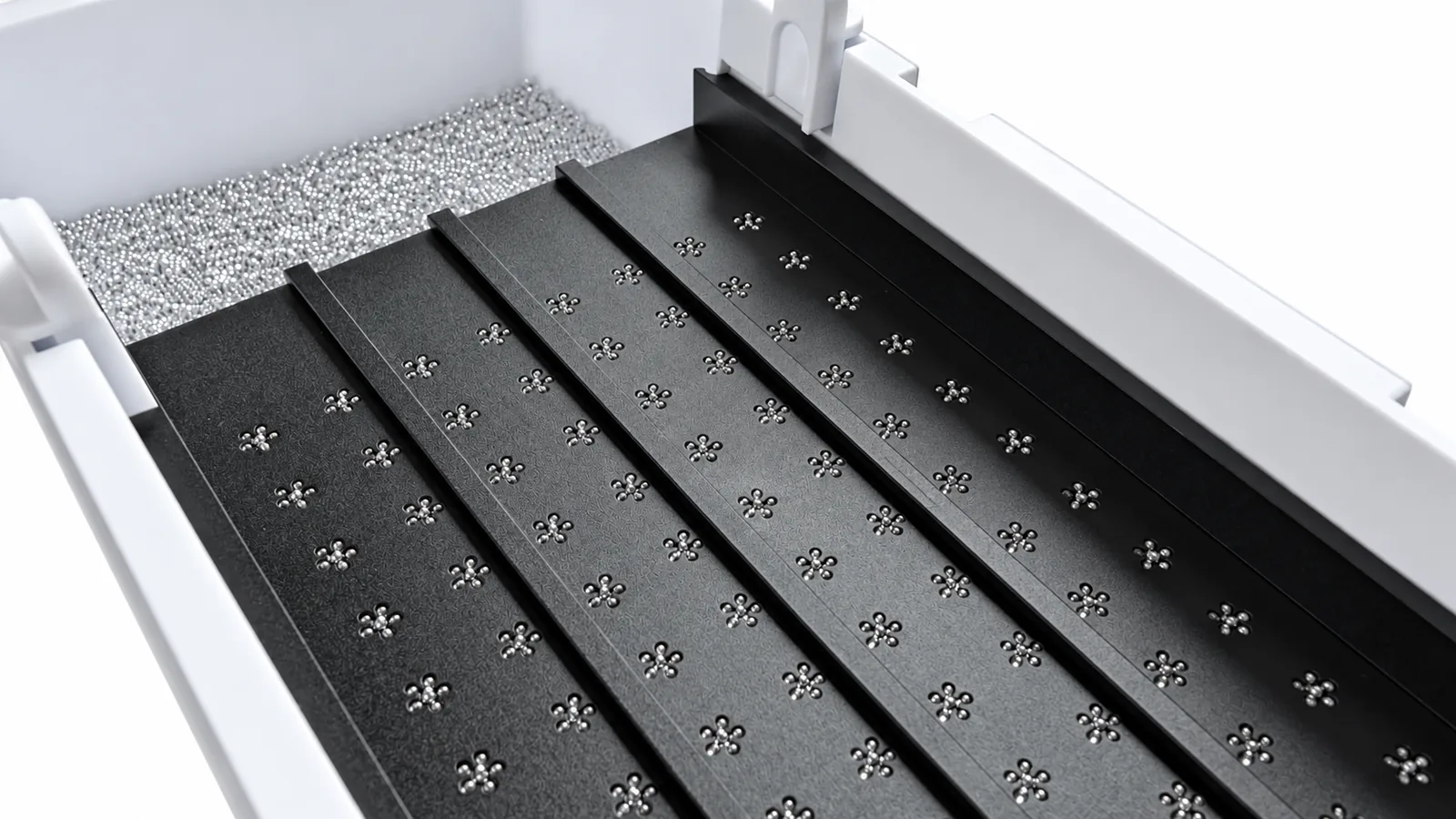
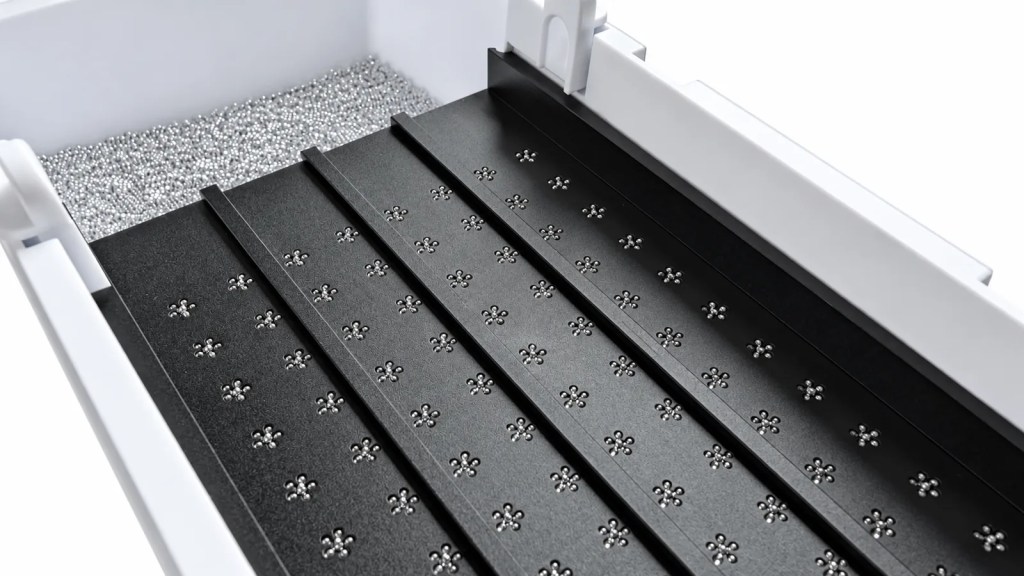
If your buffer works together with beads, as in the soil protocol, the beads must be in every tube or well before the buffer goes in. Scooping by hand is slow and uneven. The 96-Well Bead Dispenser drops beads into all 96 wells of a plate in about 8 seconds, and the 48 Tube Bead Dispenser does the same for tubes. Both use exchangeable mesh plates, and the full range is on the bead dispensers page. The machines that shake the plate are on the bead beaters page. For how long to shake, see bead beating: how long is long enough. For the wider picture of lysis methods, see what is cell lysis and our page on cell disruption methods.
What this does not cover
None of the three papers tests a lysis buffer for protein work, so this article is about DNA. A dispenser does not choose or improve your buffer: it puts the same number of beads in each well, so the bead step is identical across the plate. The buffers above were each tested on one kind of sample and do not transfer to yours without a test.
Limits of this summary
We read the article pages, not the supplementary files. For Lenka et al. and Yuan et al., the later part of each page, including the discussion, was read from a machine made summary and not verbatim, and the sample count for the fin study was not visible to us. For Guerra et al., the numerical yields are in figures we could not read, and the results after the first part were read from a summary. For Boom et al., we read the abstract only.
Sources
- Lenka P, Singh N, Ghosh D, Mahato V, Ghosh S. A highly cost-effective, eco-friendly tissue lysis and extraction method for faster DNA isolation from fish fin. PLoS ONE. 2025;20(2):e0318708. https://doi.org/10.1371/journal.pone.0318708
- Guerra V, Beule L, Lehtsaar E, Liao HL, Karlovsky P. Improved protocol for DNA extraction from subsoils using phosphate lysis buffer. Microorganisms. 2020;8(4):532. https://doi.org/10.3390/microorganisms8040532
- Yuan S, Cohen DB, Ravel J, Abdo Z, Forney LJ. Evaluation of methods for the extraction and purification of DNA from the human microbiome. PLoS ONE. 2012;7(3):e33865. https://doi.org/10.1371/journal.pone.0033865
- Boom R, Sol CJ, Salimans MM, Jansen CL, Wertheim-van Dillen PM, van der Noordaa J. Rapid and simple method for purification of nucleic acids. Journal of Clinical Microbiology. 1990;28(3):495 to 503. https://doi.org/10.1128/jcm.28.3.495-503.1990
Written by Bas Millenaar, LabTIE International B.V., labtie.com. LabTIE builds manual seed, bead and powder dispensers for 96 well plates, 384 well plates, tubes and vials.
Leave a Reply