
48 tubes · In stock
48 Tube Bead Dispenser
Drops grinding beads into 48 screw cap or snap cap tubes in one slider motion, in about 8 seconds. The mesh plate sets the bead size and the count per tube, and the rack is built around the tube you actually use.

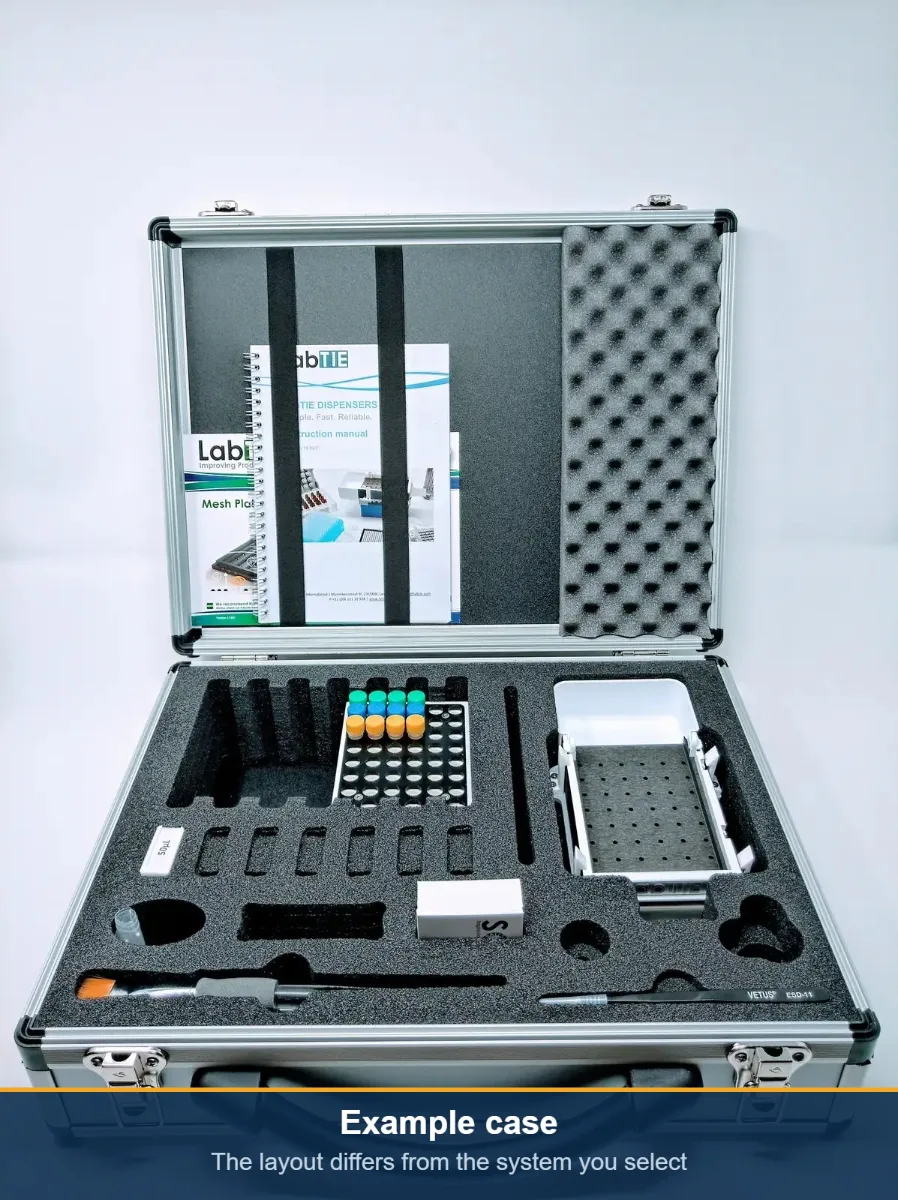 The case as it arrives, example only
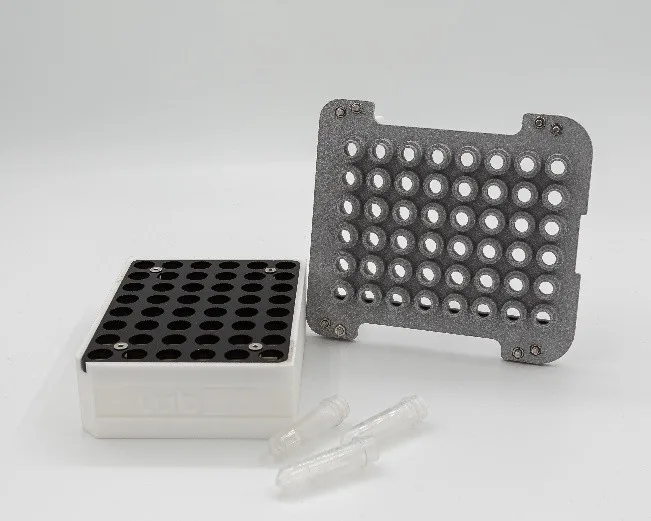 Fits on: LabTIE 48-tube vial rack
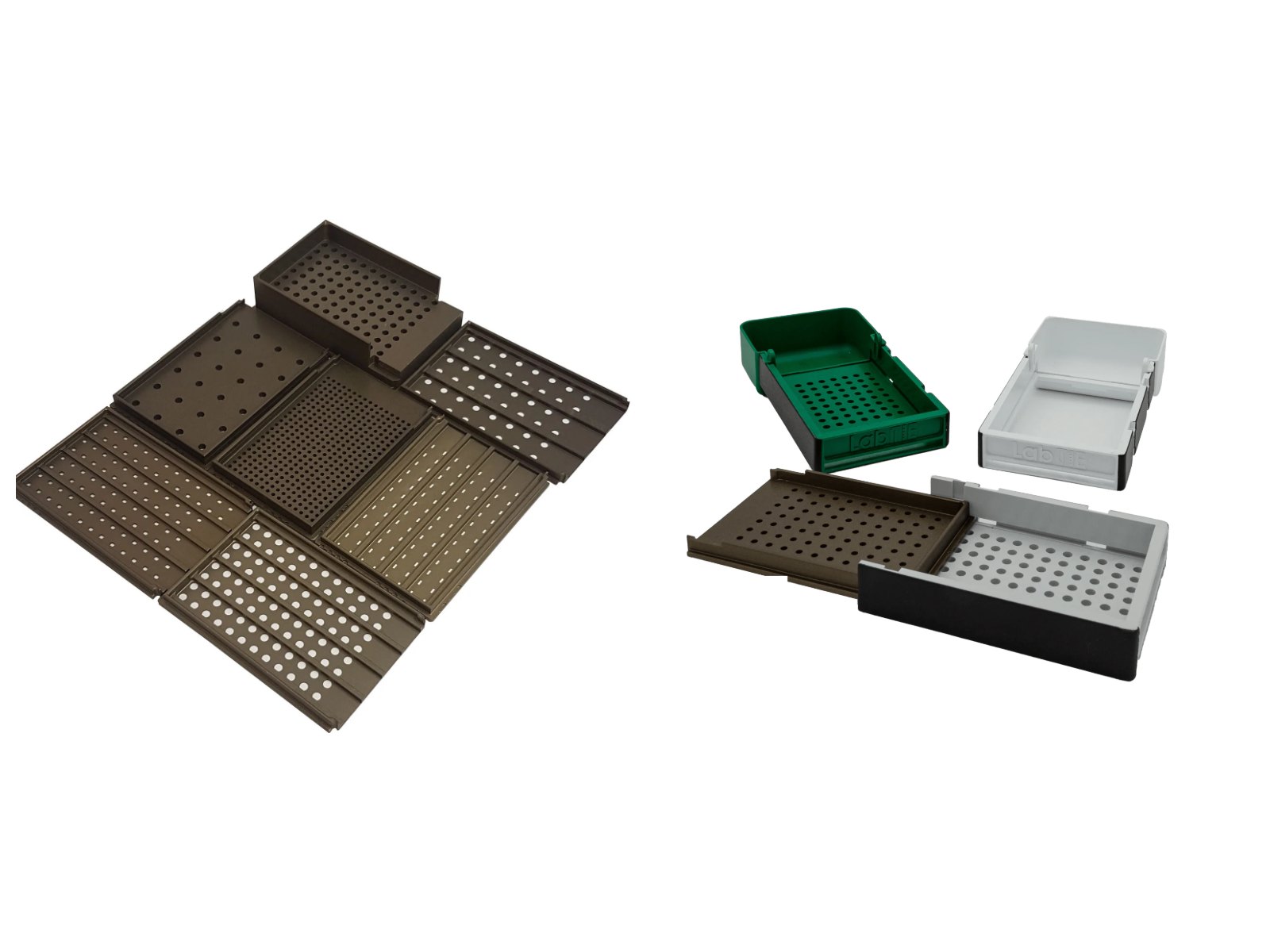 Swap the plate to change bead size
Click any photo to open it full size.
The transport case photo is an example: the foam layout is arranged for the system you select, so it will differ from the case shown here.
Openings are written as count x diameter, so 4 x 2.0 mm drops four 2.0 mm beads per tube. The 48 position mesh plates are shared across the 48 formats, including the auto-decapping vial rack. Custom openings are made to order.
Price on request
Every unit is quoted with the 48 tube rack and mesh plate for your own tubes and beads, so we price per configuration. You receive a written quote in USD or EUR, DHL Express shipping included, within one working day. There is no online checkout: every order is confirmed by quote and invoice.
| Product code | Depends on the mesh plate opening you select above (see the opening codes) |
|---|---|
| Availability | In stock, except customs |
| Shipping | World wide, DHL Express |
| Shipping time | 7 to 20 working days |
| Shipping weight | 4.4 kg, transport case included |
- ✓Load 48 tubes with beads in one motion, no tweezers
- ✓Rack cut to your own tube, so all 48 positions line up
- ✓Mesh plates swap like a pipette tip to change bead size
Why labs choose it+
Why labs choose it
One motion, 48 tubes
Dropping beads into 48 tubes with tweezers takes most of a coffee break and invites missed tubes. Filling, levelling and sliding takes about 8 seconds.
The same beads in every tube
Every position is filled by the same mesh plate in the same movement, so samples stay comparable across a run and between operators.
Change bead size in seconds
The mesh plate sets the size and the count. Swap it and the same dispenser body runs a different bead, with no recalibration and no second instrument.
Any bead material
Electrostatic glass, silica, zirconia, chrome, stainless steel and lightweight freeze dried bacto beads all run on the same body, on an antistatic mesh plate.
Nothing to break down
No motors, no software, no service contract. It works in a fume hood, a glovebox or a cold room exactly as it works on the bench.
Fitted to your tube
Tube diameters and cap types vary between suppliers. The rack is cut around the tube you actually use, so all 48 positions line up every time.
General information+
General information
The LabTIE Bead Dispenser is a manual system that loads grinding media accurately. You pour the beads onto the mesh plate, tilt the dispenser so the surplus runs back into the tray, place it on the loaded rack and pull the slider once. The same set of beads drops into every tube at the same moment.
This is the 48 tube format, 6 × 8 on a 14.00 mm grid. Because tube diameters and cap types differ between manufacturers, the rack is cut around your specific tube so that all 48 positions align and no bead is dropped between them. Tubes that a robot de-caps have their own ribbed holder, described on the auto-decapping page.
It is used for DNA and RNA extraction by bead beating, homogenization and cell disruption, and for bacterial work on agar, in research institutes, life science, seed companies and pharma. See also our grinding media and bead beaters.
Documents to download+
Documents to download
LabTIE 48-Well Bead Dispenser converter measurements, accurate modular powder dispenser: grid pitch, clear span between brackets and the racks that fit the 48 grid.
Assembly, loading, dispensing, swapping mesh plates, cleaning and spare part numbers.
Cleaning, drying and sterilising the body, slider and mesh plates between bead types.
Laboratories and institutes running LabTIE dispensers, by field and application.
Frequently asked questions+
Frequently asked questions
How does it work?
Pour the beads onto the mesh plate, tilt the dispenser so the surplus runs back into the tray, set it on the loaded rack and pull the slider once. All 48 tubes receive the same beads at the same moment.
Which tubes fit?
Standard 1.5 and 2.0 mL microtubes, screw cap and snap cap alike, on a 14.00 mm grid. The rack pocket is cut to your tube body, so send the tube name or part number with your quote request and we confirm the diameter before building.
Which bead size suits a 2 mL tube?
Up to about 3 mm, commonly 1 to 3 mm zirconia or a single 2.8 mm steel ball. Beads should occupy no more than about a third of the tube volume, since overfilling causes overheating in the bead beater.
Which bead materials can it handle?
Electrostatic glass and silica, borosilicate, zirconia, chrome, stainless steel and lightweight freeze dried bacto beads. Static beads are handled by the antistatic mesh plate, and an antistatic treatment on the beads helps further.
Do you have a version for auto-decapping vials?
Yes. Ribbed 2 mL vials that a robot de-caps sit in a two-part holder that keys the tube against rotation. That build is described on the 48 tube auto-decapping page, and the same 48 bead mesh plates fit it.
Can I order more mesh plates later?
Yes. Every 48 format bead plate can be ordered on its own for a dispenser you already own, and the 48 plates fit every 48 format. The full list is on the mesh plates page.
How do I load beads into tubes quickly using a bead dispenser?
The LabTIE 48 Tube Bead Dispenser allows you to fill 48 tubes simultaneously in a single tilting motion: no tweezers, no pipettes, and no counting individual beads. Simply load the reservoir with your beads, place the dispenser over a rack of 48 tubes, and tilt. The entire rack is loaded in under 30 seconds with <1% error between tubes.
What size beads fit in the 48 Tube Bead Dispenser?
The 48 Tube Bead Dispenser supports bead diameters from 1.4 mm up to 7 mm via interchangeable mesh plates. Common sizes used with tube-format dispensers include 2.8 mm ceramic and 4.0 mm stainless steel beads. Custom mesh plates are available for specialty bead sizes on request.
How does a tube bead dispenser work for bead-based homogenization?
The LabTIE 48 Tube Dispenser fills each tube with a controlled quantity of homogenization beads in one pass, eliminating the manual step of adding beads tube by tube. Consistent bead loading improves reproducibility across all 48 samples in a bead mill or vortex-based lysis protocol. This is especially valuable in plant, animal tissue, and soil DNA extraction workflows.
What is the best way to dispense grinding beads into 48 tubes for tissue lysis?
Place the 48 Tube Bead Dispenser over your tube rack, add your grinding beads to the reservoir, and tilt once. The precision mesh ensures each tube receives the same number of beads for uniform disruption during bead-beating. Labs running FastPrep, BeadBug, or similar instruments report significantly more consistent results when using a LabTIE dispenser for loading.
How accurate is the LabTIE 48 Tube Bead Dispenser?
Like all LabTIE dispensers, the 48 Tube model achieves less than 1% dispensing error across all 48 tubes. This level of precision ensures that every tube in your rack receives the same bead load, removing a common source of variability in high-throughput homogenization. The dispenser has been validated in pharma and biotech labs worldwide.
Which bead types are compatible with the 48 Tube Bead Dispenser?
The 48 Tube Bead Dispenser is compatible with glass beads, ceramic beads, zirconium beads, and stainless steel beads in diameters from 1.4 mm to 7 mm. The exchangeable mesh system allows you to switch between bead types without purchasing a new dispenser. Contact LabTIE to confirm mesh availability for your specific bead type and size.
How do I clean and sterilize the 48 Tube Bead Dispenser?
All bead-contact components of the 48 Tube Bead Dispenser can be rinsed with 70% ethanol or water and are autoclavable at 121 °C. This ensures the dispenser is suitable for work with biological samples that demand strict cross-contamination controls. A quick ethanol wipe between sample types is all that is needed for most microbiology and molecular biology labs.
How fast can you load 48 tubes with a bead dispenser?
A full rack of 48 tubes can be loaded in approximately 15–25 seconds using the LabTIE 48 Tube Bead Dispenser, compared to 15–20 minutes of manual loading. This is a significant time saving when running multiple racks per day. No power source or calibration is required before use.
Can the 48 Tube Bead Dispenser be used with standard 1.5 mL or 2.0 mL tubes?
Yes. The 48 Tube Bead Dispenser is designed for use with standard 2.0 mL microtubes and is compatible with most 1.5–2.0 mL tube formats used in molecular biology. Check the product specifications for exact tube diameter compatibility, or contact us to confirm compatibility with your specific tube brand.
What are the shipping times for LabTIE dispensers?
LabTIE ships from the Netherlands. Standard shipping takes 3–7 business days within Europe and 7–14 business days internationally. Express shipping is available. Please specify at the time of order.
Do you offer a warranty on LabTIE dispensers?
Yes. All LabTIE dispensers come with a 12-month warranty covering manufacturing defects. If any component fails under normal laboratory use, contact us for a repair or replacement. Mesh plates are consumables and are available separately at low cost.
Can I order custom mesh plates for non-standard containers?
Yes. LabTIE manufactures custom mesh plates for non-standard tube formats and container sizes. Share your tube dimensions and bead size requirements and we will provide a quote. Many customers use custom mesh plates with proprietary or non-standard tube racks.
What is the best bead dispenser for a lab?
For 48-tube rack workflows, the LabTIE 48 Tube Bead Dispenser is the most practical option for consistent and fast bead loading. It fills all 48 tubes in under 15 seconds with less than 1% placement error, supports bead sizes from 0.5 mm to 7 mm, and does not need power or calibration to operate. Labs running bead mill homogenizers with 48-tube racks use it to eliminate the slow hand-loading step entirely.
Which manual bead dispenser is used in pharmaceutical labs?
The LabTIE 48 Tube Bead Dispenser is used in pharmaceutical labs that process samples in standard 48-tube bead mill racks. It fits the rack precisely, delivers one bead per tube in a single action, and is autoclavable for use with biological samples requiring strict contamination controls. It removes a manual bottleneck from sample prep pipelines that run dozens of racks per day.
How do I choose the right bead dispenser for my lab?
If your bead mill uses 48-tube racks, start with the LabTIE 48 Tube Bead Dispenser since it is sized specifically for that format. Verify your bead size requirements: the mesh plate system covers 0.5 mm to 7 mm, with custom plates available for non-standard sizes. If you are loading more than a couple of racks per day, the time savings become substantial since hand-loading 48 tubes takes several minutes while the dispenser takes seconds.
What bead dispensers do plant genomics labs use?
Plant genomics labs using 48-tube bead mill racks for tissue grinding use the LabTIE 48 Tube Bead Dispenser to keep their sample prep moving. In high-throughput phenotyping runs where hundreds of plant samples need lysis, consistent bead loading per tube directly affects extraction quality. The sterilizable design also helps prevent contamination between plant species or breeding lines processed back to back.
What should I look for when buying a bead dispenser?
The most important thing is format compatibility: a 48-tube dispenser will not fit a 45-tube rack, so confirm the tube count and spacing of your rack before ordering. After that, check accuracy (you want under 1% placement error) and bead size range. The LabTIE 48 Tube Bead Dispenser is designed around all of those requirements and adds sterilizability and no power dependency as practical bonuses.
Which bead dispenser is best for 96-well plate tissue lysis?
If your lysis workflow uses 48-tube racks rather than plates, the LabTIE 48 Tube Bead Dispenser is the right tool. For plate-based workflows, LabTIE offers dedicated 96-well and 384-well dispensers. The 48-tube model fills every tube in one press, handles a range of bead sizes, and keeps bead placement consistent across the rack so lysis conditions do not vary between samples.
Are there manual bead dispensers that work without electricity?
The LabTIE 48 Tube Bead Dispenser is fully manual and operates without any power source. There are no motors, sensors, or software: you press it over the rack and beads drop into each tube. This makes it practical inside biosafety cabinets and anywhere you cannot use powered equipment. All bead-contact components are sterilizable, so cleaning between runs is straightforward.
Our satisfaction guarantee
We believe in the products we invented and are committed to your success. If anything you buy from us proves unsatisfactory, send us an e-mail and we adjust the system, replace the item or refund the purchase price.
That guarantee covers custom mesh plates and custom racks as well, which is why we would rather see your tube and your beads first than guess at a fit.
Tell us your tube, your bead size and your throughput. You receive a written quote within one working day.