
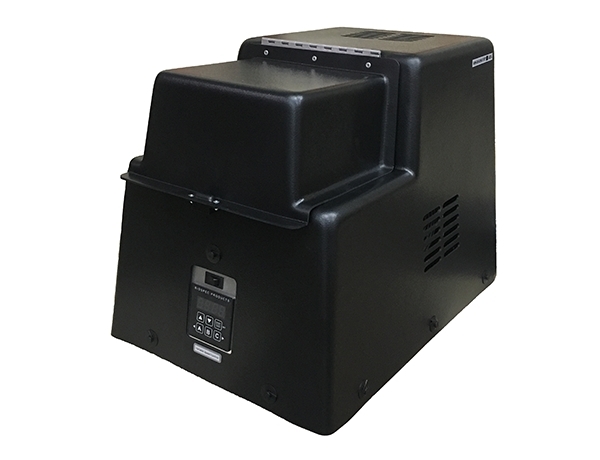
The bead beater range
Count your samples, then read the protocol. Capacity decides the model, and the protocol decides whether you need variable speed.

Beads and loading
Dispense, beat, extract
Load the beads
A LabTIE bead dispenser drops grinding media into every well in one slide.
Add sample and buffer
Keep beads to about a third of the vessel volume so they can still move.
Run the bead beater
Pulse mode, one minute on and one minute on ice, keeps heat sensitive samples cool.
Extract
Spin the beads down and go straight into your DNA, RNA or protein protocol.
What a bead beater does, and which one to pick
A bead beater shakes your sample against small hard beads until the cell wall gives way. Sample, buffer and beads go into a sealed screw cap vial or a sealed deep well plate, the machine runs for one to three minutes, and better than 95 percent of the cells are open. Because nothing is ever unsealed during the run, there is no cross contamination between positions.
Chemistry alone does not reach mycobacteria, spores or fibrous plant tissue. Force does.
Read more
Capacity first, control second
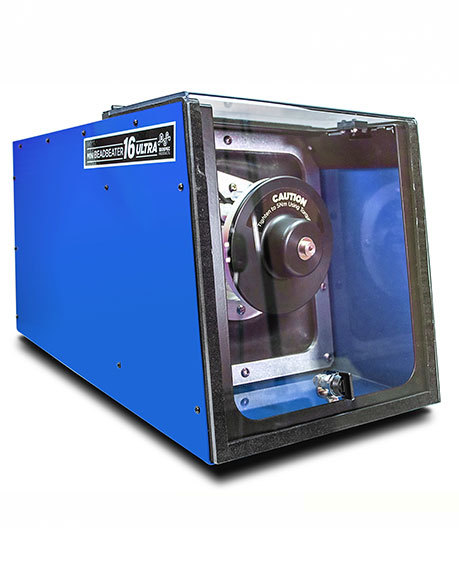
Sixteen vials a run is plenty for most method development and for a lab running a few dozen samples a week, which is what the Mini-BeadBeater-16 ULTRA is for. Past that, throughput starts to hurt. The 24 ULTRA adds eight positions and, more usefully, variable speed from 2400 to 3800 rpm with five programmable runtime cycles, so a kit protocol that specifies rpm and a rest interval can be followed exactly rather than approximated. Plate work is a different question again. If your samples arrive in deep well plates, the Mini-BeadBeater 96 takes one 2 mL plate or two 1 mL plates and runs 192 positions in a single cycle.
Beads, and how much to load
Bead choice does as much work as the instrument. Zirconia and chrome steel for hard plant tissue, seed, soil and bone. Glass or silica for yeast and soft cell lines. Fill to about a third of the vessel volume, or a screw cap vial roughly half full, so the beads keep moving. Up to 400 mg wet weight of material per 2 mL microvial is a sensible ceiling. All of it is on the grinding media page, and a bead dispenser loads a full plate in about 8 seconds if you would rather not do it by hand.
Heat is the real limit
Beating puts energy into the sample and roughly 10 °C per minute comes back out as heat. Nucleic acids in a chaotropic buffer tolerate that. Native protein, membranes and organelles do not, so break the run up: one minute of beating, one minute in ice water, to a total on time of three minutes. The 24 ULTRA does that cycling on its own. A pre-chilled aluminium vial rack buys a little more headroom. A cold room buys nothing, and a Mini-BeadBeater 96 will not start in one by design.
Plates leak before they break
This is the failure we hear about most on plate runs, and it is not the instrument. At this energy level an ordinary sealing film lifts and wells contaminate each other. BioSpec tested mats from several manufacturers against the Mini-BeadBeater 96 and only the Porvair Sciences 2 mL deep well plate 219030 with EVA mat 219004 passed both the leakage and the breakage test. Press the mat on firmly before you load the plate. If plate integrity still bothers you, the supplied 45 position rack of screw cap microvials sidesteps the problem entirely.
How we quote them
Price on request, and there is no checkout. Voltage, finish, vial and plate racks and grinding media are all separate line items, so we quote the configuration rather than a headline number. Tell us the model, the voltage and what you are grinding, and a written quotation follows within one working day. Shipping is from the Netherlands.
Frequently asked questions
What is a bead beater and when do I need one?
A bead beater breaks cells open mechanically by shaking the sample against small hard beads inside a sealed vial or a sealed well. You need one when chemistry alone will not reach the sample: mycobacteria, spores, yeast, fungal mycelium, fibrous plant tissue, seed, soil and bone. Two to three minutes of beating gives complete lysis on most of those, and because every vial stays sealed there is no cross contamination between samples.
Which Mini-BeadBeater should I choose?
Count your samples first, then look at the protocol. The Mini-BeadBeater-16 ULTRA takes 4 to 16 microvials at a fixed 3450 strokes per minute and suits routine, repeated work. The Mini-BeadBeater-24 ULTRA takes up to 24 vials and adds variable speed from 2400 to 3800 rpm with programmable on and off cycling, which matters when a kit protocol specifies a speed or when the sample is heat sensitive. The Mini-BeadBeater 96 works in the plate format and runs up to 192 samples at once, so it is the choice for plate based screening and high volume nucleic acid extraction.
How long does a bead beating run take?
One to three minutes of actual beating for most sample types. Tough material such as mycobacteria, spores or fibrous tissue needs the full two to three minutes. If you are only doing PCR downstream and can accept less than total lysis, shorter runs often suffice.
Which beads do I use, and how many?
Match the bead to the sample. Zirconia or chrome steel for hard plant tissue, seed and soil. Glass or silica for yeast and soft cell lines. Fill the vessel to roughly a third with beads, or fill a screw cap vial about half full, so the beads still have room to move. Our grinding media page lists the materials and sizes we hold in stock.
How do I keep samples from heating up?
High energy bead beating raises homogenate temperature by roughly 10 °C for every minute of beating. For DNA or RNA in a chaotropic extraction buffer that rarely causes a problem. For native protein, membranes and organelles it does, so run in pulses: one minute of beating, then one minute in an ice and water mix, repeated to a total on time of three minutes. The Mini-BeadBeater-24 ULTRA can do that cycling itself. A pre-chilled aluminium vial rack helps as well. Do not run a Mini-BeadBeater 96 in a cold room, the unit is designed to refuse to start there and cold air does not stop the sample warming anyway.
Can I use any 96 deep well plate in the Mini-BeadBeater 96?
No, and this is where most plate runs go wrong. The plate has to survive the shaking and the sealing mat has to hold well to well. BioSpec tested mats from several manufacturers and only Porvair Sciences deep well plate 219030 with EVA sealing mat 219004 passed their leakage and breakage tests. Mats of other polymers, and adhesive or heat bonded films, can leak under this much energy. Press the mat down firmly before the run, and if plate integrity is not good enough for your work, go back to screw cap microvials in the supplied 45 position rack.
Can these units grind dry or cryogenically?
Yes on both ULTRA models for dry grinding. For cryogenic grinding, freeze the sample to liquid nitrogen temperature first, use reinforced vials or plates, and use a solid aluminium vial holder to hold the temperature during beating. Softer material such as tissue, rubber or plastic powders well this way.
How do I order a bead beater from LabTIE, and what does it cost?
Price on request. We quote per configuration, because the voltage, the finish, the vial or plate racks and the grinding media all change the line items, and there is no webshop checkout. Send the model, the voltage you need and the sample you are running, and a written quotation follows within one working day. Everything ships from the Netherlands.