
96-well plates · In stock
96-Well Bead Dispenser
Drops grinding beads into all 96 wells of a microtiter or square deepwell plate in one slider motion, in about 8 seconds. The mesh plate sets the bead size and the count per well, so the same dispenser body covers openings from 0.8 to 6.0 mm.

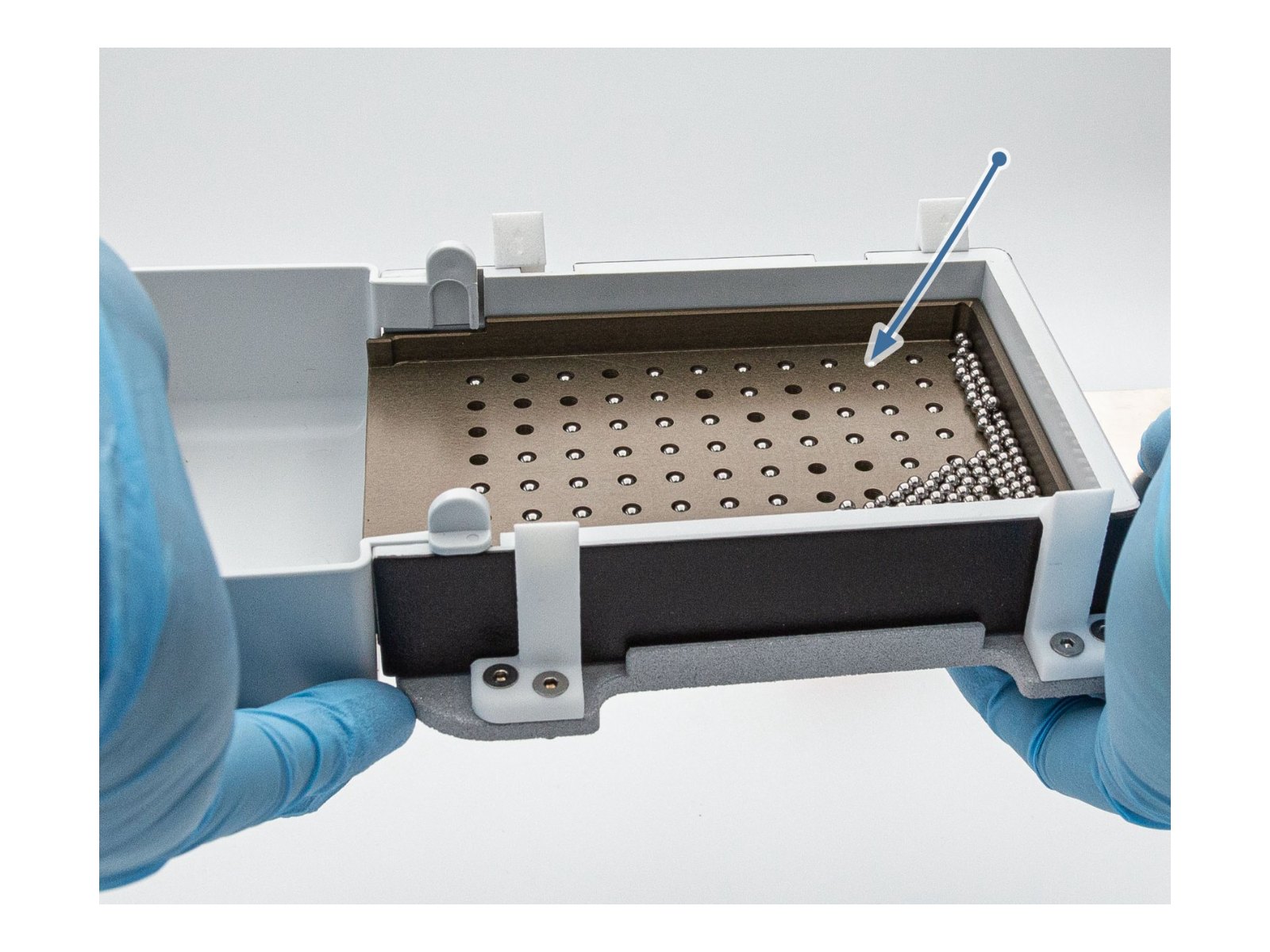 Loading the beads onto the mesh plate
 One pull fills all 96
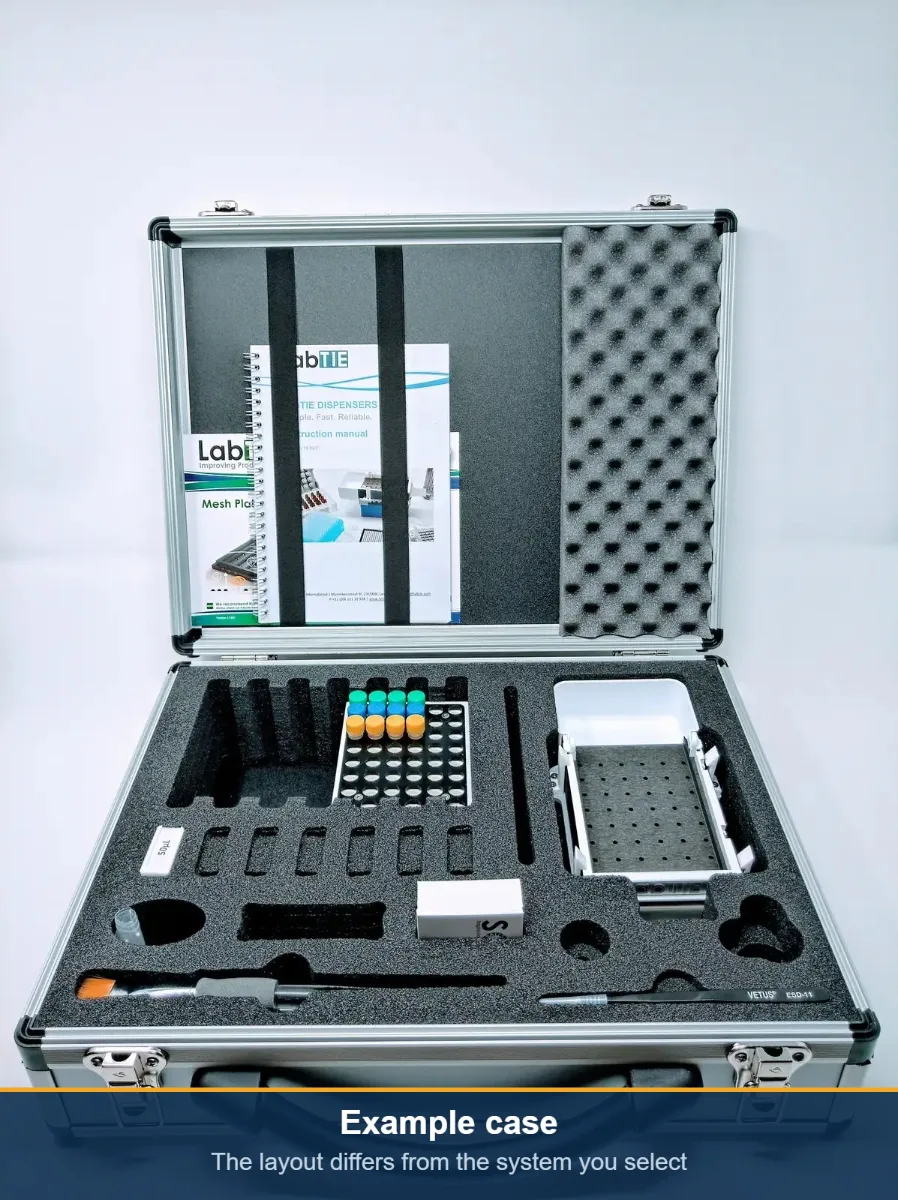 The case as it arrives, example only
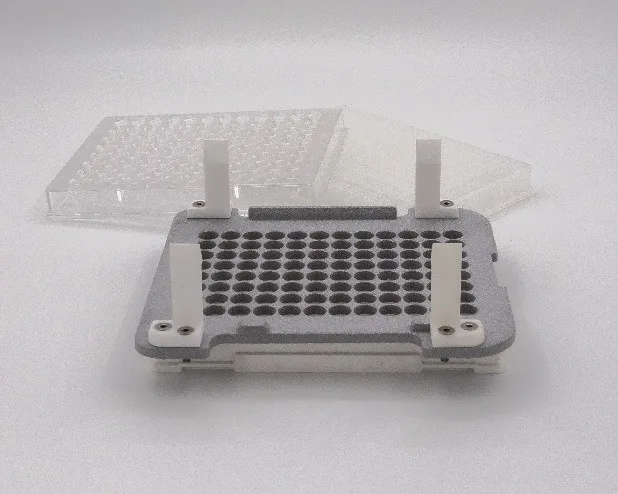 Fits on: 96-well microtiter plates
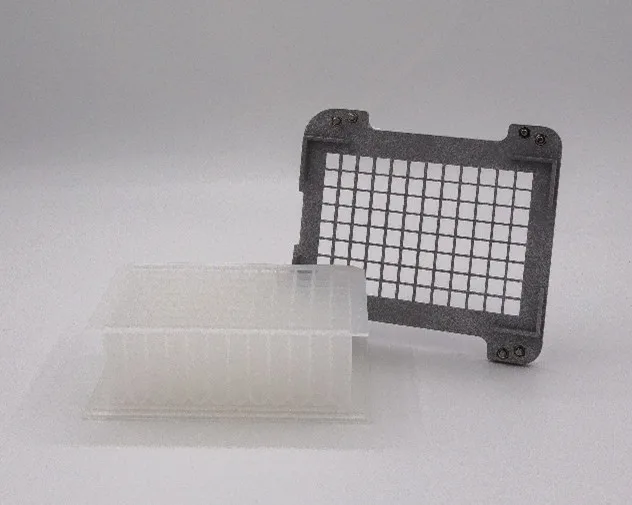 Fits on: 96-well square deepwell plates
Click any photo to open it full size.
The transport case photo is an example: the foam layout is arranged for the system you select, so it will differ from the case shown here.
Openings are written as count x diameter, so 6 x 1.0 mm drops six 1.0 mm beads per well. The 6 x 0.8 mm plate, cut for OPS beads, is the standard plate supplied with this dispenser unless you name another opening. Name the opening you need on your quote request. Custom openings are made to order.
Price on request
Every unit is quoted with the converter and mesh plate for your own plates and beads, so we price per configuration. You receive a written quote in USD or EUR, DHL Express shipping included, within one working day. There is no online checkout: every order is confirmed by quote and invoice.
| Product code | Depends on the mesh plate opening you select above (see the opening codes) |
|---|---|
| Availability | In stock, except customs |
| Shipping | World wide, DHL Express |
| Shipping time | 7 to 20 working days |
| Shipping weight | 4.4 kg, transport case included |
- ✓Fill a full 96-well plate with beads in one motion
- ✓Microtiter and square deepwell plates run on the same dispenser body
- ✓Mesh plates swap like a pipette tip to change bead size
Why labs choose it+
Why labs choose it
One bead per well, one pull
Placing 96 beads by hand is the job nobody volunteers for. One slider pull drops a single bead into every well, and it takes about 45 seconds.
No counting, no tweezers
Miscounts are the real cost of manual bead loading, and you usually find them after extraction has already failed. The mesh plate holds exactly one bead per position, so a double or a miss is not possible.
Change bead size in seconds
Bead size is set by the mesh plate, from 0.3 to 6.0 mm. Swap the plate and the same body runs a different bead. Nothing to adjust.
Beads stay where they land
Beads drop straight down through the mesh rather than being tipped across the plate, so none skitter into neighbouring wells or off the bench.
Nothing to break down
Manual, so there is nothing to service. No motors, no software, and no reason it cannot live in a cold room.
Fitted to your plate
Deepwell and microtiter rims differ between suppliers. The converter is built around the plate you use, so every well sits square under its bead.
General information+
General information
Load beads onto the mesh plate, tilt the excess back into the bucket, set the dispenser on your plate and pull the slider. Each well gets one bead at the same moment. It was built for extraction labs that were loading beads with a spatula and hoping for the best.
This is the standard 96 grid at 9.00 mm pitch, for microtiter and deepwell plates on the SBS footprint. The mesh plate holes decide the bead size, which is why we ask what you are grinding before recommending one. Soil and plant tissue rarely want the same bead as bacterial pellets.
DNA and RNA extraction, cell lysis, microbiome work and homogenisation of plant, animal and soil samples. If your bead is at the edges of the 0.3 to 6.0 mm range, send a sample and we will test it before quoting.
The 96-well format makes it the go-to choice for DNA and RNA extraction workflows, where consistent bead loading across all wells directly affects lysis efficiency and downstream yield.
Documents to download+
Documents to download
LabTIE 96-Well Bead Dispenser converter measurements, accurate modular sample prep dispenser: grid pitch, clear span between brackets and the plates that fit.
Assembly, loading, dispensing, swapping mesh plates, cleaning and spare part numbers.
Cleaning, drying and sterilising the body, slider and mesh plates between bead types.
Laboratories and institutes running LabTIE dispensers, by field and application.
Frequently asked questions+
Frequently asked questions
How does it work?
Pour the beads onto the mesh plate, tilt the dispenser so the surplus runs back into the tray, set it on your plate and pull the slider once. Every well receives the same beads at the same moment.
Can I dispense different bead sizes with the same dispenser?
Yes. The mesh plate sets the size and the number of beads per well, and swapping it takes seconds. Every 96 format bead plate fits this dispenser body.
Which bead materials can it handle?
Electrostatic glass and silica, borosilicate, zirconia, chrome, stainless steel and lightweight freeze dried bacto beads. Static beads are handled by the antistatic mesh plate, and an antistatic treatment on the beads helps further.
Which bead size suits a 96-well plate?
Up to about 3 mm in a standard 96-well plate, commonly 1 to 2 mm zirconia or a 2.0 to 2.8 mm steel ball. Deepwell plates take more. Beads should occupy no more than about a third of the well volume.
Can I order more mesh plates later?
Yes. Every 96 format bead plate can be ordered on its own for a dispenser you already own. The full list is on the mesh plates page.
My plate or opening is not listed. What then?
Send the plate name or part number, and the bead size and count you need, with your quote request. Openings outside the standard list are cut to order under MG0000475.
How do I load beads into a 96-well plate quickly?
With the LabTIE 96-Well Bead Dispenser you simply fill the reservoir, place the mesh plate over the 96-well plate, and tilt to distribute: the entire plate is loaded in as little as 8–15 seconds. No tweezers, no pipettes, and no risk of cross-contamination between wells. It is the fastest manual method available for high-throughput bead loading.
What size beads fit in a 96-well plate dispenser?
The LabTIE 96-Well Bead Dispenser works with beads ranging from 0.5 mm to 7 mm diameter, depending on the mesh plate installed. Interchangeable mesh plates let you switch bead sizes without buying a new dispenser. Contact us if you need a mesh size outside the standard range.
How does a bead dispenser work for DNA extraction?
Bead dispensers fill each well of a 96-well plate with a precise quantity of lysis beads so that your bead-beating or TissueLyser step delivers consistent cell disruption across every sample. The LabTIE dispenser keeps bead counts uniform within <1% error, giving you reproducible DNA yield across an entire plate. This removes the biggest source of variability in bead-based nucleic acid extraction workflows.
What is the best way to dispense grinding beads for tissue lysis?
Fill the LabTIE reservoir with your grinding beads (e.g. 2.8 mm ceramic or 1.4 mm zirconium), place the matching mesh plate over the 96-well plate, and let gravity do the work with a single smooth tilt. The exchangeable mesh ensures the right bead count drops into every well simultaneously. This method is used in high-throughput tissue lysis workflows at labs including Bayer, Harvard, and Syngenta.
How accurate is a manual bead dispenser?
The LabTIE 96-Well Bead Dispenser achieves less than 1% dispensing error across all 96 wells, which is comparable to automated liquid-handling systems. Precision is maintained by the mesh plate geometry, which allows exactly one layer of beads to pass per tilt. Over 120 labs worldwide rely on this accuracy for reproducible sample preparation.
What is the difference between a 96-well and 384-well bead dispenser?
The 96-well model fills a standard 96-well SBS plate in one pass and accepts mesh plates sized for 0.5–7 mm beads, while the 384-well dispenser uses a finer mesh and smaller well geometry to load four times as many wells in the same footprint. If your protocol runs 384-well plates, the dedicated 384-well LabTIE dispenser is the correct choice. Both dispensers share the same ergonomic design and sterilizable construction.
How do I clean and sterilize a bead dispenser?
The LabTIE 96-Well Bead Dispenser can be cleaned by rinsing with water or 70% ethanol between runs, and all components that contact beads are autoclavable. This makes it suitable for work with biological samples that require strict cross-contamination controls. A quick ethanol wipe-down between sample types is sufficient for most molecular biology applications.
Which bead sizes work with LabTIE dispensers?
Standard LabTIE mesh plates cover bead diameters from 0.5 mm up to 7 mm, including common sizes such as 1.4 mm, 2.0 mm, 2.8 mm, 4.0 mm, and 6.0 mm. Custom mesh plates are available on request for non-standard bead sizes or specialty applications. See the product page for the current mesh size catalogue.
How fast can you load a 96-well plate with a bead dispenser?
A single operator can load a full 96-well plate in 8–15 seconds using the LabTIE 96-Well Bead Dispenser, compared to 20–30 minutes when loading beads manually with tweezers or a pipette. This time saving compounds across hundreds of plates in a high-throughput lab. The dispenser requires no power source and no calibration before use.
What are the shipping times for LabTIE dispensers?
LabTIE ships worldwide from the Netherlands. Standard delivery takes 3–7 business days within Europe and 7–14 business days internationally. Express shipping options are available. Contact us at the time of order to arrange faster delivery.
Do you offer a warranty on LabTIE dispensers?
Yes. All LabTIE dispensers come with a 12-month warranty covering manufacturing defects. If your dispenser develops a fault under normal laboratory use, contact us and we will arrange a repair or replacement. Consumable mesh plates are not covered by the warranty but are available as low-cost replacements.
Can I order custom mesh plates for non-standard containers?
Yes: LabTIE produces custom mesh plates for non-standard plate formats, tubes, and containers. Send us the dimensions of your container and the bead size you require, and we will quote a custom mesh plate. This service is used by customers working with deep-well blocks, microtubes, and proprietary plate formats.
What is the best bead dispenser for a lab?
For 96-well plate workflows, the LabTIE 96-Well Bead Dispenser is consistently the top choice among molecular biology labs. It loads a full plate in 8 to 15 seconds with less than 1% bead placement error, covers bead sizes from 0.5 mm to 7 mm, and requires no power or calibration. Labs at institutions like Harvard and Bayer use it as their daily driver for tissue lysis and DNA extraction prep.
Which manual bead dispenser is used in pharmaceutical labs?
The LabTIE 96-Well Bead Dispenser is widely used in pharmaceutical labs for sample homogenization and high-throughput lysis workflows. It is fully sterilizable, compatible with standard SBS-format plates, and operates without electricity, which makes it practical in biosafety cabinets and restricted-power environments. Johnson and Johnson and similar organizations have adopted it for routine sample processing.
How do I choose the right bead dispenser for my lab?
Start with your plate format: if you work with standard 96-well plates, the LabTIE 96-Well Bead Dispenser is the obvious match. Check which bead sizes you use, since LabTIE mesh plates cover 0.5 mm to 7 mm and custom sizes are available on request. Also consider throughput: if you are loading more than a few plates per day, the time savings of going from 20 to 30 minutes per plate down to under 15 seconds adds up quickly.
What bead dispensers do plant genomics labs use?
Plant genomics labs often process large batches of leaf tissue in 96-well format, and the LabTIE 96-Well Bead Dispenser is a good fit for that workflow. The sterilizable design prevents cross-contamination between plant species or accessions, and the fast loading speed helps when you are grinding through hundreds of samples in a phenotyping run. A number of agricultural research groups use it alongside bead mill homogenizers for routine extraction.
What should I look for when buying a bead dispenser?
The three things that matter most are bead size compatibility, plate format fit, and placement accuracy. A good dispenser should cover your bead size range without swaps between each run, seat correctly over your plate format, and place beads with less than 1% error to avoid reruns. The LabTIE 96-Well Bead Dispenser checks all three of those boxes and adds the benefit of no power requirement, which simplifies use inside laminar flow hoods.
Which bead dispenser is best for 96-well plate tissue lysis?
The LabTIE 96-Well Bead Dispenser was designed specifically for this application. It loads one bead per well across a full 96-well plate in 8 to 15 seconds, and the mesh plate system lets you switch between bead sizes like 1.4 mm, 2.8 mm, or 4.0 mm depending on your tissue type. The low error rate keeps failed lysis wells to a minimum, which is critical when working with limited or irreplaceable samples.
Are there manual bead dispensers that work without electricity?
Yes: the LabTIE 96-Well Bead Dispenser is entirely manual and requires no power source. You simply fill the reservoir, position it over the plate, and press to dispense. This makes it compatible with biosafety cabinets, field labs, and any environment where electrical equipment is restricted. It is also lighter and easier to clean than automated alternatives.
Our satisfaction guarantee
We believe in the products we invented and are committed to your success. If anything you buy from us proves unsatisfactory, send us an e-mail and we adjust the system, replace the item or refund the purchase price.
That guarantee covers custom mesh plates and custom converters as well, which is why we would rather see your plate and your beads first than guess at a fit.
Tell us your plate, your bead size and your throughput. You receive a written quote within one working day.