
A DNA extraction protocol is usually judged by one number: how much DNA came out. Three open access comparisons, on fish scales, red seaweed and fish eggs, show why that number alone is a poor pass mark. In the seaweed study a protocol with the lowest yield gave PCR as reliable as any other, and in the fish egg study the best protocol skipped the purification step altogether. Here is what each paper specified, what it measured, and what to write down in your own protocol.
Buffer and temperature decided the yield from fish scales
Shuttleworth and Oosthuizen cut scales from one kabeljou into small pieces, because grinding in liquid nitrogen did not turn them to powder. They then compared four phenol and chloroform digests, two buffers (TNES urea and amniocyte) at 42 °C and 56 °C, overnight, against a commercial blood and tissue kit. Each protocol was repeated three times on separate days. TNES urea at 56 °C gave the most DNA, a mean of 131.56 ng/µL, while amniocyte buffer at the same temperature gave 12.40 ng/µL. Temperature mattered in both buffers, but in opposite directions. The kit at 42 °C overnight gave 29.66 ng/µL, and kit time and temperature had no significant effect (Shuttleworth and Oosthuizen, 2022).
The paper reports concentrations only, with no purity ratios and no PCR on the extracts from each protocol. It does confirm the species by sequencing a 657 bp COI fragment, and the authors call all protocols adequate for downstream work. So yield differed by a factor of ten while the paper does not show whether that mattered.
In red seaweed, yield and PCR success did not agree
Elaswad and co-workers compared four protocols on two red seaweeds from Oman: CTAB, a plant kit, HotSHOT (25 mM NaOH, 30 minutes at 94 °C) and DNAzol Direct. Sample mass was 15 to 18 mg for CTAB and the kit, and 2 to 3 mg for HotSHOT and DNAzol. Combined over species, DNAzol gave 2.390 µg of DNA per mg of tissue, HotSHOT 2.234, CTAB 0.123 and the kit 0.007, more than 300 times less than the top protocol (Elaswad et al., 2026).
Then they ran PCR on two markers, 18S and rbcL. The kit, with the lowest yield, and HotSHOT, with a combined A260/280 of only 1.305, both reached 100% success in the percentages the paper reports. CTAB did worse on Laurencia, at 80% for 18S and 50% for rbcL. The authors say it directly: DNA concentration and purity did not always correlate with PCR and sequencing success. They name HotSHOT the most practical method when performance, cost and processing time are weighed together (Elaswad et al., 2026).
Fish eggs: a heated lysate went straight into PCR
Diouri and co-workers extracted DNA from single eggs of Spicara smaris with four commercial kits and a heat protocol of their own. The heat protocol used 90 µL of a Tris, KCl, SDS, Triton X-100 and Tween buffer with 10 µL proteinase K, 15 minutes at 56 °C, then 10 minutes at 95 °C. The lysate went directly into PCR, with no column. It gave 170 ng/µL and an A260/280 of 1.8, and a qPCR cycle threshold of 18.32. The best kit reached a Ct of 20.54, one kit reached 33.87, and the two automated virus kits gave no detectable amplification and no gel band (Diouri et al., 2021).
Read this with care. It is one species, the winning protocol is the authors’ own, and the standard deviations in the yield table are very small for ten extractions per method, with no explanation of how they were derived. Even so, the result points the same way as the seaweed study: a short lysis with no purification step was enough for PCR, and more steps did not guarantee a better template (Diouri et al., 2021).
What to record in your own DNA extraction protocol
The three papers differ in sample, chemistry and readout, so no single recipe follows from them. A method for comparing protocols does follow. Write down the sample mass, the buffer volume, the lysis temperature and time, and the mechanical step if there is one. Measure three things, not one: concentration, A260/280, and a PCR on a marker you actually use. Run each protocol on the same sample at least in triplicate, on separate days, as Shuttleworth and Oosthuizen did. Then pick the protocol on the readout that matches your downstream use, not on the highest concentration.
For a plate based protocol, the lysis step has one more variable. If it uses beads, the number of beads in each well is part of the method. We looked at how published protocols state it in how many tissue homogenizer beads go per tube or well, and at the lysis step itself in what cell lysis is and how the methods compare. For a plate scale CTAB example, see CTAB DNA extraction at 96 well scale.
Where bead loading fits
None of the three papers used beads. Scales were cut with scissors, and the seaweed samples were ground with a pestle. So they say nothing about what uneven bead loading does to a plate. If your protocol does use beads, equal lysis in every well needs an equal bead count in every well, and loading by hand varies from well to well. We do not put a number on that variation here, because these sources do not measure it.
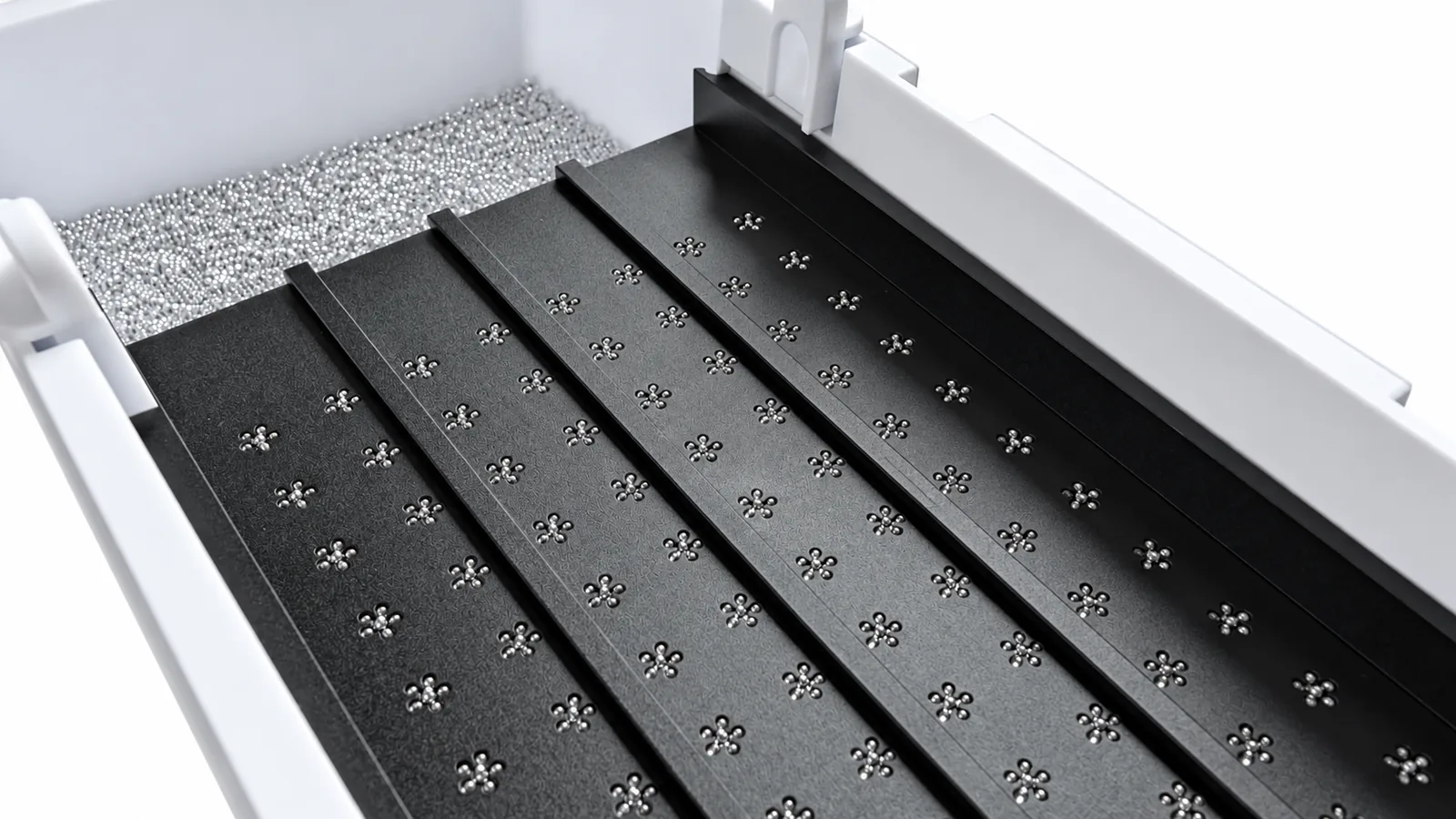
What a dispenser changes is the loading step, not the chemistry. The 96-Well Bead Dispenser places beads in all 96 wells of a plate in about 8 seconds, using exchangeable mesh plates, and the bead dispenser range covers tubes and 384 well plates. The grinding media page lists the bead materials and sizes we supply, and our cell disruption guide compares lysis routes by sample type. A dispenser does not pick your buffer, and it does not rescue a protocol that gives poor PCR.
Limits of this summary
We read the open access article pages and tables available online, not the supplementary files. The PCR percentages for the seaweed study are as we read them from the reported results. The three studies use different samples and different readouts, so their numbers show direction and not a target for your own samples.
Sources
- Shuttleworth L, Oosthuizen CJ. Comparing DNA yield from fish scales following different extraction protocols. Scientific Reports. 2022;12:2836. https://doi.org/10.1038/s41598-022-06889-y
- Elaswad AH, Al-Maawali M, Al-Alawi AA, Ali H, Al-Barashdi H, Al-Subhi K, Al-Wahaibi M, Wynne MJ. Comparison of four DNA extraction protocols for red seaweeds from Oman: impacts on purity, yield, PCR, and sequencing success. Phycology. 2026;6(3):90. https://doi.org/10.3390/phycology6030090
- Diouri L, Uwiringiyeyezu T, Abdelouahab H, Malki M, Baibai T, Soukri A. Comparison and validation of ichthyoplankton DNA extraction methods. Methods and Protocols. 2021;4(4):87. https://doi.org/10.3390/mps4040087
Written by Bas Millenaar, LabTIE International B.V., labtie.com. LabTIE builds manual seed, bead and powder dispensers for 96 well plates, 384 well plates, tubes and vials.
Leave a Reply