
Ask how many tissue homogenizer beads a sample needs and you get three different kinds of answer: a count, a mass, or a fraction of the tube. All three appear in protocols published in the past year. Only one of them is something a technician can check by eye at the bench, and that difference decides how much of your well-to-well variation comes from the loading step instead of from the sample.
We read four recent papers that use bead beating and looked only at what each one says about the beads themselves. The spread is wider than you would expect.
What published protocols actually specify
A count, set by tissue type. A plate-based CTAB protocol for crop plants gives the most usable number we found. The method loads “4–6 beads for young soybean, tobacco, and Arabidopsis, and 7–10 beads for young monocot leaves (Biospec Zirconia Beads, CAT 11079124zx)”, then runs a Mini-BeadBeater for 5 minutes at 2500 rpm. Same instrument, same buffer, same plate format: the only variable that moves with the tissue is the number of beads. Source: Quach H, de Bernardeaux G, Nguyen D, Sahay S, Hoang K (2026). A simple and efficient CTAB plate-based protocol for genomic DNA extraction from crop plants. bioRxiv preprint, posted 7 January 2026. https://doi.org/10.64898/2026.01.06.697759
A count with a diameter. A bacterial proteomics study reports the full set: 2 mL BeadBug homogenization tubes, 3 mm zirconium beads from Benchmark Scientific, and disruption “for 3 × 30 s at 4000 rpm with 5 zirconium beads per tube”, with 30 seconds on ice between rounds. Number, diameter, material, supplier, tube volume, speed and duration are all in the text. Source: Woodland B, Farrell LA, O’Rourke MB, Padula MP (2026). Lyophilization Prior to Homogenisation and Extraction Increases Membrane Protein Detection in Gram-Negative Bacterial Proteomic Analyses. Proteomes 14(3), 35. https://doi.org/10.3390/proteomes14030035
A mass. An on-chip assay for Aspergillus detection doses “0.05 g glass beads” per reaction, next to 200 μg of magnetic beads, and combines bead beating with ultrasonication. A mass is exact and, for a single microfluidic channel, it is the sensible unit. It is not a unit you can hit ninety-six times in a row without a balance. Source: Zhong J, Zhang S, Huang W, Cheng J, Li X, Wang S, Zhang T, Sui G (2026). Multiplex on-chip detection of Aspergillus by integrated ultrasonication-based bead beating lysis and magnetic beads direct amplification. Frontiers in Bioengineering and Biotechnology. https://doi.org/10.3389/fbioe.2026.1775828
Nothing at all. A Bombus terrestris genomics preprint records that hindlegs “were then frozen in liquid nitrogen and mechanically ground using LabTIE Zirconia beads (Molgen, Veenendaal, The Netherlands)”. Material and supplier are there. The number of beads and their diameter are not. Those are our beads, and even so the grinding step in that paper cannot be reproduced from the text. Source: Leung K, Becker F, Šima P, Kreskóci R, Geuverink E, Groot TVM, Pannebakker BA, van den Heuvel J (2025). Bombus terrestris Complementary Sex Determiner (BtCSD) is identified as a conserved hymenopteran sex determination region. bioRxiv preprint, posted 15 August 2025. https://doi.org/10.1101/2025.08.12.669960
The unit matters more than the number
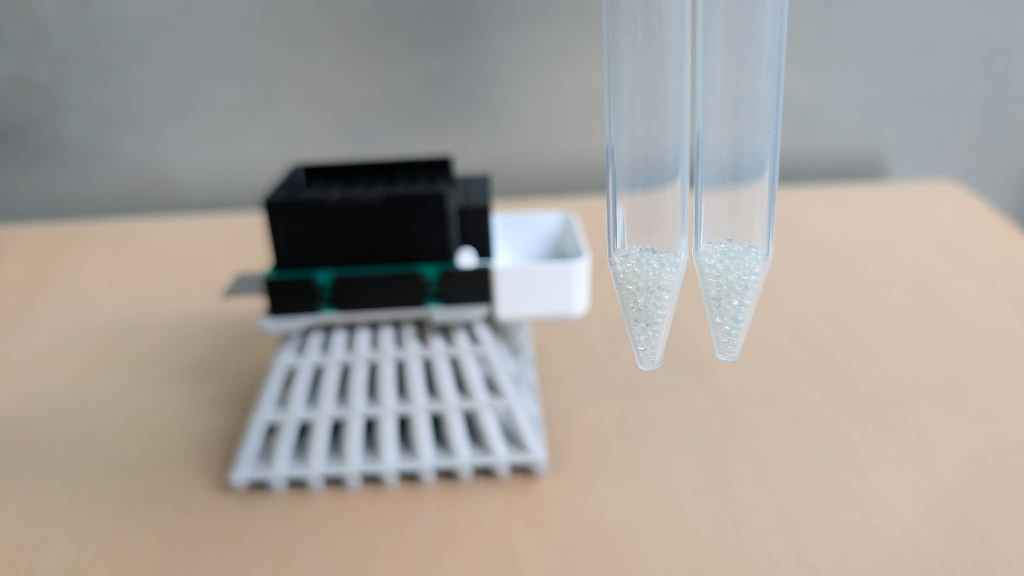
A count is the only one of the three that a second person can verify without an instrument. Five beads in a tube is either five beads or it is not. A mass needs a balance for every well. A volume rule such as “fill the tube one third with beads” is the loosest of the three, because two technicians reading the same sentence will not pour the same amount.
Worth naming plainly: none of the four papers above reports how much the bead load varied between wells or tubes, so none of them lets you rule that variation out as a source of scatter in the results. If your method section gives a count and a diameter, a reader can at least reproduce the load. If it gives neither, they cannot.
The number follows the tissue, not the instrument
The CTAB protocol is a good illustration. Young soybean, tobacco and Arabidopsis leaf get 4 to 6 beads; young monocot leaves, which are more fibrous, get 7 to 10. The bead beater and its settings do not change. That is the pattern to copy: fix the instrument, then set the bead load per sample type and write it down.
Bead diameter follows the same logic. Our own grinding media range runs from 0.3 to 6.0 mm and is grouped by what you are breaking: 0.1 to 0.5 mm for bacteria and yeast, 0.5 to 1.4 mm for fungi and organic debris, 1 to 3 mm for soft tissue and leaves, and 3 to 7 mm for seeds, grain and fibrous material. Material choice sits alongside it: zirconia silica as the general-purpose option, chrome steel for tough tissue, seed and bone, borosilicate glass where chemical inertness matters. For the settings that go with those choices, our bead beater protocol guide covers speed and duration by sample type.
Bead beating does not win every comparison
It is worth knowing where the method loses. A group at the University of British Columbia Okanagan compared five single spore DNA extraction methods for Rhizophagus irregularis in 96-well plates: direct PCR, freeze-thaw, manual crushing, bead beating and chemical lysis. The approach they carried forward was crushing the spores with a sewing needle, which they note can be done in 250 μL 96-well plates. For a single fungal spore, beads were not the answer. Source: Spence SA, Shelton BR, Belsham DY, Larrere J, Bruce CE, Regush OJ, Hart MM (2026). Optimization of a high-throughput single spore DNA extraction protocol for the model species of arbuscular mycorrhizal fungi, Rhizophagus irregularis. Mycorrhiza 36(3), 30. https://doi.org/10.1007/s00572-026-01274-3
What a count of 4 to 6 means when you fill a plate
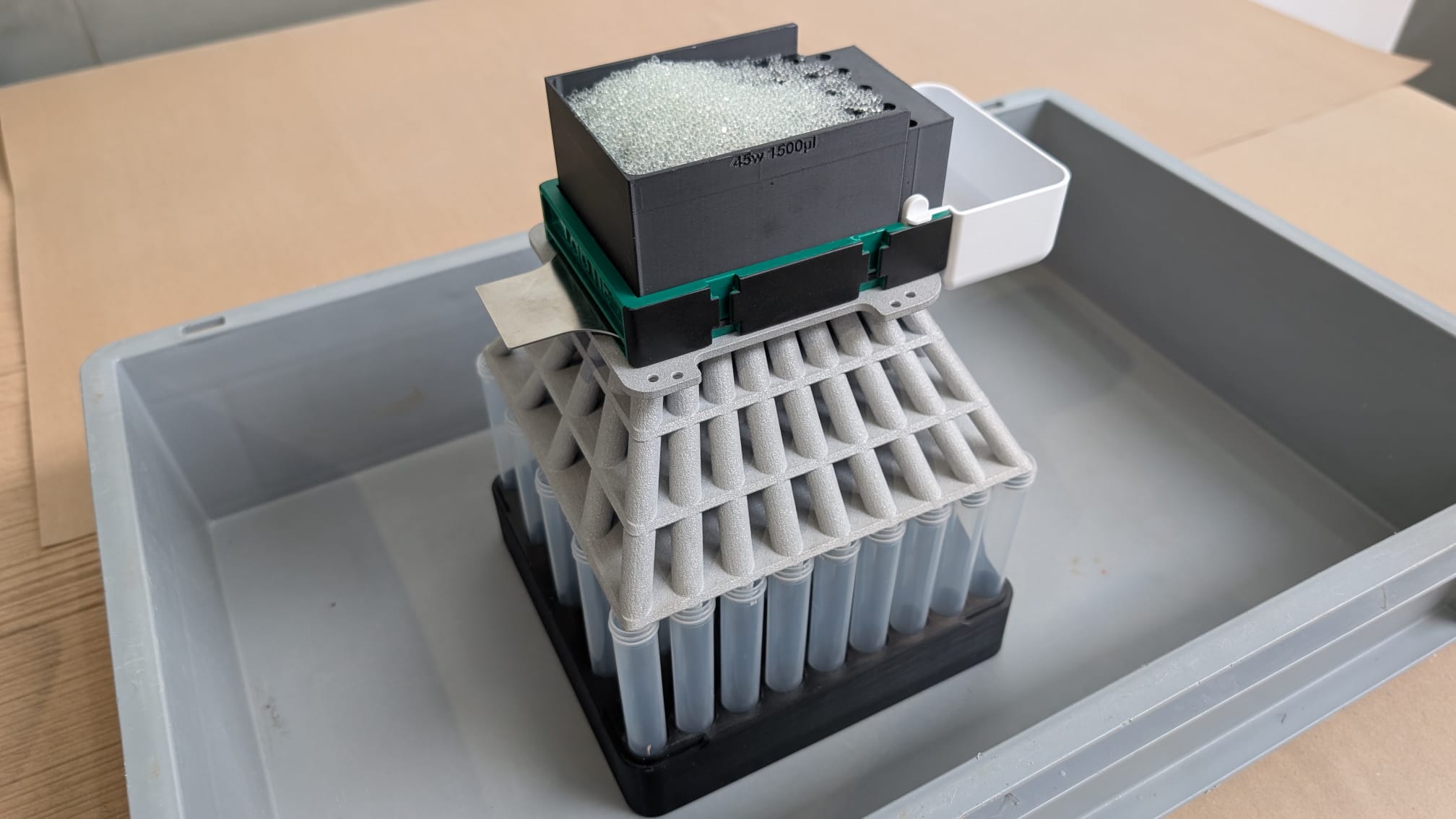
Reading “4–6 beads per well” takes a second. Doing it 96 times with a spatula is the part that eats the morning, and it is where the count quietly drifts. That is the step our dispensers remove: the 96-Well Bead Dispenser loads every well of a microtiter or deep well plate in one slider motion, in about 8 seconds, and the 48 Tube Bead Dispenser does the same for a rack of tubes. The full range sits on the bead dispensers page, and the instruments that follow on the bead beater and bead mill homogenizer page.
Two honest limits. A mesh plate doses by cavity volume, not by counting individual beads, so if your protocol specifies exactly five 3 mm beads per tube, check that the cavity you order holds five of that diameter before you standardise on it. And a dispenser does not choose your bead size or material for you; that decision still comes from the tissue, as the papers above show. If you are working out the loading step itself, our note on loading grinding beads into a 96-well plate walks through it.
What to put in your own methods section
Based on what was missing from the papers above, a reproducible bead beating method needs eight things: bead material, bead diameter, number of beads per well or tube (or the mass, if that is how you dose), supplier and catalogue number, tube or plate format and its volume, instrument, speed and duration, and any cooling between rounds. The proteomics paper above lists all eight. The bumblebee preprint lists two.
That gap is the cheapest thing in this whole workflow to fix, and it costs one sentence.
Where that sentence lives matters as much as what is in it. The grid we use for it, and the columns that belong next to it, are in the 96 well plate template, with what published layouts show about edge wells and neighbouring wells.
Questions about which bead size or dispenser format fits your samples? Get in touch and tell us the tissue and the plate format you work in.

Leave a Reply