
CTAB DNA extraction is still the method of choice for plant tissue that resists the column kits: leaves loaded with polysaccharides, polyphenols and secondary metabolites. Moving CTAB DNA extraction from tubes into 96-well plates does not change that chemistry. It changes everything around it, and that is the part protocols usually leave vague. Two recently published plate-based protocols do not. Between them they state the bead that goes into each well, the grinder settings, the yield, the throughput and the cost per sample.
What a robotic CTAB protocol reports per plate
A group at Université Laval published RoboCTAB, a modified CTAB procedure built around an Opentrons OT-2 liquid handler and deep-well plates. The numbers they report are the kind that are usually missing. One operator processes up to 768 samples, eight 96-well plates, within an eight-hour workday, with about three hours of active engagement. The set-up runs four 96-well plates, 384 samples, simultaneously in a single run. Source: Boucher St-Amour V-T, Tomar V, Belzile F (2025). High-Throughput DNA Extraction Using Robotic Automation (RoboCTAB) for Large-Scale Genotyping. Plants 14(15), 2263. https://doi.org/10.3390/plants14152263
Yield went up rather than down. Against their manual protocol on the same material, RoboCTAB gave 1.87 µg ± 0.22 per sample versus 1.06 µg ± 0.13, p = 0.004, quantified with a Qubit dsDNA HS assay. Split by tissue, radicle samples averaged 2.1 µg ± 0.2 and leaflet samples 3.2 µg ± 0.4. The authors also cost their own workflow: USD 0.40 per sample against USD 0.77 for the manual route, a 48% reduction. Those are their reagents, their labour rates and their scale, not a general price.
Two things the paper does not give: it reports no A260/280 or A260/230 ratios, so purity has to be judged indirectly, and the CTAB buffer recipe and incubation sit in a supplementary file rather than the main text. What it does show is that the DNA carried through into genotyping-by-sequencing libraries.
The bead step is written down, and it is one bead
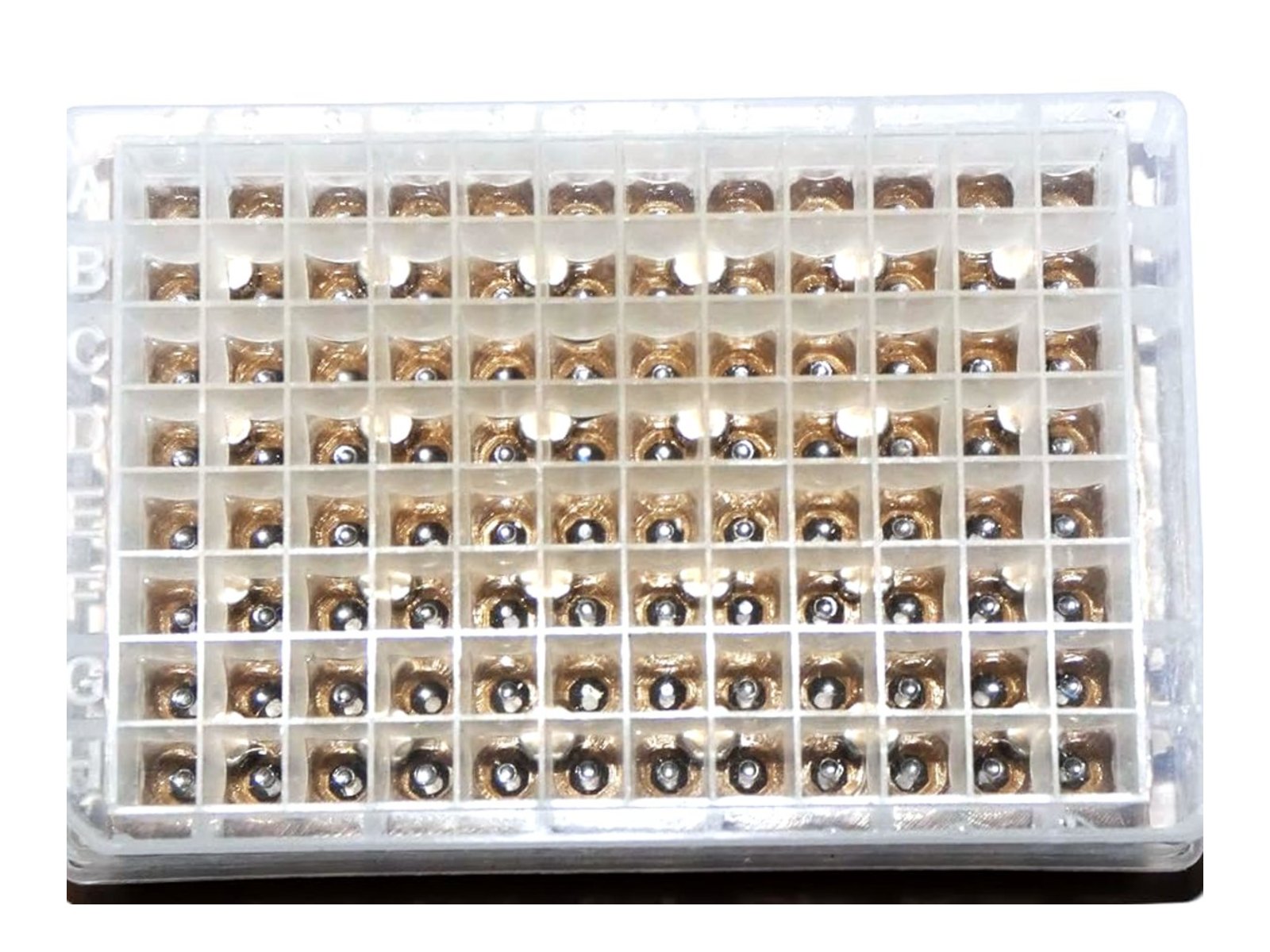
The grinding step in that protocol is specified to a level you can rebuild from the text: “For each sample, a 3 mm tungsten grinding bead was added to each well using a bead-dispensing device (LabTie™ Gravity Bead Loader, Bartlesville, OK, USA).” The plates are deep-well 96-well plates (T110-5, Simport Scientific). Before grinding, the OT-2 dispenses 50 µL of TE buffer into each well, which the authors introduced to deal with electrostatic effects and powder volatility during grinding. Grinding itself ran on a RETSCH MM 400, and proper tissue disruption was typically achieved after four 60 s cycles at 24 oscillations per second.
That loader is ours, so read the choice of instrument with that in mind. The point worth taking is not the brand but the completeness: bead diameter, bead material, one bead per well, plate format, wetting volume, instrument, cycle count and frequency. A reader with the same tissue can reproduce the mechanical half of the protocol without guessing.
A manual plate protocol sets the count by tissue
The other plate-based CTAB protocol we looked at takes a different route to the same problem. It loads “4–6 beads for young soybean, tobacco, and Arabidopsis, and 7–10 beads for young monocot leaves (Biospec Zirconia Beads, CAT 11079124zx)”, then runs a Mini-BeadBeater for 5 minutes at 2500 rpm. Same buffer, same plate format, same instrument settings across tissues: the only variable that moves is the number of beads. Source: Quach H, de Bernardeaux G, Nguyen D, Sahay S, Hoang K (2026). A simple and efficient CTAB plate-based protocol for genomic DNA extraction from crop plants. bioRxiv preprint, posted 7 January 2026. https://doi.org/10.64898/2026.01.06.697759 This one is a preprint and has not been through peer review.
Put the two side by side and the disagreement is instructive. One 3 mm tungsten bead per well in the first protocol; four to ten zirconia beads per well in the second. Both report adequate disruption of leaf tissue. Tungsten is roughly twice as dense as zirconia, so a single large tungsten bead and a handful of smaller zirconia beads are two ways of delivering comparable impact energy. What the two protocols share matters more than where they differ: the load is fixed per tissue type, and it is written into the method.
An honest limit on both: neither reports how much the bead load actually varied between wells, so neither lets a reader rule that out as a source of spread in the results.
What plate scale adds that the chemistry does not
Running extractions in plates introduces a failure mode that tube work mostly hides. A study at UC San Diego measured it directly by seeding blank wells through large microbiome runs. Their plate-based method left 128 of 672 blanks contaminated, 19%, at an average 0.21 ng/µL. Their tube-based method, using racked 1 mL barcoded Matrix tubes, left 14 of 672 blanks contaminated, 2%, at 0.026 ng/µL. Source: Brennan C, Belda-Ferre P, Zuffa S, Charron-Lamoureux V, Mohanty I, Ackermann G, Allaband C, Ambre M, Boyer T, Bryant M, Cantrell K, Gonzalez A, McDonald D, Salido RA, Song SJ, Wright G, Dorrestein PC, Knight R (2024). Clearing the plate: a strategic approach to mitigate well-to-well contamination in large-scale microbiome studies. mSystems 9(10), e00985-24. https://doi.org/10.1128/msystems.00985-24
That is a microbiome workflow on a KingFisher Flex with a magnetic-bead kit, not a CTAB extraction, and low-biomass microbiome work is more sensitive to carryover than plant genotyping. The transferable part is the method rather than the number: they only knew the rate because blanks were built into the layout and counted. Their grinding step is specified too, and it dispenses by volume rather than by count: “30 µL of 0.1, 0.5, and 1 mm zirconia-silica beads are added to each matrix tube using the LabTie bead dispenser (MolGen).”
Moving your own CTAB protocol into plates
Four things are worth settling before the first full plate. Decide the bead load per tissue type and put the number in the protocol, not in someone’s memory. Add a wetting step if you grind dry tissue; 50 µL of TE was enough to stop powder moving between wells in the RoboCTAB run. Build blanks into the plate layout in a fixed pattern and count them, so a contamination rate exists as a number rather than an impression. And fix the grinder settings first, then change only the bead load when a new tissue behaves badly, so one variable moves at a time.
Where a dispenser helps, and where it does not
Loading beads is the step that turns a 96-well protocol into a morning’s work when it is done with a spatula. Our 96-Well Bead Dispenser fills every well of a microtiter or deep-well plate in one slider motion, and the 48 Tube Bead Dispenser does the same for a rack of tubes. Diameters and materials are listed on the grinding media page, and the rest of the range on the bead dispensers page.
Two limits, stated plainly. A mesh plate doses by cavity volume, not by counting individual beads, so if your protocol calls for exactly five 3 mm beads per well, check that the cavity holds five of that diameter before you standardise on it. And the loading step is the only thing a dispenser fixes. It does not choose your bead size, and it does nothing for the buffer chemistry, which is still where CTAB protocols differ most from lab to lab.
Working out which bead size and plate format fit your tissue? Get in touch and tell us the crop and the plate you work in.
Leave a Reply