
384-well plates · In stock
384-Well Bead Dispenser
Drops beads into all 384 wells of a microtiter or PCR plate in one slider motion, in about 8 seconds. The mesh plate sets the bead size and the count per well, from 0.8 to 2.0 mm on the 384 grid.

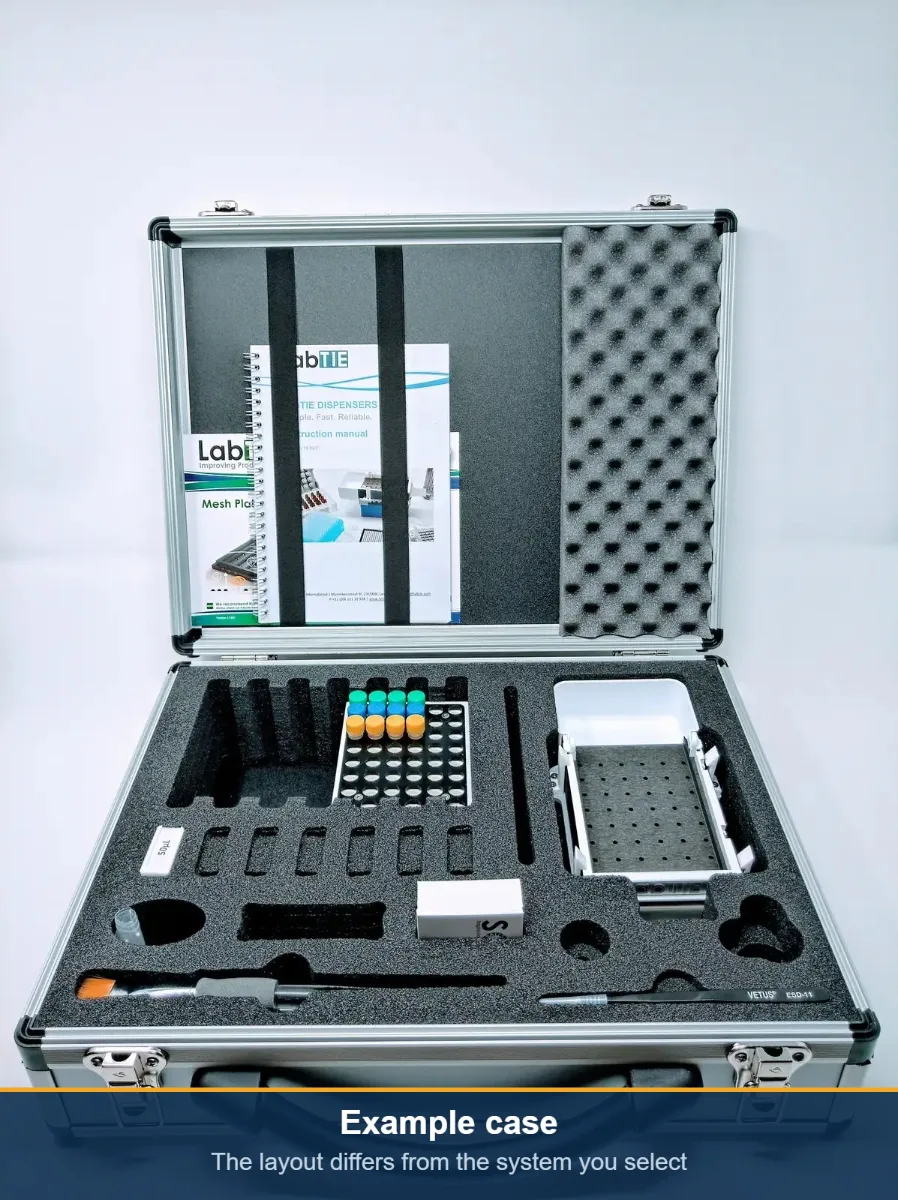 The case as it arrives, example only
 Fits on: 384-well plates
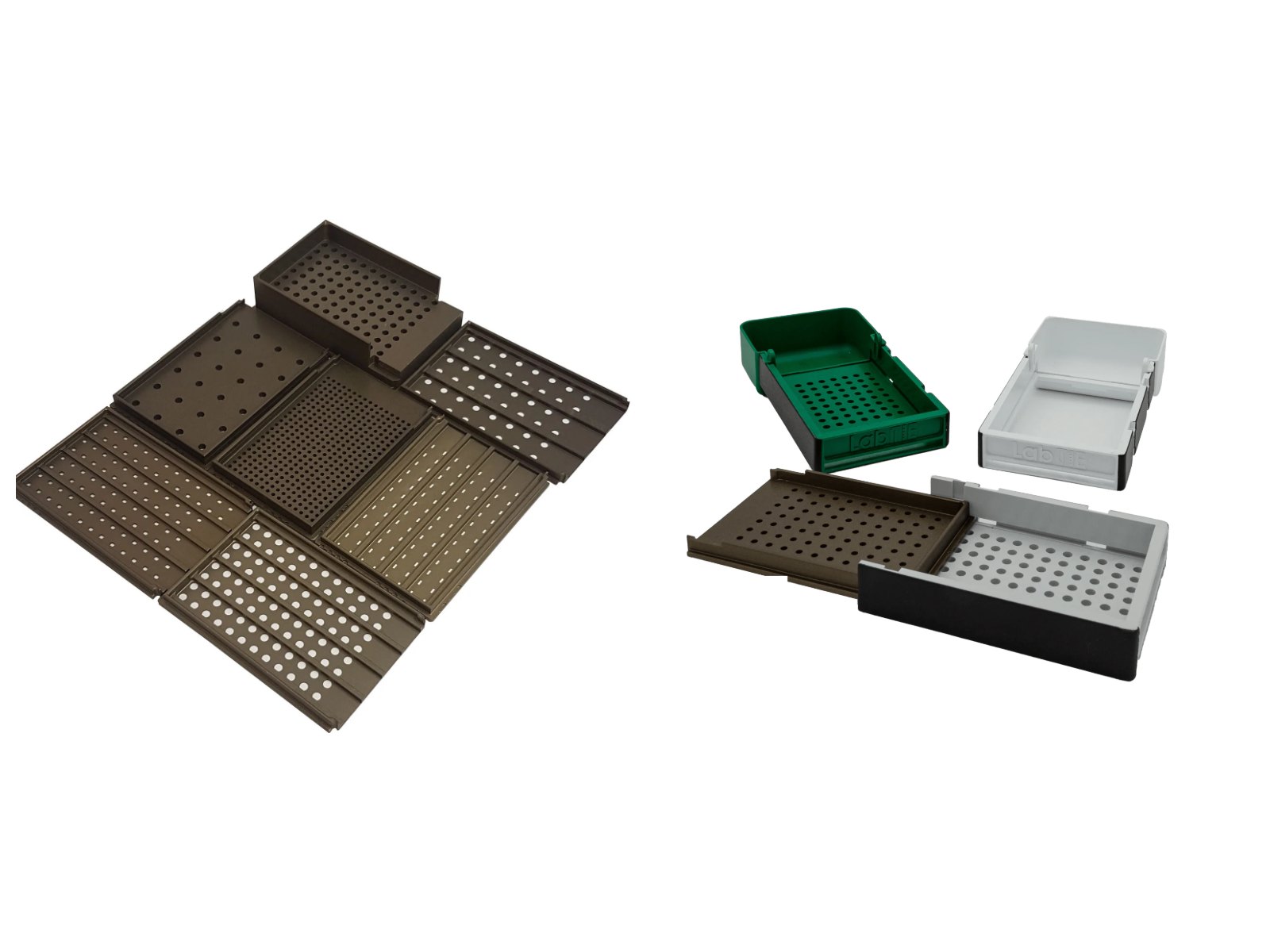 Swap the plate to change bead size
Click any photo to open it full size.
The transport case photo is an example: the foam layout is arranged for the system you select, so it will differ from the case shown here.
Openings are written as count x diameter, so 4 x 2.0 mm drops four 2.0 mm beads per well. The 6 x 0.8 mm plate, cut for OPS beads, is the standard plate supplied with this dispenser unless you name another opening. Below 0.3 mm, use the 384-Well Powder Dispenser instead. Custom openings are made to order.
Price on request
Every unit is quoted with the converter and mesh plate for your own plates and beads, so we price per configuration. You receive a written quote in USD or EUR, DHL Express shipping included, within one working day. There is no online checkout: every order is confirmed by quote and invoice.
| Product code | Depends on the mesh plate opening you select above (see the opening codes) |
|---|---|
| Availability | In stock, except customs |
| Shipping | World wide, DHL Express |
| Shipping time | 7 to 20 working days |
| Shipping weight | 4.4 kg, transport case included |
- ✓Load a full 384-well plate with beads in one motion
- ✓Microtiter and skirted PCR plates run on the same dispenser body
- ✓Mesh plates swap like a pipette tip to change bead size
Why labs choose it+
Why labs choose it
384 beads, one motion
Nobody loads a 384-well plate with beads by hand twice. One pull fills the whole grid, and every well gets exactly one bead.
No counting, no tweezers
At 384 positions a single miscount is very hard to spot and very expensive to discover later. One bead per hole, cut by the mesh plate, removes the possibility.
Change bead size in seconds
The mesh plate sets the bead size. Swap it and the same body runs a different bead, with no adjustment.
Beads stay where they land
Beads fall straight through rather than being tipped across a dense plate. At 4.5 mm pitch that matters, because a stray bead has 383 other wells to land in.
Nothing to break down
No motors, no software, no service contract. It works wherever your plates are.
Fitted to your plate
The 384 footprint leaves little margin. We build the converter around your exact plate so that every well lines up under its own hole.
General information+
General information
Load the beads, tilt off the excess, place the dispenser and pull the slider once. All 384 wells receive one bead together. This is the format labs move to when their 96-well throughput stops being enough.
It runs the dense 384 grid on the SBS footprint. Bead size is set by the mesh plate, and at this pitch the practical range sits at the finer end of our 0.3 to 6.0 mm span. Operation is identical to the 96 version.
High throughput DNA extraction, screening and microbiome work. Tell us the sample type and the plate you use, and we will confirm which bead and mesh combination actually fits before you order.
Documents to download+
Documents to download
LabTIE 384-Well Bead Dispenser converter measurements, accurate modular powder dispenser: grid pitch, clear span between brackets and the plates that fit.
Assembly, loading, dispensing, swapping mesh plates, cleaning and spare part numbers.
Cleaning, drying and sterilising the body, slider and mesh plates between bead types.
Laboratories and institutes running LabTIE dispensers, by field and application.
Frequently asked questions+
Frequently asked questions
How does it work?
Pour the beads onto the mesh plate, tilt the dispenser so the surplus runs back into the tray, set it on your plate and pull the slider once. All 384 wells receive the same beads at the same moment.
Which 384-well plates does it fit?
Microtiter and skirted PCR plates on the ANSI/SLAS footprint. Seven named plates are listed as verified above, from Greiner, Corning, Thermo Nunc, Eppendorf and Bio-Rad. Fit is judged on the upper section of the plate, not on the base.
Which bead size suits a 384-well plate?
Up to about 2 mm, commonly 0.5 to 1.5 mm zirconia. Below 0.3 mm the material behaves like a powder, so the 384-Well Powder Dispenser is the better tool. Beads should occupy no more than about a third of the well volume.
Which bead materials can it handle?
Electrostatic glass and silica, borosilicate, zirconia, chrome, stainless steel and lightweight freeze dried bacto beads. Static beads are handled by the antistatic mesh plate, and an antistatic treatment on the beads helps further.
Can I order more mesh plates later?
Yes. Every 384 format bead plate can be ordered on its own for a dispenser you already own. The full list is on the mesh plates page.
My plate or opening is not listed. What then?
Send the plate name or part number, and the bead size and count you need, with your quote request. Openings outside the standard list are cut to order under MG0000475.
Can I use a bead dispenser for 384-well plates?
Yes: the LabTIE 384-Well Bead Dispenser is purpose-built for standard 384-well SBS plates. Its fine-pitch mesh plate aligns precisely with the 384-well format so that every well receives exactly the right number of beads in a single pass. It is the fastest manual solution for bead-based 384-well workflows available today.
How do I load beads into a 384-well plate quickly?
Place the LabTIE 384-Well Bead Dispenser over your plate, fill the reservoir with your beads, and tilt: all 384 wells are loaded in 20–30 seconds with less than 1% dispensing error. This replaces hours of manual pipetting or tweezering with a single motion. The dispenser is ready to use again immediately after emptying the excess beads back into the reservoir.
What size beads fit in a 384-well plate dispenser?
The 384-Well Bead Dispenser is optimised for smaller bead diameters (typically 0.5 mm to 2.8 mm) to match the narrower well openings of a 384-well plate. Interchangeable mesh plates let you select the exact bead size for your application. Contact LabTIE to confirm mesh availability for your specific bead diameter.
How does a bead dispenser work for DNA extraction in 384-well format?
The 384-Well LabTIE Dispenser fills every well with a consistent quantity of lysis beads in one step, ensuring uniform bead-beating across all 384 samples simultaneously. Consistent bead loading is the single greatest factor in reproducible nucleic acid yield during high-throughput extraction. Labs running TissueLyser or similar instruments benefit enormously from the sub-1% well-to-well variability this dispenser provides.
What is the best way to dispense grinding beads for tissue lysis in 384-well plates?
Load your grinding beads into the LabTIE 384-Well reservoir, set the dispenser on the plate, and tilt once: the mesh does the rest. Using the correct mesh plate for your bead size ensures only the right number of beads enter each well. This is the method recommended by labs running parallel 384-well tissue lysis protocols with instruments like the Qiagen TissueLyser II.
How accurate is the LabTIE 384-Well Bead Dispenser?
The LabTIE 384-Well Bead Dispenser achieves <1% dispensing error across all 384 wells, rivalling automated liquid handlers at a fraction of the cost. The precision mesh plate geometry is laser-cut to match SBS 384-well tolerances. This accuracy has been validated by labs at institutions including Harvard and Syngenta.
What is the difference between a 96-well and 384-well bead dispenser?
The 96-well dispenser is designed for the larger well openings of standard 96-well plates and handles beads up to 7 mm, while the 384-well version uses a finer mesh and smaller geometry suited to the denser 384-well format and smaller beads. Both share LabTIE’s exchangeable mesh system and sterilizable construction. Choose the 384-well model when your protocol requires higher-density plates.
How do I clean and sterilize the 384-Well Bead Dispenser?
Rinse all components with 70% ethanol or water between runs; bead-contact parts are autoclavable at 121 °C. This makes the dispenser safe for biological samples requiring contamination-free workflows. A simple ethanol wipe is sufficient between sample types in most molecular biology labs.
How fast can you load a 384-well plate with a bead dispenser?
The LabTIE 384-Well Bead Dispenser loads all 384 wells in approximately 20–30 seconds, a process that would take 60–90 minutes by hand. This throughput gain is critical in high-volume genomics and drug discovery labs running multiple plates per day. No electricity or compressed air is required.
What are the shipping times for LabTIE dispensers?
LabTIE ships worldwide from the Netherlands. Standard delivery is 3–7 business days within Europe and 7–14 business days for international orders. Express shipping is available on request at order time.
Do you offer a warranty on LabTIE dispensers?
All LabTIE dispensers, including the 384-Well model, carry a 12-month warranty against manufacturing defects. Contact us if your dispenser malfunctions under normal use and we will arrange repair or replacement. Replacement mesh plates are available separately at low cost.
Can I order custom mesh plates for non-standard containers?
Yes. LabTIE can manufacture custom mesh plates for non-standard formats. Provide your container dimensions and required bead size and we will supply a quote. This service is available for customers working with proprietary high-density plate formats.
What is the best bead dispenser for a lab?
For high-throughput labs running 384-well plates, the LabTIE 384-Well Bead Dispenser is the most practical option available. It fills an entire 384-well plate in under 30 seconds with less than 1% placement error, supports bead sizes from 0.3 mm to 2 mm, and needs no power or calibration. Labs doing large-scale genomics or compound screening find it significantly faster than any manual alternative.
Which manual bead dispenser is used in pharmaceutical labs?
Pharmaceutical labs doing miniaturized assays in 384-well format commonly use the LabTIE 384-Well Bead Dispenser for bead-based lysis and extraction steps. The dispenser is sterilizable, works without electricity, and is compatible with standard 384-well SBS plates, making it easy to integrate into existing liquid handling workflows. It is used in GMP-adjacent environments where reliability and traceability matter.
How do I choose the right bead dispenser for my lab?
If your lab uses 384-well plates for lysis or extraction, the LabTIE 384-Well Bead Dispenser is the format match you need. Confirm your bead size requirements, since this dispenser covers 0.3 mm to 2 mm, the range most common in miniaturized assay formats. Consider how many plates you process per day: at 384 wells per plate, even one plate by hand takes a long time, and the dispenser brings that down to under 30 seconds.
What bead dispensers do plant genomics labs use?
Plant genomics labs that miniaturize their workflows into 384-well format use the LabTIE 384-Well Bead Dispenser for fast, consistent bead loading. It is particularly useful in phenotyping programs where hundreds of samples need identical lysis conditions. The sterilizable construction prevents carryover between accessions, and the manual operation keeps things simple when scaling across many plate batches.
What should I look for when buying a bead dispenser?
Plate format compatibility comes first: make sure the dispenser fits your specific well format, since 384-well geometry is much tighter than 96-well. Accuracy matters too, since an empty or double-loaded well in a 384-well plate is harder to catch visually. The LabTIE 384-Well Bead Dispenser addresses both with a precision mesh sized for small beads and an error rate below 1%, plus it works without electricity for use anywhere in the lab.
Which bead dispenser is best for 96-well plate tissue lysis?
If your lysis workflow uses 384-well plates rather than 96-well, the LabTIE 384-Well Bead Dispenser is the right tool. For labs that run both formats, LabTIE also offers a 96-well version. The 384-well dispenser fills every well in one motion, works with small beads down to 0.3 mm, and keeps lysis bead counts consistent across the entire plate for reproducible results.
Are there manual bead dispensers that work without electricity?
The LabTIE 384-Well Bead Dispenser is fully manual and runs without any power source. You load the reservoir, press it over the plate, and all 384 wells are filled in a single action. This simplicity is an advantage in biosafety cabinets, cleanrooms, or field settings where powered equipment is inconvenient. It is also straightforward to sterilize, which matters in sensitive assay environments.
Our satisfaction guarantee
We believe in the products we invented and are committed to your success. If anything you buy from us proves unsatisfactory, send us an e-mail and we adjust the system, replace the item or refund the purchase price.
That guarantee covers custom mesh plates and custom converters as well, which is why we would rather see your plate and your beads first than guess at a fit.
Tell us your plate, your bead size and your throughput. You receive a written quote within one working day.