
How Do You Fill a 96-Well Plate with Seeds for Germination or DNA Extraction?
At Wageningen, a technician was pipetting Arabidopsis seeds into a 96-well plate one well at a time. A fine-tipped spatula, a steady hand, and about 45 minutes per plate. By the third plate the seeds were sticking to the spatula tip, wells were being skipped, and the row-column tracking was off. That batch had to be repeated.
We hear a version of that story most months. Placing seed into 96 wells by hand is slow, and it goes wrong in a way nobody catches until the data comes back. It is also among the cheapest problems on a prep bench to remove.
Why Manual Seed Placement Causes Problems
Small seeds behave unpredictably under static electricity and humidity. Arabidopsis seeds, which are roughly 0.3 to 0.5 mm, cling to tools, double-load into one well, or bounce out entirely. Larger seeds like oilseed rape or sorghum are easier to handle individually but still take significant time at 96-plate scale.
The real cost of manual seed placement is not just time. It is consistency. In a germination assay, a missed well or a double-seeded well produces a missing or confounded data point. In DNA extraction workflows, a contaminated well from cross-placement can corrupt a genotyping run. When you are processing 20 plates a day across hundreds of accessions, these errors accumulate fast.
Static buildup from gloves and plastic labware makes the problem worse in air-conditioned labs. Low-humidity environments cause seeds to jump. High-humidity environments cause them to clump. There is no manual technique that fully compensates for this.
What Seed Sizes Work in a 96-Well Plate Workflow
Most 96-well plates used in plant research have well diameters of 6 to 7 mm and depths of 10 to 11 mm. The seed needs to fit the well without jamming, bridging, or falling through a filter membrane if one is present.
In practice, seeds from 0.2 mm up to around 9 mm can be dispensed into 96-well plates, depending on the plate format. Tiny seeds like Arabidopsis and tobacco sit at the small end. Maize, wheat, and barley sit at the large end and may require a plate with a deeper well or a modified insert. The key variable is seed uniformity: irregular shapes like legume seeds with hilum protrusions or wrinkled pea varieties require wider mesh openings to avoid jamming.
How a Seed Dispenser Works
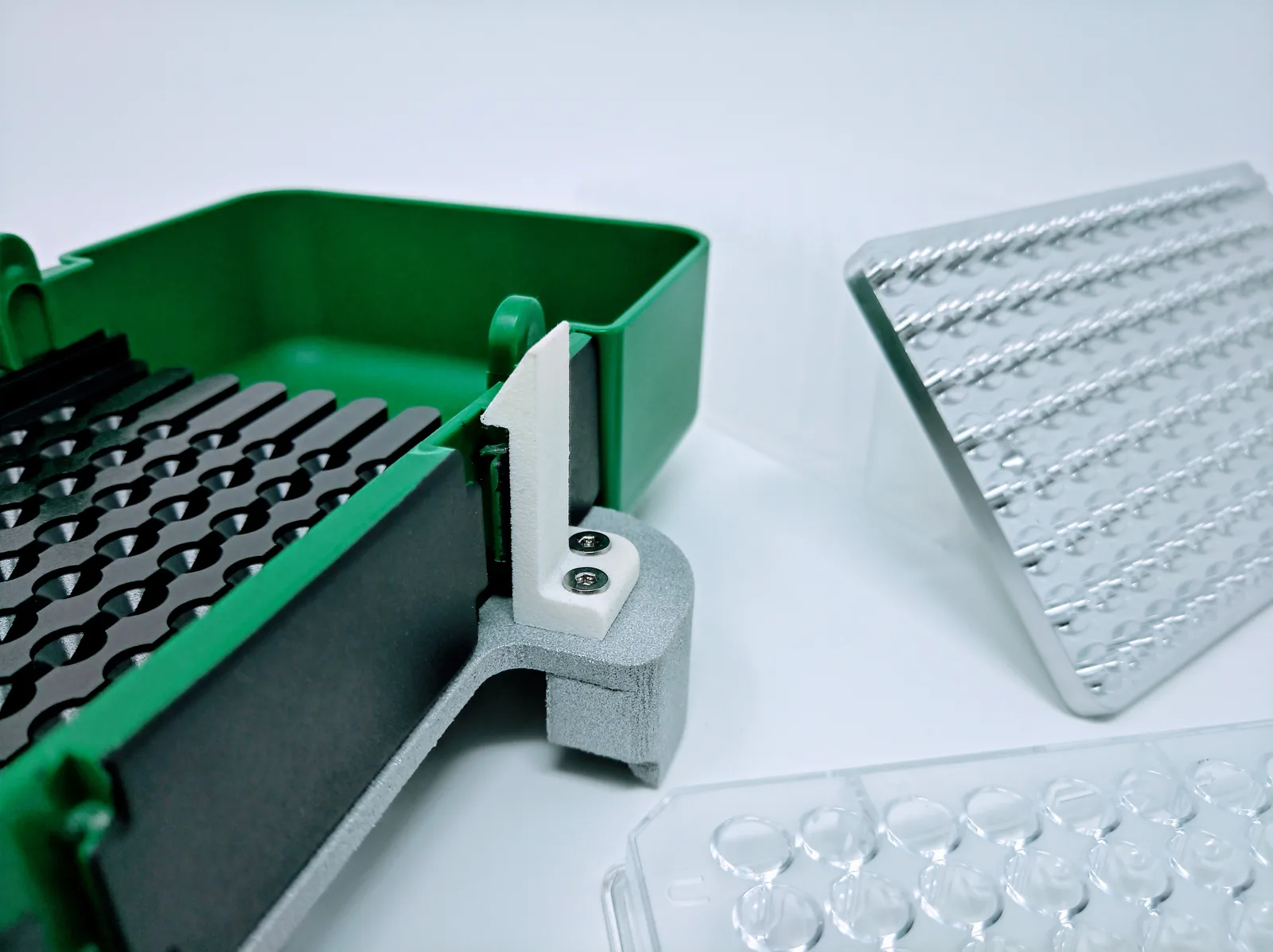
A seed dispenser designed for 96-well plates uses a two-layer mesh system. Seeds are loaded onto a mesh plate with holes sized to hold exactly one seed per position. The mesh plate sits over the 96-well plate. When the operator slides the bottom plate open, one seed drops per well simultaneously across all 96 positions.
The LabTIE seed dispenser works on this principle. Seeds are loaded onto an exchangeable mesh top plate. The operator agitates gently so seeds settle into the holes. A quick visual check confirms all 96 positions are filled. One pull of the slider releases all seeds in under 30 seconds. The device is stainless steel and fully sterilizable, which matters when working with pathogen-sensitive germination assays or when switching between accessions with strict contamination controls.
Mesh plates are exchangeable to accommodate different seed sizes. The same device handles Arabidopsis in the morning and sorghum in the afternoon without modification beyond swapping the mesh insert. It is compatible with standard 96-well plates, deep-well plates, germination trays, petri dishes, and 2 mL tube arrays.
Using a 96-Well Plate for Germination Assays
In a germination assay, each well in a 96-well plate represents a single seed or a defined seed lot. Researchers track germination rate, radicle emergence timing, and seedling vigor under controlled conditions, sometimes across hundreds of genotypes in one experiment.
Consistency of seed placement is directly linked to data quality. A seed that lands on the well edge instead of the base may have delayed contact with the moisture medium. A double-seeded well complicates scoring. A skipped well creates a gap in the dataset that either needs to be excluded or flagged as missing data. At scale, even a 2% placement error rate introduces noise that can obscure real biological differences between genotypes.
Using a dispenser eliminates most of these sources of error. Seeds land flat in the center of each well. Germination timing data is cleaner. Replicate plates are processed in minutes rather than hours, which allows labs to run more biological replicates within the same experiment.
Using a 96-Well Plate for DNA Extraction
In plant breeding programs, DNA extraction from seed tissue is a routine first step before genotyping. Seed samples are placed into 96-well plates, ground or disrupted in buffer, and processed through extraction columns or magnetic bead protocols in plate format. This keeps samples organized by position and compatible with liquid handling robots.
The challenge is getting exactly one seed per well, consistently, across thousands of samples per week. Labs working on marker-assisted selection or SNP genotyping cannot afford to have wells with no seed (no DNA yield) or two seeds (mixed genotype signal). In a high-throughput breeding program processing 5,000 to 20,000 samples per season, manual seed placement is a genuine bottleneck.
A dispenser that fills a full plate in under 30 seconds with less than 1% error changes the math. At 100 plates per week, the time saving alone justifies the equipment. The consistency improvement is the part that matters most for data integrity.
| Context | Why Seed Placement Matters | Risk of Manual Errors |
|---|---|---|
| Germination assay | Each well = one data point for rate and timing | Skipped or doubled wells distort scoring |
| DNA extraction | One seed per well = one genotype per well | Mixed or missing wells corrupt genotyping runs |
| Plant breeding screens | Throughput of hundreds of accessions per day | Manual bottleneck limits sample volume |
| Arabidopsis research | Tiny seeds require precision placement | Static and adhesion cause frequent misfires |
What to Look for in a Seed Dispenser for 96-Well Plates
Not all dispensers are designed for the same seed range or plate format. Before selecting a device, check that it covers your seed size, handles your plate type, and can be cleaned between runs if you are switching between accessions or species.
Key criteria: exchangeable mesh plates for different seed sizes, compatibility with standard SBS-format plates, sterilizability, and a mechanism that delivers one seed per well without jamming. The LabTIE dispenser meets all of these and is already in use at institutions including Wageningen University, Syngenta, and BASF for exactly this workflow.
For labs running high-throughput plant breeding programs or genomics workflows, the device pays for itself quickly. The bigger benefit is the reduction in human error and the shift from a labor-intensive manual step to a consistent, repeatable one.
Try it on your seeds and plates
If you want to try it on your seeds and plates, we can send a test unit.
See the 96-Well Seed DispenserRelated
For seed too fine for a standard mesh, the 96-well Arabidopsis seed dispenser is cut for it. For tubes instead of a plate, the 48-tube seed dispenser places one seed in each of 48 tubes in a single motion.
Leave a Reply