

Choosing between manual and automated powder dispensing comes down to three variables: weekly throughput, the physical properties of your compounds, and capital budget. This article compares analytical balances, manual mesh-plate dispensers, and robotic gravimetric systems across accuracy, setup time, cost, and compound compatibility, so you can match the right tool to your lab’s actual workload.
What a Powder Dispensing System Actually Does
A powder dispensing system controls the transfer of dry compound from a bulk source to individual target vessels at a defined weight or volume. In drug discovery, this means moving milligram quantities of active pharmaceutical ingredients (APIs), reagents, or reference compounds into vials, tubes, or microplates with enough precision that downstream assays are not confounded by dosing error. The operation sounds simple. It is not.
The technical challenge is that powder flow is governed by particle size, electrostatic charge, hygroscopicity, and bulk density, and these vary dramatically between compounds. A coarse crystalline salt such as NaCl flows freely under gravity and is easy to portion. A fine-milled API with a bulk density below 100 mg/mL, high surface area, and static charge will bridge, clump, and cling to surfaces. A system optimised for one compound class will fail on another. That mismatch is the central reason why no single dispensing platform is universal.
The Analytical Balance: Still the Standard for Low Throughput
The analytical balance remains the default tool in most discovery labs because it works on every compound, requires no method development, and costs little to operate. Accuracy of 0.5 to 2% is achievable by any trained technician weighing directly into a tared vial. There is no validation overhead beyond the daily calibration check, and the instrument doubles as a general-purpose lab balance. For groups handling 10 to 20 compounds per week, this is the rational choice.
The limitation is throughput. A skilled operator working carefully will dispense one vial per minute, so 48 vials takes the better part of an hour, and that is before accounting for taring, labelling, and logging. At 100 compounds per week the balance is a bottleneck; at 300 it becomes a project risk. The moment a single researcher is spending more than two hours per day on powder dispensing, the case for a dedicated dispensing platform becomes straightforward.
| Factor | Analytical balance | LabTIE manual dispenser | Robotic gravimetric |
|---|---|---|---|
| Throughput | 1 vial per minute | 48 tubes in 45 seconds | 100+ per hour |
| Accuracy | 0.5 to 2% | Less than 2% | Less than 1% |
| Setup time | None | Minutes | Days to weeks |
| Capital cost | Low (EUR 2,000 to 10,000) | Low (EUR 3,000 to 5,000) | High (EUR 30,000 to 200,000+) |
| Validation required | Daily calibration check | Gravimetric test on compounds | 2 to 8 weeks IQ/OQ/PQ |
| Compound range | Universal | Free-flowing powders best | Broadest (per-compound calibration) |
| Audit trail | Manual log | Manual log | Automated, 21 CFR Part 11 |
Manual Dispensers: Faster Than a Balance, Simpler Than a Robot
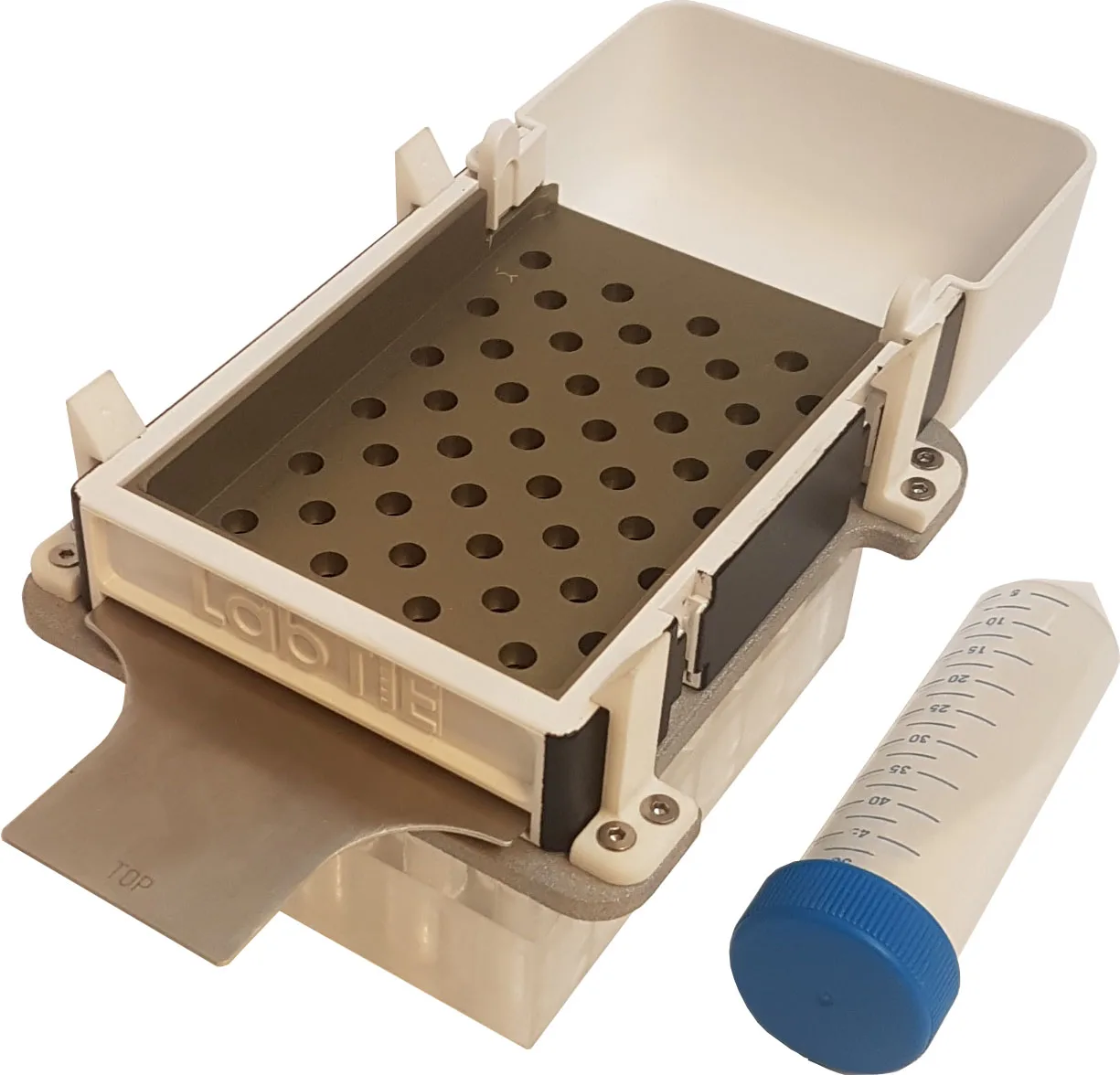
Mesh-plate dispensers such as the LabTIE powder dispenser operate on a volumetric principle: a precision-machined mesh plate sits above the tube rack, compound is loaded into the plate cavities, and a single actuating motion releases all doses simultaneously. Because the plate geometry determines volume and bulk density determines mass, no individual weighing step is needed. The result is 48 identical doses in 45 seconds with accuracy below 2%, comparable to careful balance work but at roughly 64 times the throughput.
The tradeoff is that dose volume is fixed per plate: to change the target mass you swap to a different plate. This is straightforward in labs with consistent tube formats and repeat dose levels, and adds minimal handling time. For groups running 50 to 500 samples per week with stable protocols, a manual dispenser deploys the same day it arrives: no IQ/OQ qualification, no service contract, no integration project. It occupies roughly the same bench footprint as a balance, and the initial cost sits in the same range as a mid-spec analytical balance. Request a quote to get a format specified for your labware within one working day.
Automated Gravimetric Dispensing: When the Volume Justifies It
Robotic gravimetric systems, including the Quantos from Mettler-Toledo, the Sartorius Cubis platform, and XPR/XPE auto-dispensers, dispense powder sequentially into individual vessels while an integrated balance measures each dose in real time and adjusts until the target weight is reached. Accuracy is typically below 1% and the target can be set per vessel, which makes these platforms suited to variable-dose compound libraries. An automated audit trail compliant with 21 CFR Part 11 is built in, removing the manual log requirement for regulated workflows.
The investment is substantial: list prices run from EUR 30,000 for entry-level auto-dispensers to EUR 200,000 or more for fully integrated robotic workstations with environmental control. Installation and qualification (IQ/OQ/PQ) typically requires 2 to 8 weeks and a dedicated project team. Per-compound method development adds further time before any production dispensing begins. These systems are justified when weekly throughput consistently exceeds 500 compounds, when regulatory compliance demands an electronic audit trail, or when compound diversity and variable dosing targets make volumetric approaches impractical.
| Weekly volume | Recommended system | Rationale |
|---|---|---|
| Under 100 samples | Analytical balance | Low capital, universal, no validation |
| 100 to 500 samples | Manual dispenser (LabTIE) | Same-day deploy, low cost, scales well |
| 500+ samples, fixed formats | Manual dispenser with multiple plates | Cost effective if formats are consistent |
| 500+ samples, variable targets, regulated | Robotic gravimetric system | Audit trail, per-compound calibration, 21 CFR |
Compound Properties That Affect Dispensing Performance
No dispensing system performs equally across all powder types. Fluffy, low-density powders with high electrostatic charge are problematic for every platform: they bridge across openings, adhere to surfaces, and generate dose-to-dose variability that no calibration can fully correct. Manual mesh-plate dispensers perform best with free-flowing powders above roughly 100 mg/mL bulk density; below that threshold, gravimetric feedback on a robotic system is the more reliable approach. Hygroscopic compounds absorb moisture from the air within seconds of exposure, shifting mass and altering physical properties mid-run. Fast transfer in a low-humidity environment is essential regardless of which system you use, and batch size should be kept small enough to finish before uptake becomes significant.
Compounds classified as dust-explosion hazards require enclosed dispensing environments with appropriate ignition controls, a consideration that applies to equipment selection before any throughput or accuracy comparison begins. When handling potent compounds (occupational exposure limits below 10 micrograms per cubic metre), containment takes precedence over throughput, and isolator-compatible dispensing formats become necessary. In both cases the physical properties of the compound, not the weekly sample count, drive the equipment decision.
Practical Recommendations
Start with the simplest system that meets your current throughput, then validate it gravimetrically on your actual compounds before committing to a protocol. Scale to automation only when throughput consistently and predictably exceeds what manual dispensing can handle, not in anticipation of growth that may not materialise. When you do add a robotic system, keep the manual dispenser on the bench: robots have downtime for maintenance, calibration, and method development, and a manual backup protects your schedule when the automated system is unavailable.
Specify a LabTIE powder dispenser for your lab
24, 45, 48, 96 and 384-position formats. Quoted within one working day with the converter specified for your labware.
Request a quoteRelated
The manual option in this comparison is one frame with exchangeable mesh plates. The 96-well powder dispenser doses 10 to 1000 microlitres into all 96 wells at once, within 2%, in about 45 seconds. The 384-well powder dispenser does the same on a 384 grid, including material finer than 0.3 mm.
Leave a Reply