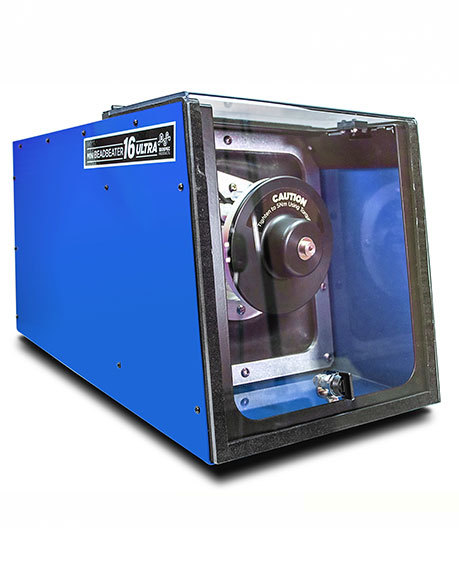
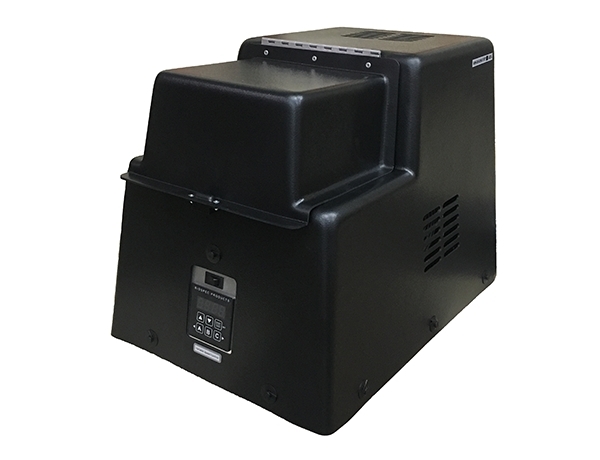

Mini-BeadBeater 96
The plate format bead beater. One 2 mL deep well microplate, two 1 mL plates, or the supplied rack of 45 screw cap microvials, up to 192 samples in a single one to three minute cycle. It shakes in a 3-D figure of eight with the plates held near horizontal, so nothing needs reorienting mid run. This is the unit our 96-well bead dispenser was built to feed.
Voltage, the optional 7 mL and 50 mL racks and grinding media are separate line items. Tell us the container you are running and we will quote the build around it.
Thousands of samples in a day
Two 1 mL deep well plates per cycle is 192 positions, and a cycle is one to three minutes with no motor cool down needed between runs. Throughput stops being the constraint.
Plates or vials, your choice
A poly rack for 45 microvials of 0.5, 1.5 or 2.0 mL comes with the instrument. Racks for twenty 7 mL tubes or two 50 mL tubes are available separately.
Same disruption as the rest of the range
Disruption efficiency matches the other Mini-BeadBeater models, so methods developed on a 16 or a 24 carry across to plate format without revalidation.
Cycling built into the timer
Up to ten run cycles with pauses of nought to five minutes between them, on a brushless motor. Set a beat and rest pattern once and walk away.
A plate at a time, and the one thing that will catch you out
Sample, extraction medium and small ceramic or steel beads are sealed into a deep well plate or into microvials, and the instrument shakes them hard in a 3-D figure of eight. After one to three minutes better than 95 percent of cells are open. Because the beads and the plate are disposable and nothing is unsealed during the run, cross contamination between positions is eliminated, which is why the method suits PCR, PAGE and probe work. Up to 400 mg wet weight of tissue per microvial, in phenol, guanidinium thiocyanate or a commercial kit solution.
The catch is the plate itself. At this energy level an ordinary sealing film lifts and wells leak into each other, and with steel beads a weak plate can lose the bottom of a well. That is not the instrument, it is the labware, and it is worth reading the plate sealing note below before you order.
Specifications
Catalogue numbers
Europe normally takes the 230 V build. The 45 position microvial rack is included with both.
Plate sealing, and which plates actually survive
Read this one before ordering plates. The instrument clamps the sealing mat evenly across the whole plate, but the initial seal is on you: press the mat firmly onto the plate before the run. Elastomeric mats in EVA or silicone rubber hold best under mechanical stress, and a roller applicator or a mat press makes the seal more consistent.
BioSpec tested mats from several manufacturers against this instrument. Only the Porvair Sciences 2 mL deep well plate 219030 sealed with EVA polymer mat 219004 passed both their leakage and their breakage tests. Mats of other rubber like polymers, and adhesive or heat bonded films, may leak. With steel bead media a weak plate can also lose the bottom of a well.
If plate integrity is not good enough for your assay, use screw cap microvials in the supplied 45 position rack instead. It sidesteps the problem completely.
Loading, balance and beads
Fill screw cap vials at least half full with beads, between a half and three quarters is fine. Insert the microtubes into the holder and distribute them symmetrically, with at least four tubes at each corner, so the head stays balanced.
Match the bead to the sample: zirconia or chrome steel for hard plant tissue, seed, soil and bone, glass or silica for yeast and soft cell lines. Our grinding media page lists sizes and materials. Loading beads into 96 wells by hand is slow and error prone, which is exactly what our 96-well bead dispenser exists for: one slide, about 8 seconds, every well.
Always run with the black plastic hood lowered over the chamber. It keeps hands away from the shaker and contains anything that breaks free.
Cooling, and why a cold room will not help
Bead beating raises homogenate temperature by roughly 10 °C for every minute of beating. For nucleic acids in a chaotropic isolation medium, cooling is not needed. For native proteins, membranes and organelles it is essential.
Pre-cool the beads and the sample, beat for one minute, then cool the vials or the plate in an ice and water mixture for one minute, and cycle to a total on time of three minutes. A pre-chilled aluminium vial rack helps hold the temperature during beating.
Do not run this instrument in a cold room. Cold air does not prevent the sample warming, and the electronics are designed to stop the machine from starting there.
Cryogenic grinding
Softer material such as biological tissue, rubber or plastic can be powdered by pre-freezing the sample to liquid nitrogen temperature first. Use reinforced microvials, stainless steel microvials or reinforced microplates, and a solid aluminium vial holder to hold the cryogenic temperature during beating. Powdered material can then be dissolved in an organic solvent in the same vial, which simplifies recovery of organic analytes.
Applications
High throughput nucleic acid extraction is the main one. Doing mechanical disruption and extraction simultaneously in a chaotropic solution gives high yields of good quality RNA and DNA, and the sealed vessels remove cross contamination as a concern.
Beyond that: protein recovery, metabolite work, microbiome and environmental studies, and general grinding of spores, microorganisms, plant and animal tissue and soil samples.
Ordering, delivery and warranty
Price on request, and there is no online checkout, because every unit is quoted per configuration. Send the voltage, the container you run and whether you need the 7 mL or 50 mL racks, and a written quotation follows within one working day.
At 120 lb this unit ships as freight rather than parcel, so give us the delivery address and any loading dock or lift restrictions with the enquiry. Warranty is two years.
Frequently asked questions
How many samples does the Mini-BeadBeater 96 process at once?
Up to 192. That is two 1 mL deep well microplates, or one 2 mL deep well plate, or 45 screw cap microvials in the rack that comes with the instrument. With optional racks it also takes twenty 7 mL tubes or two 50 mL tubes. A cycle is one to three minutes and no cool down is needed between runs, so thousands of samples a day is realistic.
Can I use any 96 deep well plate?
No. The plate has to survive the shaking and the sealing mat has to hold well to well. BioSpec tested mats from several manufacturers and only the Porvair Sciences 2 mL deep well plate 219030 with EVA polymer sealing mat 219004 passed both the leakage and the breakage tests. Mats of other polymers, and adhesive or heat bonded films, can leak at this energy level, and with steel beads a weak plate can rupture at the bottom of a well. Press the mat on firmly before the run, and if plate integrity is not good enough for your assay, use screw cap microvials in the supplied 45 position rack.
What speed does it run at?
Variable from 1400 to 2400 rpm, in a 3-D figure of eight pattern with the plates or vials held near horizontal. No reorientation is needed part way through a cycle. Disruption efficiency matches the other Mini-BeadBeater models, so protocols developed on a 16 or a 24 transfer without revalidation.
How much sample goes in each vial?
Up to 400 mg wet weight of biological material per microvial, in a nucleic acid extraction solution, phenol, guanidinium thiocyanate or a commercial kit reagent. Fill the vial at least half full with beads, between a half and three quarters is fine.
Do I need to cool the samples?
Only for heat sensitive targets. Bead beating adds roughly 10 °C per minute of beating. Nucleic acids in a chaotropic isolation medium do not need cooling. Native proteins, membranes and organelles do: pre-cool the beads and sample, beat for one minute, cool in an ice and water mix for one minute, and cycle to a total on time of three minutes. A pre-chilled aluminium vial rack helps.
Can I run it in a cold room?
No. Cold air does not prevent the sample warming during bead beating, and the unit contains electronics that prevent it from starting in a cold room. Use pulse cycling and an ice and water bath instead, or a pre-chilled aluminium vial rack.
How do I load beads into 96 wells without it taking all morning?
Use a bead dispenser. A LabTIE 96-well bead dispenser drops one or more beads into every well in a single slide, about 8 seconds for a full plate, with a 0% error rate. Dropping beads in by hand is where most of the time and most of the mistakes in plate based bead beating come from.
What does the Mini-BeadBeater 96 cost, and how does it ship?
Price on request. We quote per configuration because voltage, the optional tube racks and grinding media are separate line items, and there is no webshop checkout. At 120 lb the instrument ships as freight rather than parcel, so send us the delivery address and any dock or lift restrictions along with your enquiry. A written quotation follows within one working day.