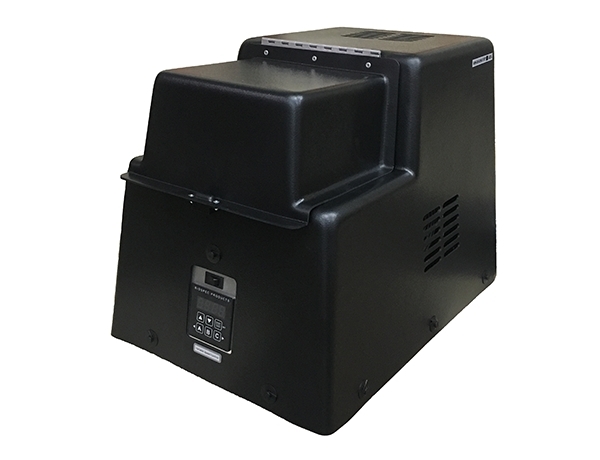

Mini-BeadBeater-24 ULTRA
Up to twenty four 2 mL screw cap microvials, variable speed from 2400 to 3800 rpm, and programmable on and off cycling that holds the sample temperature down without anyone standing over it. This is the high capacity model in the Mini-BeadBeater range, and the one to pick when the protocol names an rpm figure and a rest interval rather than leaving them to the machine.
Voltage, finish and grinding media are separate line items, so we quote the build rather than a headline number. Tell us the voltage and what you are grinding.
Cycling that runs itself
Programmed on and off intervals keep heat from building during a long run, which is what makes this model compatible with kit protocols written around rest periods. Nobody has to stand at the bench with a stopwatch and a bucket of ice.
Speed you can write into a method
Variable from 2400 to 3800 rpm, with five programmable runtime cycles and three presets. Set the method once and the next operator repeats it exactly.
68 dB instead of 82
The mechanical redesign drops typical operating noise by 14 dB against the previous model, which is roughly a twenty five fold reduction in perceived loudness. It changes what it is like to share a room with one.
A carrier that holds the vials square
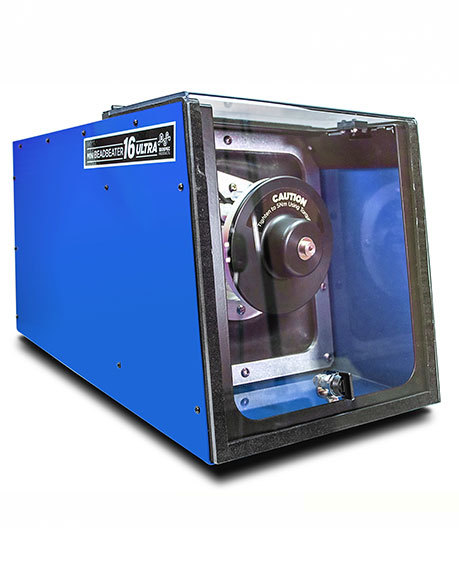
Precision machined vial carrier, torque key on the retaining cap, positive latch on the door and an interlock that stops the head if the door opens mid cycle. The door is clear, so you can confirm the load at a glance.
Eight more positions, and control over how they are beaten
The extra capacity over the 16 ULTRA is the obvious reason to buy this one. It is rarely the real reason. What changes the work is the controller: variable speed, five runtime cycles and three presets, plus automated on and off intervals that hold the temperature down while the run proceeds. That combination is what lets you follow a third party extraction kit to the letter instead of approximating it, and it is what makes temperature sensitive RNA, protein and metabolite work practical at twenty four samples a time.
The disruption itself is unchanged. Same high energy beadbeating that has been the reference for complete lysis for thirty years, so bacteria, yeast, fungi, plant and animal tissue open in two to three minutes. If you never touch the speed and your samples tolerate a continuous run, the 16 ULTRA does the same job for less. If your samples arrive in plates, you want the Mini-BeadBeater 96.
Specifications
Catalogue numbers
Europe normally takes the 230 V build. Name the finish on the quote request, or leave it to us and we will quote black.
What you get, and what you will still need
The instrument arrives with the precision machined vial carrier, the torque key and retaining cap, and the digital controller built in. No software, no power supply to configure, nothing to install.
Consumables are quoted separately because they depend on the sample: 2 mL screw cap microvials, and grinding beads in the right material and size. Zirconia or chrome steel for hard plant tissue, seed, soil and bone. Glass or silica for yeast and soft cell lines. See the grinding media page for what we hold, and the bead dispensers if you would rather not drop beads into twenty four vials by hand.
Applications
DNA and RNA extraction, protein recovery, metabolite profiling, microbiome studies and tissue homogenization, routinely ahead of PCR, PAGE and diagnostic assays. It handles the material that defeats chemical lysis: mycobacteria, bacterial and fungal spores, fibrous plant tissue, seed, soil and faecal samples.
The cycling is what widens the range. Because the controller can hold a beat and rest pattern on its own, workflows built around temperature sensitive RNA, native protein and organelle recovery become routine rather than a supervised operation.
Heat, and why the cycling matters
High energy bead beating raises homogenate temperature by roughly 10 °C for every minute of beating. Nucleic acids in a chaotropic extraction buffer tolerate that. Native protein, membranes and organelles do not.
On a fixed speed machine you manage that by hand: beat one minute, cool in an ice and water mix for one minute, repeat to a total on time of three minutes. The 24 ULTRA programs that pattern into the run instead, which is both more repeatable and considerably less tedious. A pre-chilled aluminium vial rack adds a little more headroom on top.
Ordering, delivery and warranty
Price on request, and there is no online checkout, because every unit is quoted per configuration. Send the voltage and the finish and a written quotation follows within one working day. Shipping is world wide by DHL Express, typically 7 to 20 working days depending on destination and customs.
The instrument carries the manufacturer’s warranty against defects in materials and workmanship under normal laboratory conditions. Ask us for the current terms with your quote.
Frequently asked questions
What is the difference between the 24 ULTRA and the 16 ULTRA?
Capacity and control. The 24 ULTRA takes up to 24 vials against 16, and its controller offers variable speed from 2400 to 3800 rpm, five programmable runtime cycles, three presets and automated on and off cycling. The 16 ULTRA runs at a fixed 3450 strokes per minute with a programmable timer but no speed control and no cycling. Disruption performance is the same on both, so if you never change the speed and your samples tolerate a continuous run, the 16 ULTRA is the more economical choice.
How many samples can it run, and in what vials?
Four to twenty four 2.0 mL screw cap microvials, with 0.1 to 1.0 mL of material in each. Four is the floor rather than a suggestion, because the head needs to stay balanced, and on a partial load you should distribute the vials symmetrically.
What does the automated runtime cycling actually do?
It runs the instrument in programmed on and off intervals instead of one continuous burst, so heat that would otherwise accumulate has time to dissipate between bursts. That protects temperature sensitive RNA, DNA, proteins and metabolites, and it is what makes the 24 ULTRA compatible with third party kits and protocols that specify beat and rest patterns.
How much quieter is it?
Typical operating noise drops from about 82 dB on the previous model to about 68 dB. A 14 dB reduction is a large change to the ear, roughly a twenty five fold drop in perceived loudness, which is the difference between an instrument people put in a side room and one they are happy to run on a shared bench.
How long is a run?
Two to three minutes of beating gives rapid, complete disruption of bacteria, yeast, fungi, plant tissue and animal tissue. Where the downstream step is PCR and total lysis is not required, shorter runs usually suffice.
Can it grind dry or cryogenically?
Dry grinding, yes. For cryogenic grinding, freeze the sample to liquid nitrogen temperature first, use reinforced vials, and hold the temperature with a solid aluminium vial holder during beating. Softer material such as tissue, rubber or plastic powders well this way.
Which beads should I use, and how full should the vial be?
Match the bead to the sample: zirconia or chrome steel for hard plant tissue, seed, soil and bone, glass or silica for yeast and soft cell lines. Fill a screw cap vial about half full with beads, or keep beads to roughly a third of the vessel volume, so they can still move. Up to 400 mg wet weight of material per 2 mL vial is a sensible ceiling.
What does the Mini-BeadBeater-24 ULTRA cost?
Price on request. We quote per configuration because voltage, finish and grinding media are separate line items, and there is no webshop checkout. Send the voltage you need and a written quotation follows within one working day. Shipping is from the Netherlands.