
Starter kit · In stock
96-Well Starter Bead Dispenser
The entry point into bead dispensing. One bead per well across a full 96-well plate in about 10 seconds, in a fixed bead size of 2.0, 3.2, 4.0 or 5.0 mm, supplied in a small case ready to use.
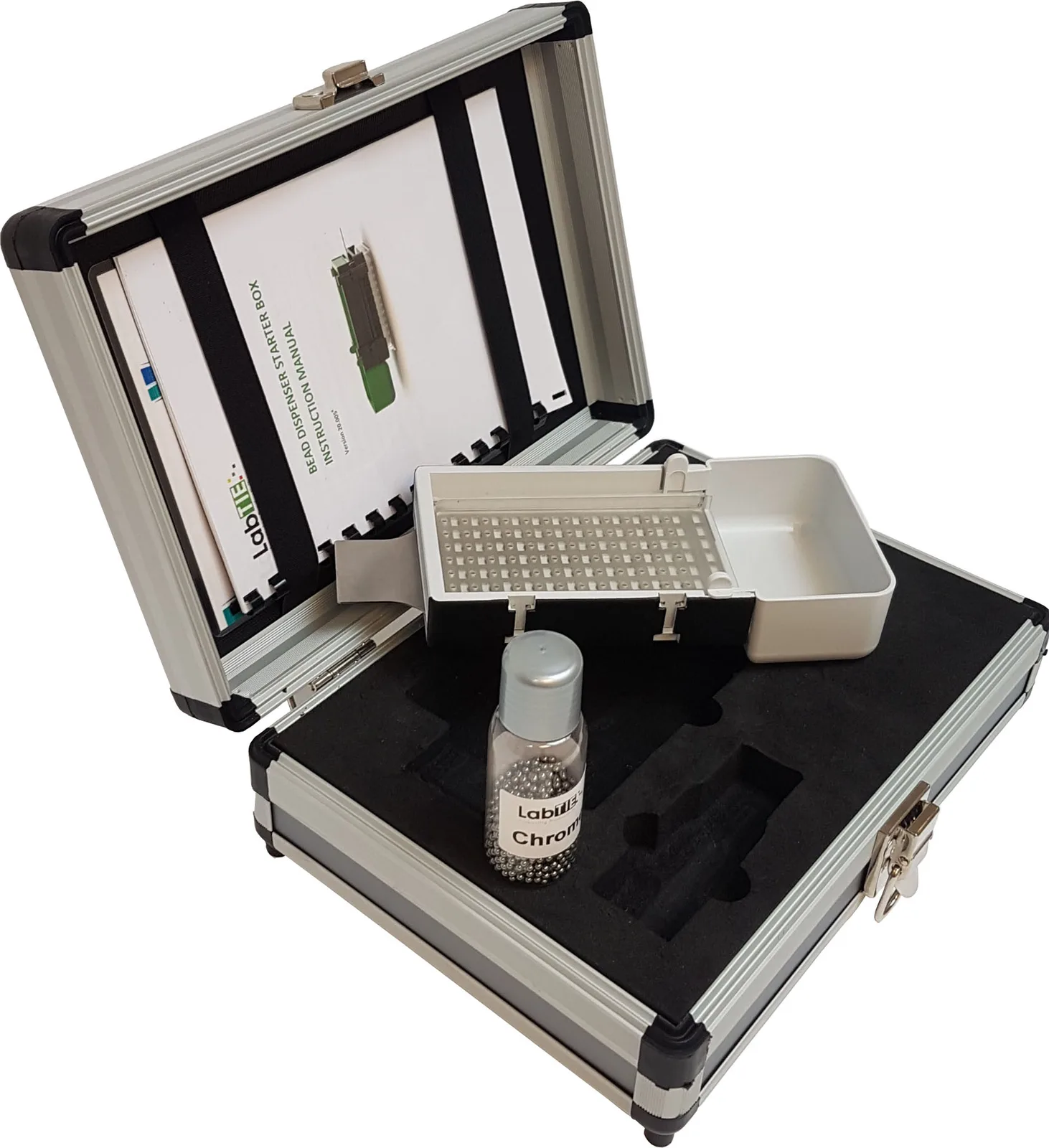
 One pull fills all 96
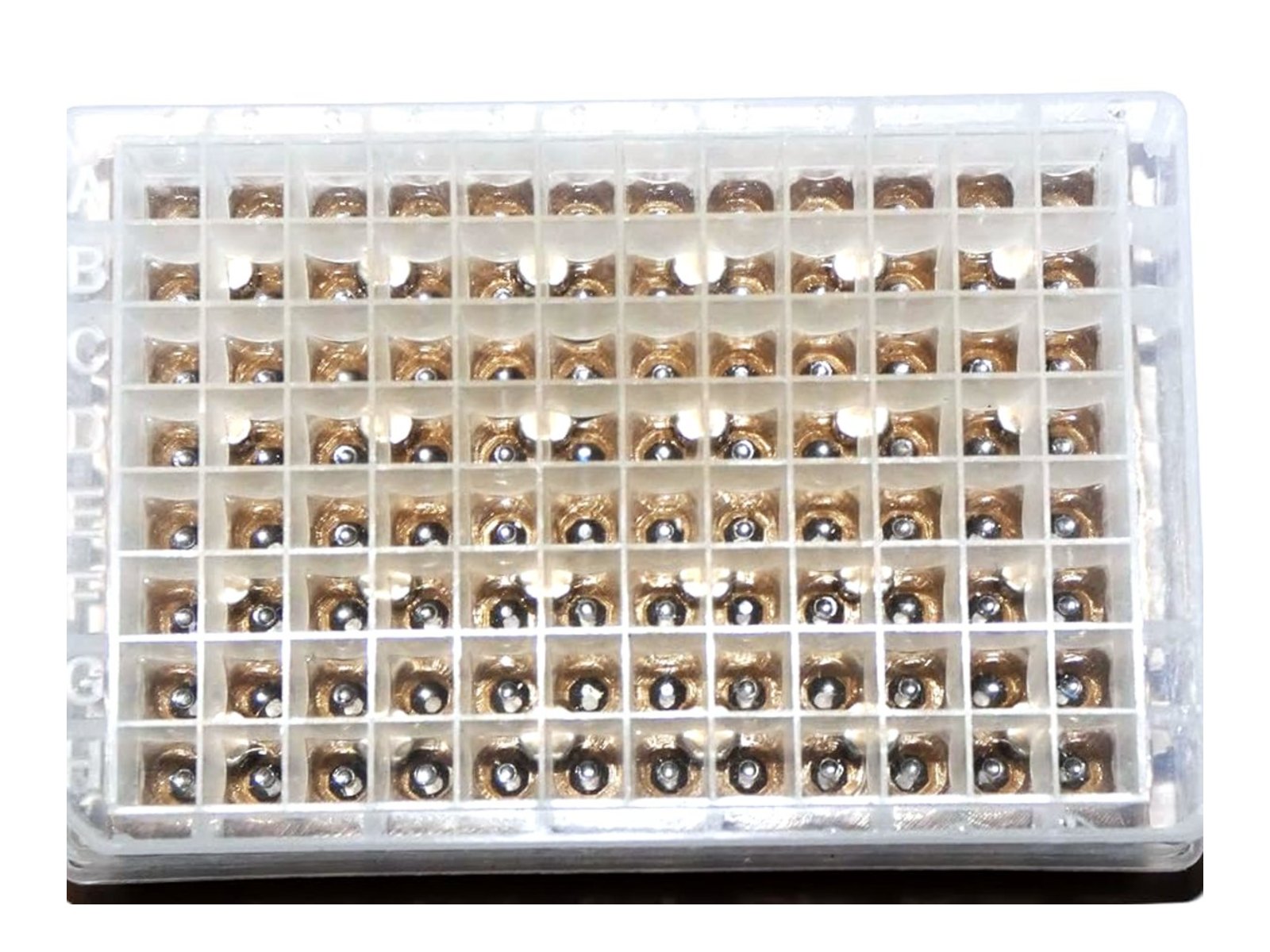 Fits on: 96-well and deepwell plates
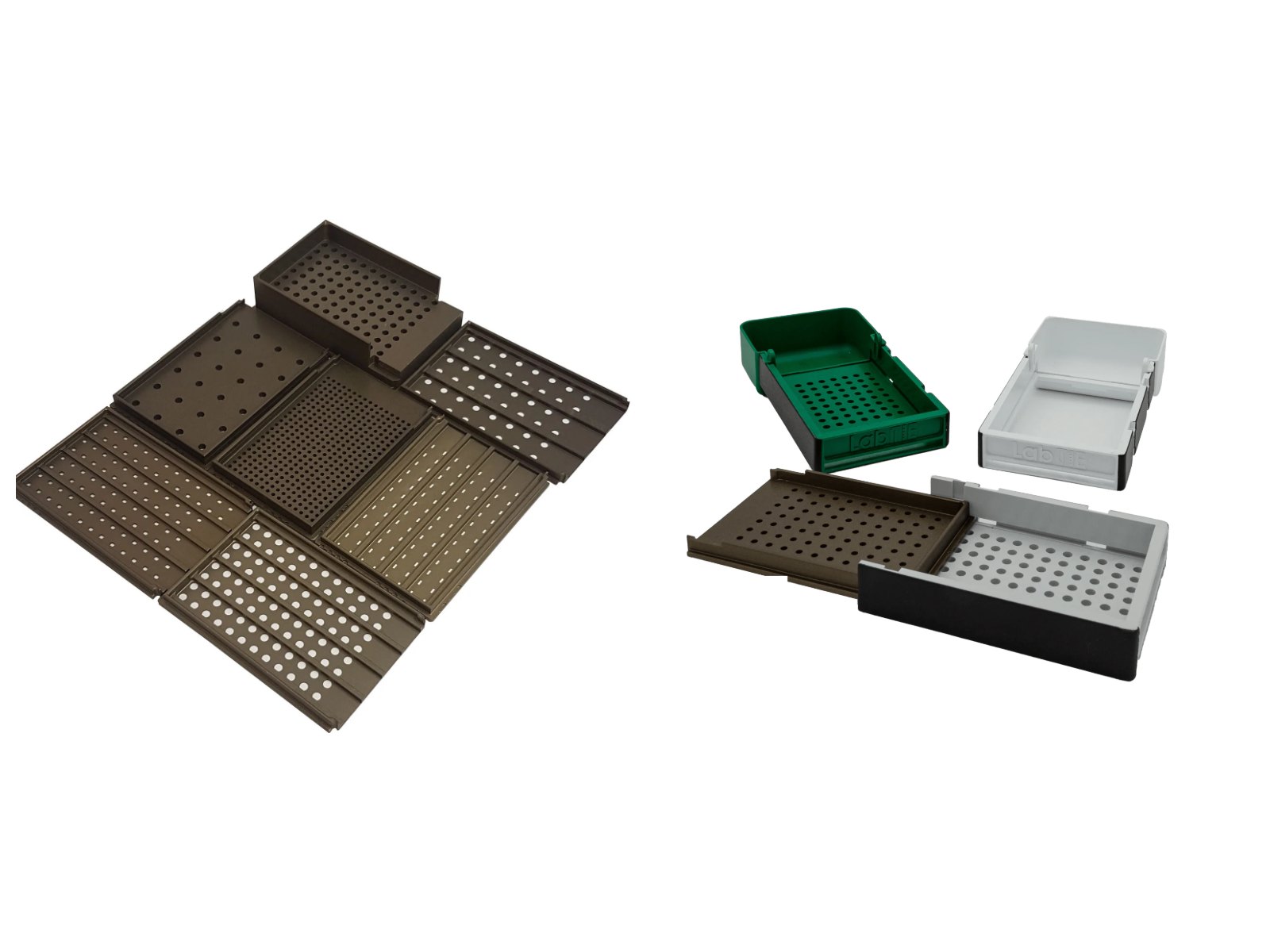 Standard mesh plates, one per bead size
Click any photo to open it full size.
One bead per well, in one of these four sizes. Name the size on your quote request and we confirm the plate code. Openings outside this list, more than one bead per well or a custom cut plate call for the full 96-Well Bead Dispenser.
Price on request
The starter kit is quoted with the mesh plate for your bead size, so we price per configuration. You receive a written quote in USD or EUR, DHL Express shipping included, within one working day. There is no online checkout: every order is confirmed by quote and invoice.
| Product code | Depends on the bead size you select above (see the size codes) |
|---|---|
| Availability | In stock, except customs |
| Shipping | World wide, DHL Express |
| Shipping time | 7 to 20 working days |
| Shipping weight | On request, small case included |
- ✓One bead in every well of a 96-well plate, in one motion
- ✓Microtiter, deepwell and individual tube plates on the same body
- ✓Lower entry price than the full bead dispenser system
Why labs choose it+
Why labs choose it
A full plate in one motion
Placing beads in 96 wells with tweezers takes minutes and invites missed wells. Filling, levelling and sliding takes about 10 seconds.
Exactly one bead per well
The standard mesh plate holds a single bead above each well and releases them together, so no well is skipped and none is double loaded.
The shorter route in
For a settled assay with a standard bead, this is the lower entry price. Everything you need to start is in the case.
Any bead material
Metal, silica, borosilicate and zirconia all run on the same body, on an antistatic mesh plate.
Nothing to break down
No motors, no software, no service contract. It works in a fume hood, a glovebox or a cold room exactly as it works on the bench.
Room to grow into
If the assay changes later, the full 96-Well Bead Dispenser covers the whole plate range, multiple beads per well and the self aligning converter.
General information+
General information
The LabTIE Starter Bead Dispenser is a manual system that loads one grinding bead into every well of a 96-well plate. You pour the beads onto the mesh plate, tilt the dispenser so the surplus runs back into the tray, place it on the plate and pull the slider once. It was added to the range for labs running a standard assay with a standard bead, to replace loading by hand.
It takes standard mesh plates in 2.0, 3.2, 4.0 and 5.0 mm and runs 96-well microtiter plates, deepwell plates and individual tubes. Beads of any material work: metal, silica, borosilicate and zirconia alike, within a 0% error range.
Where the assay is not settled, the full 96-Well Bead Dispenser is the better buy: unlimited mesh plates, several beads per well, the self aligning converter and the large case. See also our grinding media and bead beaters.
Documents to download+
Documents to download
Assembly, loading, dispensing, swapping mesh plates, cleaning and spare part numbers.
Cleaning, drying and sterilising the body, slider and mesh plate between bead types.
Laboratories and institutes running LabTIE dispensers, by field and application.
The starter kit has no converter. The 96 grid figures are in the full 96-Well Bead Dispenser measurements sheet.
Frequently asked questions+
Frequently asked questions
How does it work?
Pour the beads onto the mesh plate, tilt the dispenser so the surplus runs back into the tray, set it on your plate and pull the slider once. Every well receives one bead at the same moment.
What is the difference from the 96-Well Bead Dispenser?
The starter kit comes with standard mesh plates in four bead sizes and a small case. The full dispenser adds the self aligning converter, the large case with brushes and tweezers, the whole mesh plate range including custom plates, several beads per well, and the option to add plates later.
Which bead sizes can it dispense?
2.0, 3.2, 4.0 and 5.0 mm, one bead per well. Other openings, or more than one bead per well, are handled by the full 96-Well Bead Dispenser.
Which plates does it fit?
Standard 96-well microtiter plates, 96 deepwell plates and 96 individual tubes. Bead size is also limited by the well: a standard 96-well plate takes up to about 3 mm, deepwell plates take more.
Can I upgrade later?
The starter kit is not expandable. Labs that outgrow it move to the full 96-Well Bead Dispenser, which takes additional mesh plates and the converter.
Are the beads included?
No. Grinding media is ordered separately, in glass, zirconia, chrome or stainless steel, from our grinding media range.
How do I get started with dispensing beads into a 96-well plate?
The LabTIE 96-Well Starter Bead Dispenser is the ideal entry point: it gives you all the core functionality of the full 96-Well Bead Dispenser at a lower cost, making professional-grade bead loading accessible for smaller labs or pilot projects. Simply load the reservoir, place the dispenser over your plate, and tilt to fill all 96 wells in one pass. No training or calibration is required.
What size beads fit in the 96-Well Starter Bead Dispenser?
The Starter model supports the same bead size range as the full 96-Well Bead Dispenser (from 0.5 mm to 7 mm) via interchangeable mesh plates. The included mesh plate covers the most common bead size for your chosen application. Additional mesh sizes are available as affordable accessories.
How does the 96-Well Starter Bead Dispenser work for DNA extraction?
Fill the reservoir with lysis beads, set the dispenser over a 96-well plate, and tilt once: all 96 wells are loaded in under 15 seconds. Consistent bead loading is essential for reproducible cell disruption and DNA yield across an entire plate. The Starter Dispenser delivers the same <1% dispensing accuracy as the full LabTIE range.
How accurate is the 96-Well Starter Bead Dispenser?
The LabTIE 96-Well Starter Bead Dispenser achieves <1% dispensing error across all 96 wells, matching the full professional range. This precision ensures consistent bead counts for reproducible lysis and extraction results. Over 120 labs, including those at Bayer, Syngenta, and Harvard, trust LabTIE precision.
What is the best way to dispense grinding beads for tissue lysis using the Starter Dispenser?
Select the mesh plate for your grinding bead size, fill the reservoir, and tilt the dispenser over your 96-well plate. The Starter Dispenser loads all wells in one smooth motion, giving every sample the same bead count. This is the recommended approach for labs running bead-mill tissue lysis on 96-well plates at moderate throughput.
How fast can you load a 96-well plate with the Starter Bead Dispenser?
The Starter Dispenser fills all 96 wells in approximately 8–15 seconds, compared to 20–30 minutes of manual bead loading. Even at starter-level throughput, this time saving is meaningful. No power source is required and the unit is ready to use out of the box.
Which bead sizes work with the LabTIE 96-Well Starter Bead Dispenser?
Bead diameters from 0.5 mm to 7 mm are supported via the exchangeable mesh plate system. Standard mesh plates are stocked for the most common bead sizes. Custom mesh plates for non-standard diameters can be ordered on request.
What are the shipping times for LabTIE dispensers?
LabTIE ships worldwide from the Netherlands, with standard delivery in 3–7 business days within Europe and 7–14 business days internationally. Express options are available. Contact us at order time to arrange faster delivery.
Do you offer a warranty on LabTIE dispensers?
Yes. The 96-Well Starter Bead Dispenser comes with a 12-month warranty covering manufacturing defects. If the unit develops a fault under normal use, contact us to arrange repair or replacement. Mesh plates are consumable items available separately.
Can I order custom mesh plates for non-standard containers?
Yes. LabTIE can supply custom mesh plates for non-standard plate formats or container sizes. Provide the relevant dimensions and your required bead size and we will provide a quote. This is ideal for labs working with proprietary deep-well or non-SBS formats.
What is the best bead dispenser for a lab?
For labs just getting started with bead-based lysis in 96-well format, the LabTIE 96-Well Starter Bead Dispenser is a cost-effective entry point without sacrificing the core functionality. It loads a full 96-well plate in 8 to 15 seconds, covers the most common bead sizes, and operates without electricity. It is a good way to evaluate manual bead dispensing in your workflow before committing to a larger setup.
Which manual bead dispenser is used in pharmaceutical labs?
Pharmaceutical labs that need a reliable 96-well bead dispenser at a lower entry price often start with the LabTIE Starter model. It gives the same placement speed and accuracy as the full LabTIE 96-well dispenser, making it a practical choice for smaller teams or labs setting up a new bead milling workflow. Several institutional labs use it as a backup or secondary unit alongside their main dispenser.
How do I choose the right bead dispenser for my lab?
If your lab uses 96-well plates and you want to try bead dispensing without a large commitment, the LabTIE Starter model is a sensible starting point. Confirm your bead size needs and plate format, then check whether you need additional mesh sizes beyond what the Starter kit includes. If your throughput grows, you can upgrade to the full LabTIE 96-well system, and the mesh plates carry over.
What bead dispensers do plant genomics labs use?
Smaller plant genomics labs or those piloting bead-based lysis for the first time often use the LabTIE 96-Well Starter Bead Dispenser to test the workflow before scaling. It handles the same 96-well format used for leaf tissue grinding, supports standard bead sizes used in plant extraction kits, and is easy to sterilize between runs. Labs that find it fits their needs well often add additional units as their sample numbers grow.
What should I look for when buying a bead dispenser?
For a first bead dispenser purchase, focus on format compatibility, accuracy, and bead size range. The LabTIE 96-Well Starter Bead Dispenser covers the standard 96-well SBS format, achieves less than 1% placement error, and includes mesh plates for the most common bead sizes. It is also manual and sterilizable, which keeps the operational requirements simple. Starting with a proven design like this avoids the learning curve of poorly documented alternatives.
Which bead dispenser is best for 96-well plate tissue lysis?
The LabTIE 96-Well Starter Bead Dispenser is designed for exactly this use case. It loads one bead per well across all 96 wells in a single press, with less than 1% error to keep failed lysis wells to a minimum. If you later need additional mesh sizes or higher throughput, the LabTIE full 96-well model is a natural upgrade path with compatible accessories.
Are there manual bead dispensers that work without electricity?
Yes: the LabTIE 96-Well Starter Bead Dispenser is fully manual and needs no power at all. It is one of the simplest tools in the bead milling workflow: fill the reservoir, press over the plate, done. The lack of electronics makes it easy to use inside biosafety cabinets and simple to maintain. It is a good illustration of how a mechanical solution can outperform complex automated equipment for a single, repetitive task.
Our satisfaction guarantee
We believe in the products we invented and are committed to your success. If anything you buy from us proves unsatisfactory, send us an e-mail and we adjust the system, replace the item or refund the purchase price.
If the starter kit turns out to be the wrong fit for your assay, we will tell you before you order rather than after.
Tell us your plate and your bead size. You receive a written quote within one working day.