
By Bas Millenaar, LabTIE International, Doorn, the Netherlands
Start with the rack. Before rpm, before price, before anything on a spec sheet, check that the homogeniser accepts the same plate or vial block your dispenser fills. That one question decides whether the two machines work as a pair or whether somebody spends the next five years tipping samples from one format into another.
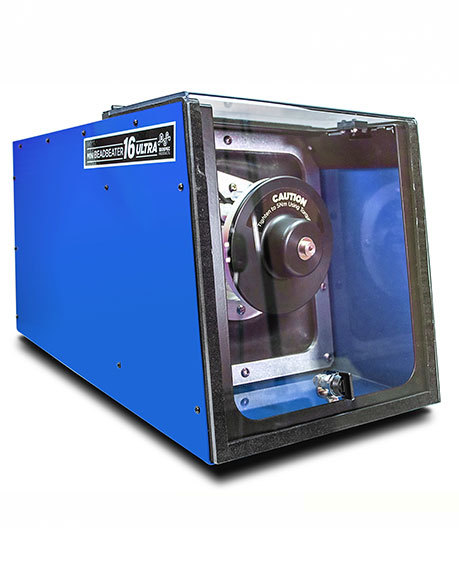
BioSpec replaced two machines this year. The Mini-BeadBeater-16 ULTRA and the 24 ULTRA take over from the standard 16 and 24, and the old 16 stays on the price list for roughly six months during the changeover. If a homogeniser is in your budget this year, that timing is worth knowing, so this is what changed and what it pairs with.
Why we are writing about somebody else’s machine
We build dispensers. We do not build homogenisers, we do not resell them, and we earn nothing if you buy a BioSpec machine after reading this.
The commercial relationship runs the other way: BioSpec distributes our dispensers in the United States, Canada and Mexico. What we get out of writing this is fewer awkward emails. A dispenser bought without checking the mill’s rack is a dispenser that irritates somebody for years, and we would rather not have built that one.
The rack question, answered
The Mini-BeadBeater-96 accepts one 2 mL deepwell microplate, or two 1 mL plates, or 45 microvials, or 20 tubes of 7 mL, or two of 50 mL.
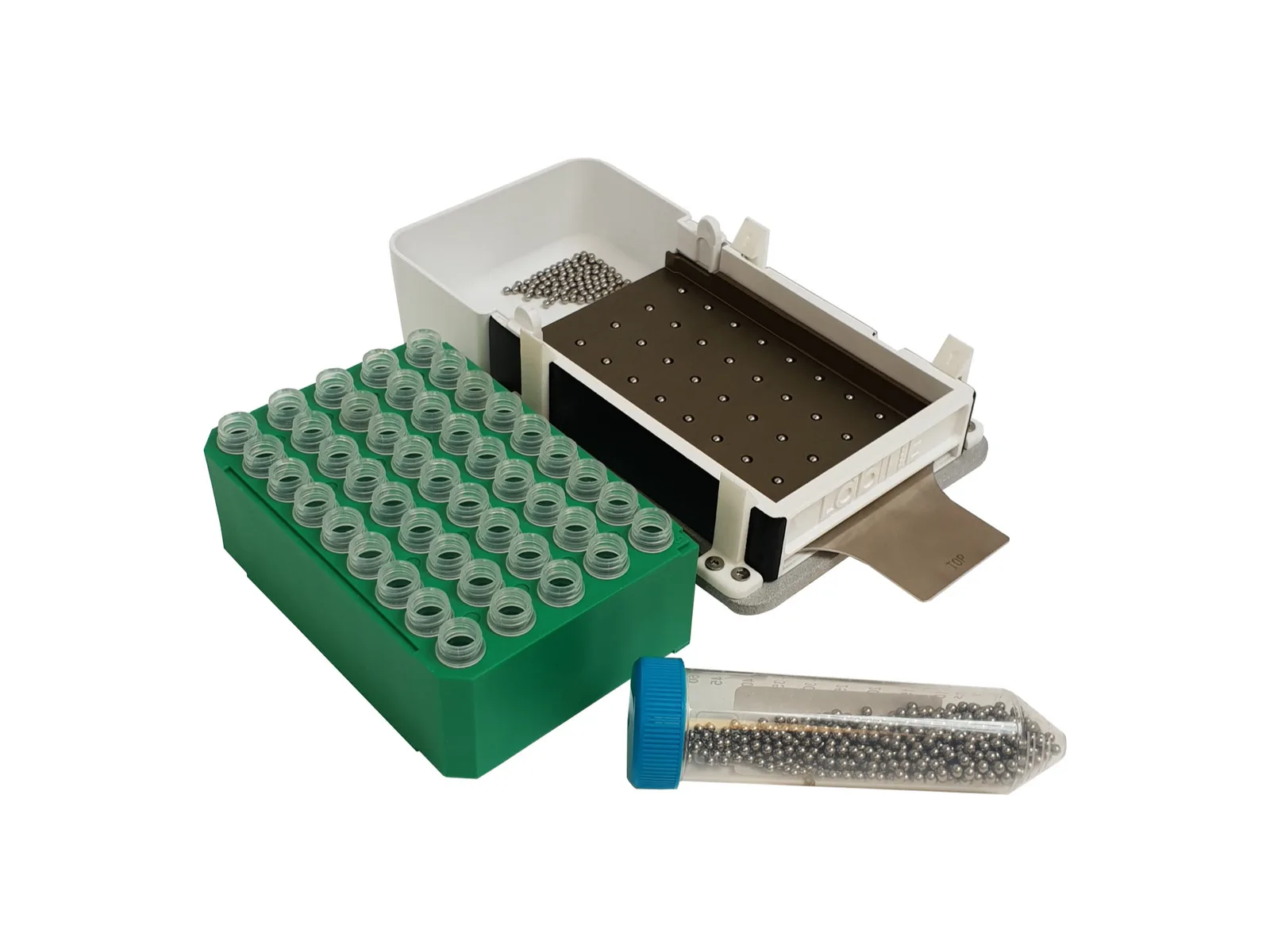
Our two most requested bead dispensers fill a 96-well deepwell plate and a 45 position tube rack.
Those are the same two formats. Load on the bench, slide the rack straight into the carrier, run it. Nothing to decant, no adapter to source, no plate sitting on the bench while somebody transfers 45 tubes one at a time because two suppliers picked different geometry.
It is a dull thing to check and it is the thing people skip.
What changed on the ULTRA machines
Three things, and only one of them is about speed.
Noise. Both ULTRA units run at about 68 dB against 82 dB on the models they replace. If the mill lives in the room where people work rather than in a cupboard down the corridor, this is the change they notice on day one.
A safety interlock. Open the door mid run and the motion stops. The door latches positively and you can see through it, so the carrier can be checked for symmetrical loading before the run rather than diagnosed by ear during it.
Programmable cycling on the 24. The Mini-BeadBeater-24 ULTRA runs programmable on and off intervals to hold heat down during high speed beating, with five runtime cycles and three presets. That is the one specification on either machine we would go out of our way to point at, because heat is what quietly costs you RNA.
Both machines also dropped the old fastening arrangement for a precision machined vial carrier and a retaining cap tightened with a torque key to 5 Nm. The figure is printed on the part itself, which removes the argument about how tight is tight enough.
Professor Bruce Noden at Oklahoma State University has run these since 2014 and now has three. On the noise change his word was “incredible”. He also singled out the window door, which lets him watch a run, and called the torque key a lot easier than the old method. We are quoting a named user at a named institution rather than saying “labs love it”, because the second thing means nothing.
The range, and who each machine suits
Figures come from BioSpec’s release documents and product pages. Confirm them against biospec.com before ordering, because ours is not the authoritative copy.
| Model | Holds | Speed and control | Suits |
|---|---|---|---|
| Mini-BeadBeater-16 ULTRA | 4 to 16 screwcap microvials of 2.0 mL, 0.1 to 1.0 mL processing volume | 3450 rpm fixed, 22.2 mm stroke, digital timer from 1 second to 5 minutes | Batches of sixteen, which covers a lot of molecular biology. Does dry and cryogenic grinding too. 53 lbs, so two people can shift it. |
| Mini-BeadBeater-24 ULTRA | 4 to 24 screwcap microvials of 2.0 mL, 0.1 to 1.0 mL processing volume | 2400 to 3800 rpm variable, five programmable cycles, three presets, on and off cycling | Higher throughput, and the only one of the four with heat management in the controller. Pick it if you work with RNA, proteins or metabolites. |
| Mini-BeadBeater-96 | One 2 mL deepwell plate, two 1 mL plates, 45 microvials, 20 tubes of 7 mL or two of 50 mL | 1400 to 2400 rpm, three dimensional figure of eight motion | Plate work, and up to 192 samples per run on two deepwell plates. The one that pairs with our 96-Well Bead Dispenser and 45 Tube Dispenser. |
| BeadBeater | 350 mL chamber, 200 mL working volume, up to 80 g wet weight | 15,800 rpm | Bulk protein, enzyme and organelle prep. Nothing to do with plates, or with anything we make. |
Two things a European buyer should sort out first
All three Mini-BeadBeaters exist as 230 volt versions with their own catalogue numbers, separate from the 115 volt ones. Ask for the 230 volt part specifically rather than assuming the quote will land on the right side. Getting that wrong is a slow problem to fix across an ocean.
And the 96 is heavy. Around 54 kg on a 16 by 24 by 18 inch footprint, shipped freight only. That is a permanent position on a solid bench, not a machine anyone carries between rooms.
It also runs slower than the vial units, 1400 to 2400 rpm against 3450 on the 16 ULTRA. You trade speed for moving a whole plate at once. If your material is genuinely stubborn and you only ever have sixteen samples, buy the smaller machine. We would rather say that than pretend bigger is always better, and BioSpec sells both anyway.
Which BioSpec beads our mesh will actually drop
Nobody publishes this, so here it is in full. Our standard mesh openings are 0.8, 1.0, 2.0, 2.5, 3.0, 3.2, 3.96, 4.7 and 6.0 mm, and the dispensers handle beads from 0.3 to 6.0 mm. Against BioSpec’s stocked range that works out as follows.
| BioSpec bead | Sizes stocked | With a LabTIE mesh dispenser |
|---|---|---|
| Glass | 0.1, 0.5, 1.0, 2.7, 3.5, 6.35 mm | 0.5 mm upward, with a note on 6.35 below |
| Zirconia/silica | 0.1, 0.5, 1.0, 2.3 mm | 0.5 mm upward |
| Zirconia, including yttria stabilised | 0.5, 0.7, 1.0, 2.0, 2.3 mm | All of them |
| Chrome steel | 1.3, 2.3, 3.2, 6.35 mm | All except 6.35, see below |
| Stainless steel | 1.5, 2.3, 3.2, 6.35 mm | All except 6.35, see below |
| Garnet, silicon carbide | graded sharp fractions | No. Irregular media will not seat one to an opening |
The 6.35 mm case. Those beads sit just above our standard 6.0 mm ceiling, and they are exactly what a lot of plant labs use, one large chrome steel bead per deepwell. It is a mesh cut to order rather than a refusal. Say 6.35 mm in the enquiry and the right plate gets made the first time.
The 0.1 mm case. Stop. That is below what any mechanical loader can place one at a time, ours included. Buy pre-filled tubes.
One more thing that decides whether any of this works: buy graded beads. A mesh drops each bead through a single opening, so it trusts the diameter on the label. Media sold loose by the kilo carries a tolerance wide enough to break that assumption, and the fills go inconsistent. It is the first thing we check when somebody reports a problem, and usually the last. BioSpec’s lysis bead range and their selection guidelines are where we send people, partly because bead choice is their expertise and not ours, and partly because graded media makes our product behave.
Where to buy
Bead beaters and lysis beads, worldwide
BioSpec Products, Bartlesville, Oklahoma. Every homogeniser and bead mentioned above, including the 230 volt versions for Europe. They are also our distributor for the United States, Canada and Mexico, so North American labs should order LabTIE dispensers from BioSpec rather than from us. They publish list prices openly, which is rare in this market and makes a budget request far easier to write.
Dispensers in Europe and the rest of the world
LabTIE International, Doorn, the Netherlands. Outside North America, order the dispensers direct from us. Quotes come back within one working day and standard units ship within a few business days by DHL Express. Send your plate or vial along with a sample of your beads. The beads get measured before a mesh is cut, for the reason two sections up.
Questions we get asked
Which bead beater pairs with a LabTIE 96-well dispenser?
Any homogeniser that takes a standard 2 mL deepwell microplate. The BioSpec Mini-BeadBeater-96 does, and it also holds 45 microvials, the same format as our 45 Tube Dispenser.
What is the difference between the Mini-BeadBeater-16 and the 16 ULTRA?
Identical beating mechanics at 3450 rpm. The ULTRA adds a safety interlock that stops motion when the door opens, a see-through door, a torque key retaining cap at 5 Nm, a programmable timer from 1 second to 5 minutes, and roughly 68 dB of operating noise against 82 dB before. The standard 16 stays available for about six months, then the ULTRA is the only 16 position machine.
Should I buy the 16 ULTRA or the 24 ULTRA?
Batch size decides most of it. Beyond that, the 24 ULTRA is the one with variable speed from 2400 to 3800 rpm and programmable on and off cycling to limit heat build-up, which matters for RNA, proteins and metabolites.
Are there 230 volt versions for Europe?
Yes, for the 16 ULTRA, the 24 ULTRA and the 96. They carry separate catalogue numbers from the 115 volt models, so ask for the 230 volt part by name.
Can I put 6.35 mm beads through a LabTIE dispenser?
Yes, with a mesh cut to order. Our standard openings stop at 6.0 mm, so state 6.35 mm in the enquiry and the correct plate gets built.
Does LabTIE sell bead beaters?
No. We build dispensers only. For homogenisers and lysis beads we send people to BioSpec Products.
About BioSpec Products
BioSpec Products is a manufacturer and distributor of scientific equipment based in Bartlesville, Oklahoma. The company pioneered the beadbeating method of cell disruption and has been building the instruments for it for more than forty years. The Mini-BeadBeater platform alone has been in laboratories for over thirty.
Their catalogue covers the whole disruption workflow rather than a single machine: bead mill homogenisers and cell disrupters, rotor stator homogenisers, blade blenders and tissue grinders, cryogenic pulverisers, tissue dispersers, mixers, lysis beads in eight materials, bead loaders, and the vials and microplates that go with them. They sell worldwide, they list prices openly, and the Mini-BeadBeaters come in 230 volt versions for laboratories outside North America.
BioSpec is also the distributor for LabTIE dispensers in the United States, Canada and Mexico.
- Address
- PO Box 788, Bartlesville, OK 74005, United States
- Telephone
- +1 918 336 3363
- Fax
- +1 918 336 6060
- info@biospec.com
- Website
- biospec.com
Written by Bas Millenaar of LabTIE International, Doorn, the Netherlands. Figures for BioSpec instruments come from their product release documents and product pages, and should be confirmed against biospec.com before ordering.
Leave a Reply