
Evaluating TissueLyser alternatives is common when labs face budget constraints or need higher throughput. This guide covers what TissueLyser does well, where alternatives match it, and the hidden bottleneck that affects every bead mill platform.
What Makes TissueLyser the Benchmark
The TissueLyser family from Qiagen has set the standard for bead-based mechanical homogenization in life science labs over the past two decades. The TissueLyser LT handles a single 24-tube rack, while the TissueLyser II runs two adapters at the same time, either two racks of 24 tubes or two 96-well plates, making it the instrument of choice when sample throughput matters. Its reputation is built on three pillars: consistent mechanical performance, a broad library of peer-reviewed application notes published by Qiagen covering bacteria, yeast, plant tissue, mouse tissue, and insects, and a mechanically straightforward design that uses horizontal oscillation at a defined frequency to drive bead collisions.
That simplicity translates directly into reproducibility. Because the TissueLyser operates at a set oscillation frequency, adjustable between 10 and 30 Hz, researchers can transfer published protocols between instruments and labs with minimal re-optimisation. The instrument has been used as a reference platform in published metagenomic studies and genomic sample preparation comparisons, which means there is a large body of evidence to draw on when setting up new sample types. For labs working in regulated or publication-facing environments, this protocol library is a meaningful technical asset.
TissueLyser Price: The Main Barrier
The TissueLyser II is priced between EUR 5,000 and 7,000 depending on the distributor and region. The 96-well plate adapter, required for high-throughput formats, adds EUR 500 to 1,000 on top of that. Factor in a service contract and consumable replacement parts over a five-year period and the total cost of ownership climbs further. For well-funded research groups or core facilities processing hundreds of samples per week, this is manageable within standard equipment budgets. For university startups, resource-limited facilities, or labs in lower-income research environments, this price point is often prohibitive.
This gap between capability and cost has created a growing market of alternatives that aim to replicate TissueLyser performance at lower acquisition cost. Several established instruments now compete directly on throughput and lysis efficiency, and independent head-to-head comparisons have been published for the most common sample types. The table below summarises the main options alongside the TissueLyser II for direct comparison.
| Instrument | Throughput | Speed range | Cooling | Price (approx.) |
|---|---|---|---|---|
| Qiagen TissueLyser II | 2 x 24 tubes or 2 x 96-well | 10 to 30 Hz | Optional Cryoblock | EUR 5,000 to 7,000 |
| MP Bio FastPrep-24 5G | 24 tubes | 2 to 10 m/s | Built-in cooling | EUR 3,500 to 5,000 |
| Bertin Precellys 24 | 24 tubes | 3,000 to 10,000 rpm | Optional Cryolys | EUR 3,500 to 5,000 |
| BioSpec BeadBeater-16 | 16 to 350 mL vessels | 2,800 rpm | Ice jacket | USD 2,000 to 3,500 |
| Omni Bead Ruptor 24 | 24 tubes or 96-well | 1 to 10 m/s | Optional cryo module | EUR 3,000 to 4,500 |
Key Parameters to Evaluate When Choosing
Frequency range and accuracy is the first parameter to verify before purchasing. The TissueLyser II runs at 10 to 30 Hz and the output is well-characterised: the actual oscillation closely tracks the set point, and this consistency is part of why its published protocols transfer reliably between labs. Several alternatives express speed in m/s or rpm rather than Hz, which makes direct comparison harder. Before committing, request third-party or manufacturer data confirming that actual output matches the set point across the operating range. Variations of 10 to 15 percent can materially affect lysis efficiency on difficult samples. Cooling is the second critical factor, particularly for RNA extraction from soft tissue. The Qiagen Cryoblock accessory is the most widely validated cooling solution for TissueLyser, while the FastPrep-24 5G includes integrated cooling, a meaningful advantage for labs running RNA workflows without wanting to purchase separate accessories. Precellys and Omni offer optional cryo modules; BioSpec requires a manual ice jacket setup.
Throughput format determines how well the instrument fits your plate-based workflows. The 24-tube format is standard across all platforms and is adequate for most lab scales. The 96-well format, the highest-throughput configuration, requires an adapter on TissueLyser and on most alternatives; only the Omni Bead Ruptor 24 supports it natively without additional purchase. Published application data is the final variable. Qiagen’s application note library is the most extensive available, covering extraction protocols for bacteria, yeast, plant tissue, mouse tissue, and insects with specific bead sizes, frequencies, and extraction buffer recommendations. Competitors have fewer peer-reviewed application notes, which means more in-house protocol development is typically required for unusual sample types.
The Hidden Cost: Bead Loading
Every bead mill platform on the market shares a problem that instrument manufacturers rarely quantify in their marketing material: the time it takes to load grinding beads into tubes or plates before each run. For a 24-tube rack, manual loading with a spatula or pipette takes 10 to 15 minutes per run. For a 96-well plate, which is precisely the format labs choose when they want to maximise throughput, manual bead loading takes 20 to 30 minutes. At 10 plates per week, that is three to five hours spent on bead loading alone: the equivalent of a full working day every two weeks, just filling wells.
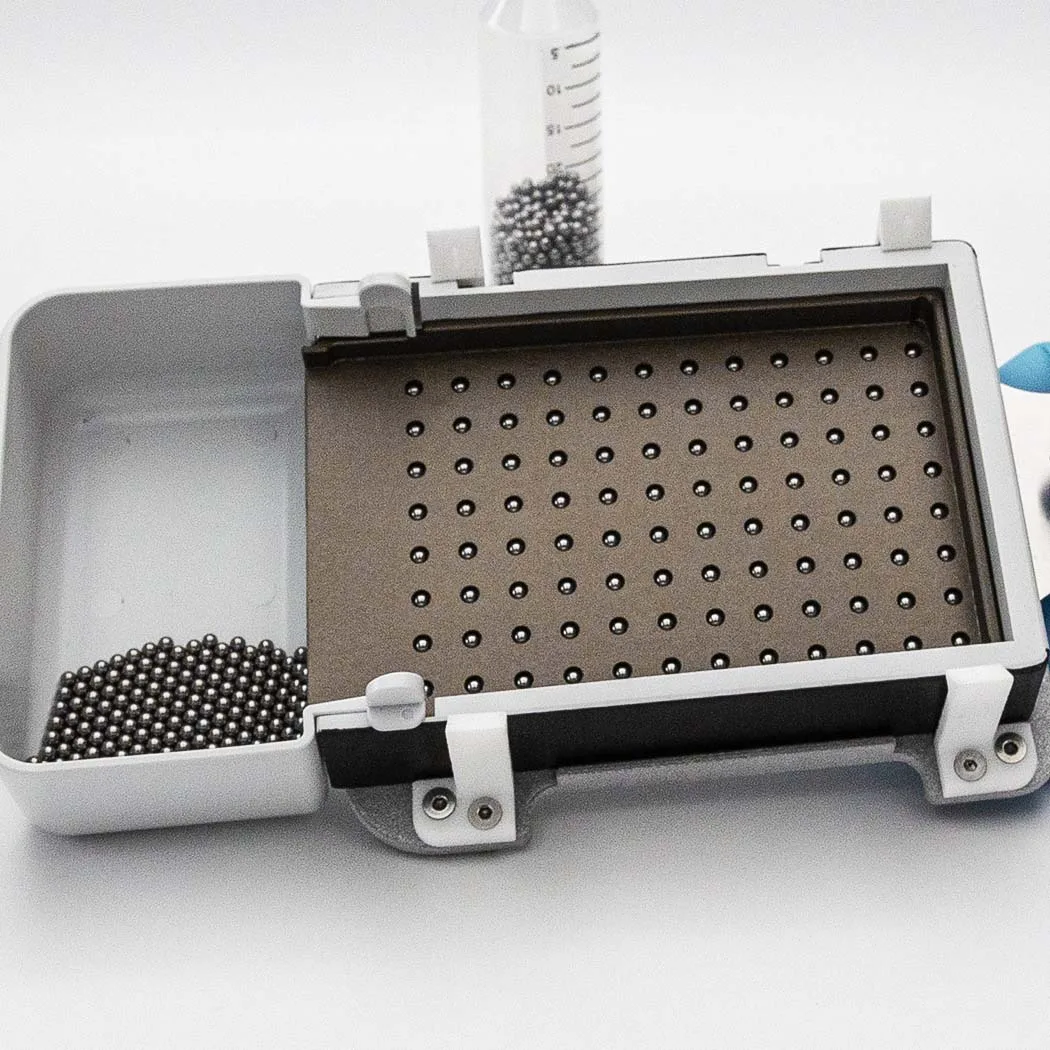
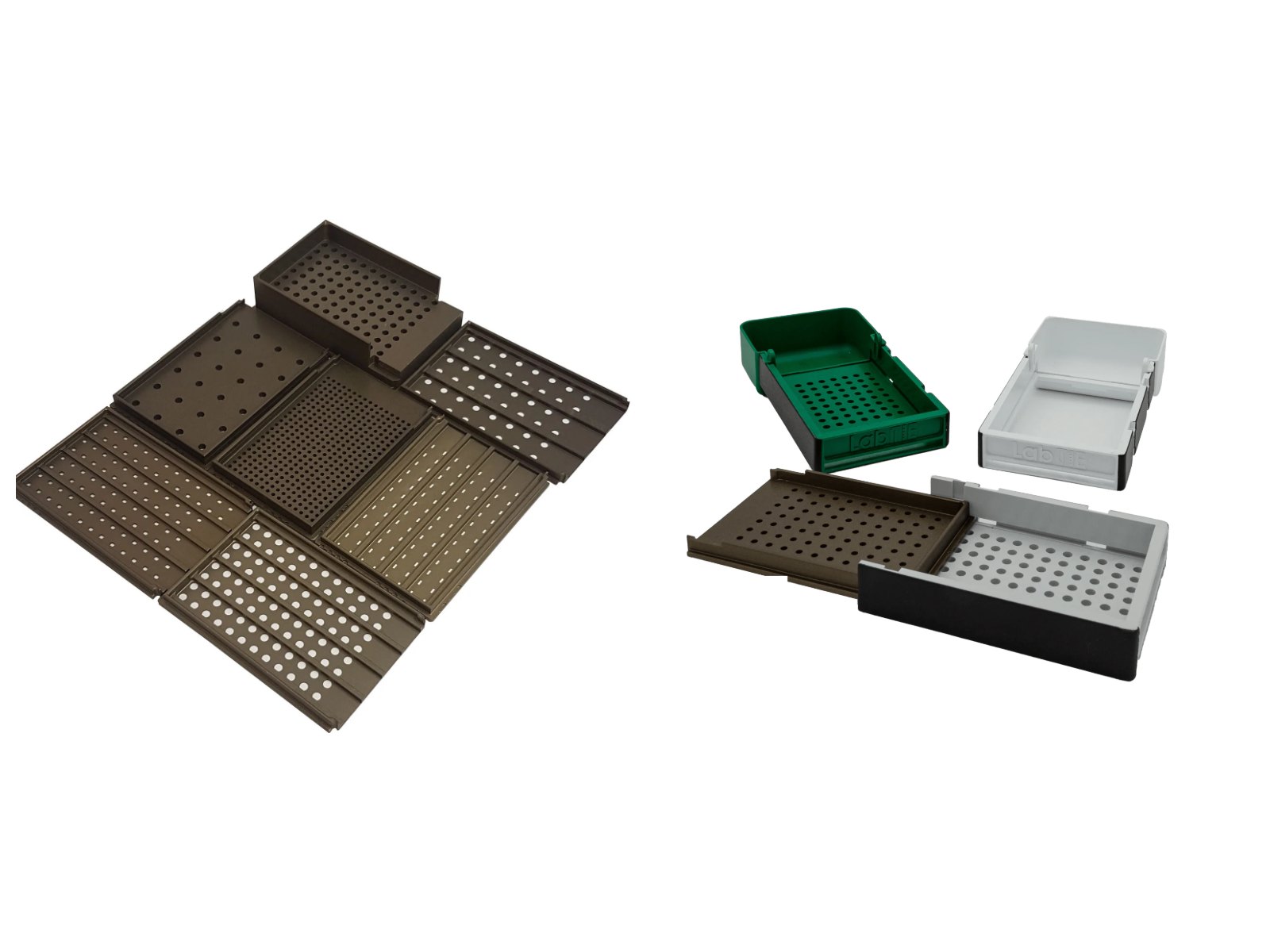
This is the bottleneck that the instrument run time does not reveal. The homogenisation cycle itself may take two to five minutes per plate; the bead loading step that precedes it takes ten times as long. LabTIE bead dispensers solve this directly: a single slider motion dispenses beads into all 96 wells in under five seconds, regardless of the bead size or well format. Interchangeable mesh plates cover the full range from 0.3 mm to 6.0 mm beads, matching the bead types specified in Qiagen, FastPrep, Precellys, and Omni protocols. Dispensers are compatible with standard microplates and deep-well plates. For labs also sourcing grinding media, LabTIE supplies beads matched to the dispenser plate sizes.
| Method | 24-tube rack | 96-well plate | 10 plates per week |
|---|---|---|---|
| Manual (spatula/pipette) | 10 to 15 min | 20 to 30 min | 3 to 5 hours/week |
| LabTIE bead dispenser | Under 30 s | Under 5 s | Under 1 min/week |
Making the Decision
For standard sample types processed at moderate scale, any of the established alternatives (FastPrep-24 5G, Precellys 24, or Omni Bead Ruptor 24) performs comparably to the TissueLyser II at optimised settings, and at a meaningfully lower acquisition cost. The differences between instruments at this level are in cooling convenience, tube format flexibility, and the depth of published application data rather than fundamental lysis capability. For unusual samples, regulated GMP environments, or situations where the ability to reference a Qiagen-published protocol directly reduces validation burden, the TissueLyser’s protocol library is a genuine advantage worth paying for.
Either way, the instrument choice is rarely the most important variable in your workflow economics. Account for bead loading time in your total calculation before purchasing. A lab running 10 plates per week on any platform, TissueLyser or alternative, spends three to five hours per week on bead loading unless a dispenser is part of the setup. The run time is the visible part; the prep time is where efficiency is lost or recovered.
Pre-fill bead plates in seconds, for any bead mill
LabTIE bead dispensers work with TissueLyser, FastPrep, Precellys, Omni, and any plate-format homogenizer. One dispenser, every bead type from 0.3 to 6.0 mm.
View bead dispensersRelated
The plate format alternative on our own bench is the Mini-BeadBeater 96, up to 192 samples per run in deep well plates. The bead loading step that every bead mill shares is described on the sample homogenization page.
Leave a Reply