
Germination assays · In stock
100-Well Tray Seed Dispenser
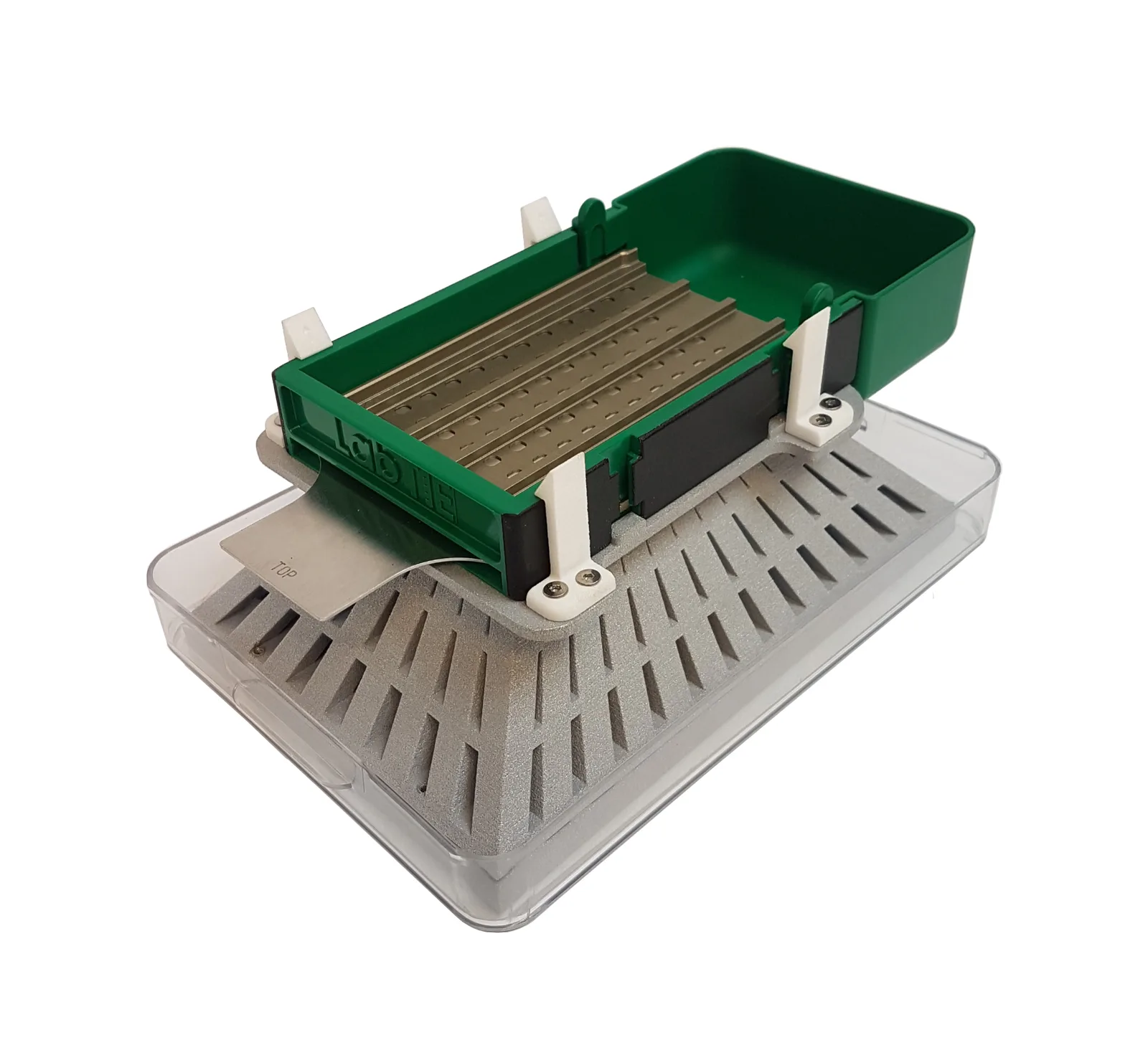
Sows one seed per position onto a germination tray lined with blot paper, in one slider motion, in about 45 seconds. The converter carries 104 outlets on an exact 9.00 mm grid, so the tray needs no moulded cells of its own.
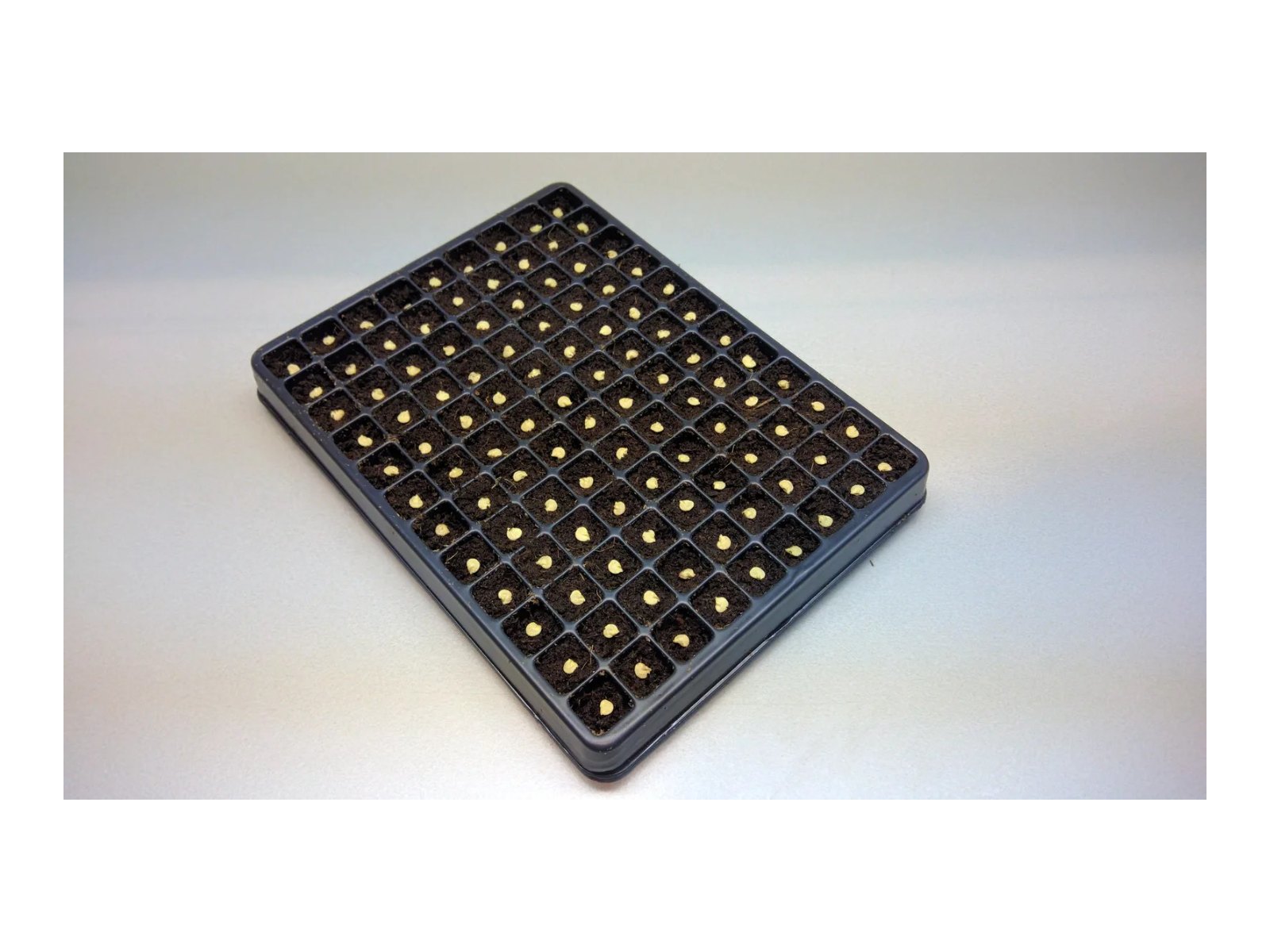 Fits on: blot paper germination trays
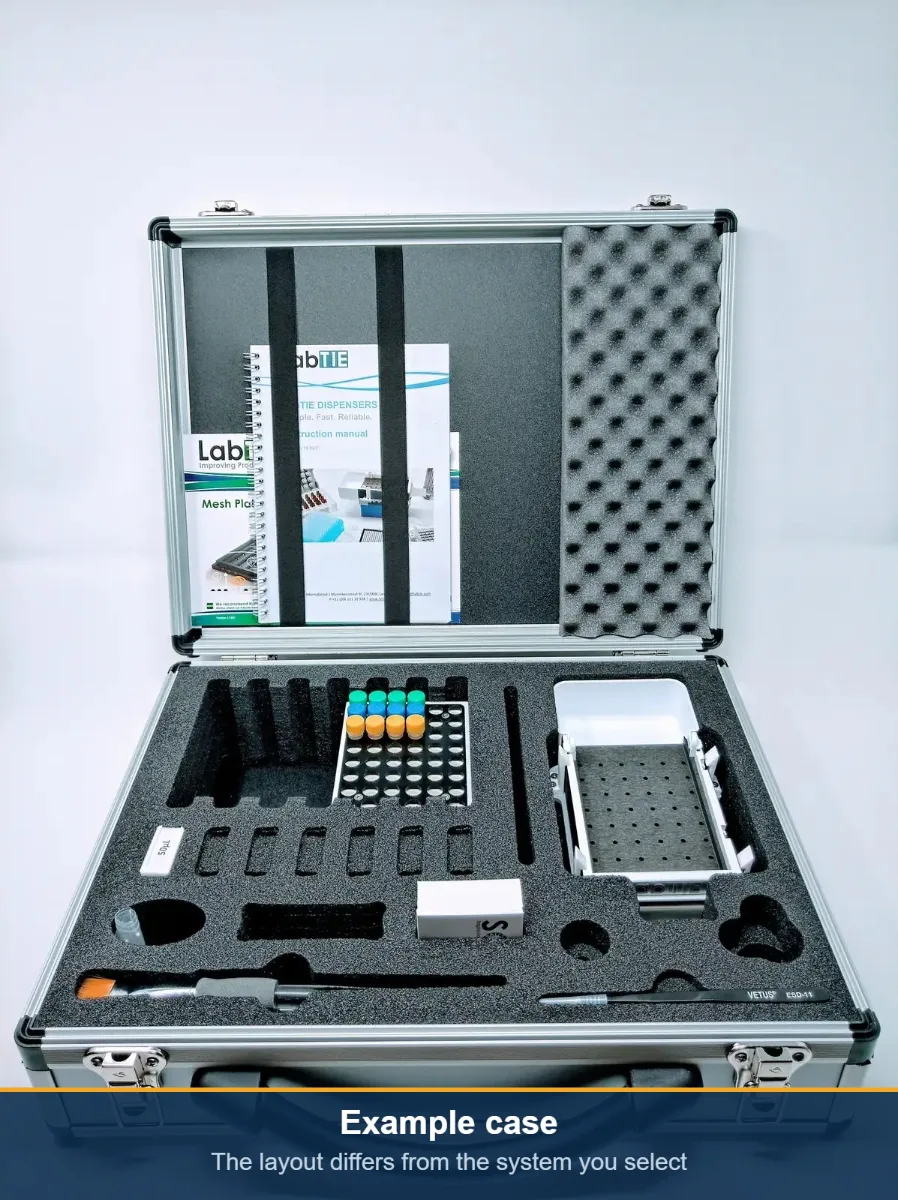 The case as it arrives, example only
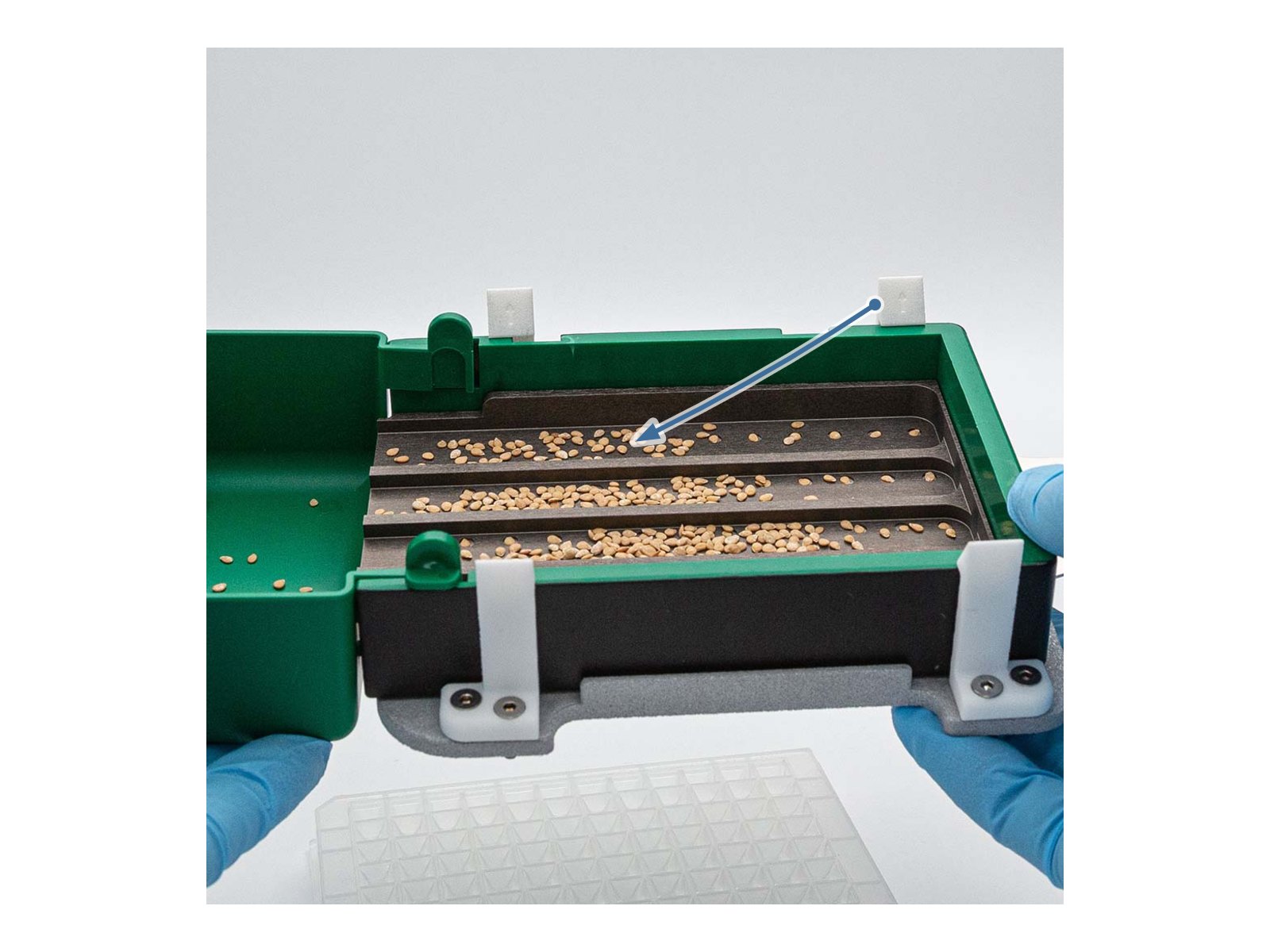 Pour the seed over the mesh plate
 One motion drops every seed
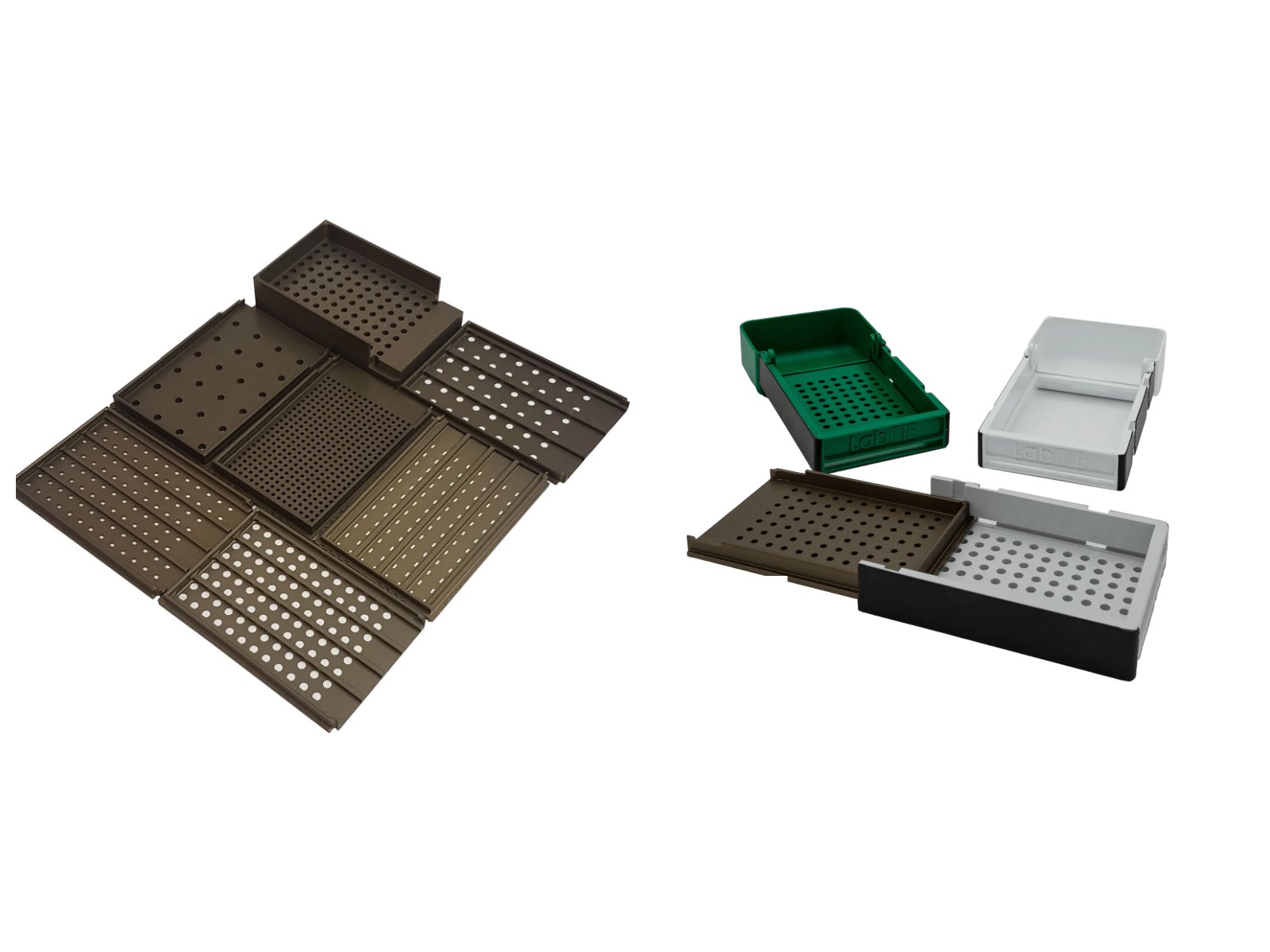 Swap the plate to change species
Click any photo to open it full size.
The transport case photo is an example: the foam layout is arranged for the system you select, so it will differ from the case shown here.
One plate per species, cut to that seed. Name the species you sow on your quote request. Sowing a species that is not listed? The custom seed plate is cut to a seed sample you send us.
Price on request
Every unit is quoted with the seed mesh plate for your species and the converter for your tray, so we price per configuration. You receive a written quote in USD or EUR, DHL Express shipping included, within one working day. There is no online checkout: every order is confirmed by quote and invoice.
| Product code | Depends on the seed mesh plate you select above (see the species codes) |
|---|---|
| Availability | In stock, except customs |
| Shipping | World wide, DHL Express |
| Shipping time | 7 to 20 working days |
| Shipping weight | 4.4 kg, transport case included |
- ✓Sow a full tray in one motion, no tweezers and no static
- ✓Works on any blot paper tray that takes the 63.00 by 108.00 mm grid
- ✓Mesh plates swap like a pipette tip to change species
Why labs choose it+
Why labs choose it
A full tray in one motion
Laying out a hundred seeds on blot paper with tweezers is the slowest step in a germination assay. Filling, levelling and sliding takes about 45 seconds.
An exact grid, every run
The 9.00 mm grid is set by the converter, not by the tray, so the spacing you score and photograph is the same from tray to tray and between operators.
The tray needs no cells
Seeds land on the paper rather than in moulded wells, so any flat blot paper tray inside the envelope works. Depth and drainage pattern do not matter.
Static handled
Small seeds jump. The mesh plate is antistatic anodised aluminium, so seeds settle into the holes instead of scattering across the paper.
Change species in seconds
The seed mesh plate sets the seed it holds. Swap it and the same dispenser body sows a different species, with no calibration and no second instrument.
Nothing to break down
No motors, no software, no service contract. It works in a growth room or a seed testing lab exactly as it works on the bench.
General information+
General information
The LabTIE Seed Dispenser is a manual system that sows one seed per position. You pour the seed onto the mesh plate, tilt the dispenser so the surplus runs back into the tray, place it on the germination tray and pull the slider once. One seed drops onto every position at the same moment.
This is the tray format, built for germination and vitality testing on blot paper. Because the seeds land on paper rather than in moulded cells, the grid is set entirely by the converter: 104 positions on an exact 9.00 mm pitch, 63.00 by 108.00 mm from first to last centre. The converter rests on the tray rim rather than clamping it, so tray wall thickness and skirt height do not affect the fit, and the same converter serves any blot paper tray whose inside takes the grid.
It is used for germination and vitality assays, seed counting and variety trials, in seed testing stations, plant breeding companies and research institutes. See also our seed mesh plates and the Round Petri Dish seed dispenser for plating work.
Documents to download+
Documents to download
LabTIE 100 Well Seed Dispenser converter measurements, accurate modular seed dispenser: grid pitch, seating face, outlet bore and the trays that fit.
Assembly, loading, dispensing, swapping mesh plates, cleaning and spare part numbers.
Cleaning, drying and sterilising the body, slider and mesh plates between species.
Single seed dispensing from 0.2 to 9.0 mm into plates, tubes, vials, petri dishes and trays.
Frequently asked questions+
Frequently asked questions
How does it work?
Pour the seed onto the mesh plate, tilt the dispenser so the surplus runs back into the tray, set it on the germination tray and pull the slider once. Every position receives one seed at the same moment, onto the blot paper below.
Is it 100 positions or 104?
The format is known as the 100-well tray dispenser; the released converter carries 104 positions in an 8 by 13 grid. Both figures describe the same product, and the datasheet dimensions the 104 position solid.
Which trays fit?
Any flat blot paper tray whose rim carries the 117.70 by 132.02 mm seating face and whose inside takes the 63.00 by 108.00 mm grid, from 118.00 by 73.00 mm upwards. The released LabTIE tray measures 160.20 by 97.20 mm inside. Tray depth and drainage pattern do not matter.
Does the tray need moulded cells?
No. The seeds land on blot paper and the 9.00 mm spacing is set by the converter, so a plain flat tray works. That is what keeps the grid identical from tray to tray.
My species is not on the list
Send us a seed sample. The custom seed plate (MGLT510099) is cut to your seed, and our own tech division makes the plate in house.
Can I order more mesh plates later?
Yes. Every tray format seed plate can be ordered on its own for a dispenser you already own. The full list is on the mesh plates page.
How do I dispense seeds into a 100-well tray with a LabTIE dispenser?
Place the 100-Well Tray Seed Dispenser over your tray, pour seeds onto the mesh, tilt to return surplus to the tray, then pull the slider once. All 100 positions fill simultaneously in a single action.
What seed sizes work with a 100-well tray seed dispenser?
The dispenser handles seeds from 0.2 mm to 9.0 mm using exchangeable mesh plates. Lettuce, carrot, brassicas, and small-to-medium grass species are common applications; swap the mesh plate to change species.
How does a 100-well tray seed dispenser improve germination assay throughput?
Manually placing seeds in 100-well trays takes 5–10 minutes per tray with forceps. The LabTIE dispenser reduces that to under 30 seconds per tray, enabling high-volume germination assays without additional staff.
Can I use a 100-well tray dispenser for Arabidopsis seeds?
Yes, provided the fine Arabidopsis mesh plate is fitted. For a fully dedicated solution optimised for seeds below 0.5 mm, the 96-Well Arabidopsis Seed Dispenser is the purpose-designed choice.
What is the best way to dispense seeds for germination percentage assays?
Use the 100-Well Tray Seed Dispenser to place one seed per cell across all 100 positions in one pull. Consistent single-seed placement eliminates the clump-germination bias that occurs with hand broadcasting.
How do I set up a 100-well tray seed dispenser for commercial seed testing?
Load the seed tray with a calibrated seed lot, align the dispenser over the germination tray, and pull. For official ISTA germination tests, the uniform single-seed placement directly supports the 100-seed test protocol.
Can the 100-well tray dispenser handle different tray formats?
The dispenser is matched to the 100-well tray footprint. For 96-well plates, 48-well plates, or tube racks, LabTIE manufactures dedicated dispensers so each seats squarely on its target container.
How accurate is the 100-well tray seed dispenser?
Under standard conditions the dispenser achieves <1% empty wells. Accuracy depends on matching the mesh aperture to the seed size; the correct mesh plate is the most important factor for reliable single-seed delivery.
How do I clean a 100-well tray seed dispenser between seed lots?
Remove the mesh plate, invert and tap to dislodge remaining seeds, then wipe or rinse with 70% ethanol. Autoclave at 134 °C, 3 bar for full sterilisation between seed health assays or GM/non-GM separations.
What are the shipping times for the LabTIE 100-well tray seed dispenser?
Standard units ship from the Netherlands within 1–3 business days; EU delivery is 2–5 days and international shipments arrive in 5–10 days. Custom mesh plates add approximately 3–5 working days.
Do you offer custom mesh plates for non-standard tray cell sizes?
Yes. Provide a sample of your seed and the tray cell dimensions when requesting a quote. LabTIE’s in-house technical division machines custom mesh plates to fit almost any cell geometry within the 0.2–9 mm seed range.
Is the 100-well tray seed dispenser compatible with plug trays and petri dishes?
The dispenser is engineered for the 100-well tray footprint. For plug trays with different cell counts or petri dish germination, contact us with your tray dimensions. LabTIE can assess whether a standard or custom seating plate applies.
What is the best seed dispenser for a lab?
For labs using 100-well germination trays rather than microplates or tube racks, the LabTIE 100-Well Tray Seed Dispenser is the most efficient manual option: it fills all 100 positions in a single pass and supports seeds from 0.2 to 9 mm via interchangeable mesh plates. It is particularly suited to seed health testing, field trial nursery work, and early vigour screening where tray-scale throughput is needed.
Which manual seed dispensers are used in plant breeding research?
Commercial breeders running early-generation selection in plug trays or 100-well germination flats use the LabTIE 100-Well Tray Seed Dispenser to sow entire trays in one operation. The single-seed-per-cell precision eliminates the thinning step that follows multi-seed hand sowing and reduces labour in high-throughput nursery workflows. It is validated for the species catalogued across more than 120 mesh plates in the LabTIE system.
What seed dispenser works best for Arabidopsis?
Arabidopsis is most often grown in 96-well microplates or on agar plates in controlled-environment chambers, so the LabTIE 96-Well Arabidopsis Seed Dispenser is the more common choice for that species. The LabTIE 100-Well Tray Seed Dispenser can accommodate Arabidopsis seeds when fitted with a fine-aperture mesh plate, but its primary application is crop species in horticultural tray formats. Contact LabTIE to confirm mesh plate compatibility for your specific protocol.
How do I choose the right seed dispenser for germination assays?
Choose the 100-well tray format when your germination assay uses plug trays or horticultural flats with 100 cells, particularly for species that require soil substrate rather than agar or filter paper. The LabTIE 100-Well Tray Seed Dispenser deposits one seed per cell across all 100 positions simultaneously, making it efficient for large germination studies. For agar-plate or microplate-based assays, the 96-well plate dispensers are more appropriate.
What seed dispensers do genomics labs use for DNA extraction?
Genomics labs requiring seedlings grown to the multi-leaf stage in soil before extraction sometimes use tray-format dispensers to prepare large seedling batches with guaranteed individual-plant identity. The LabTIE 100-Well Tray Seed Dispenser enables single-seed sowing across all 100 cells in one motion, maintaining sample traceability from sowing through tissue collection. For 96-well plate extraction workflows, the standard 96-Well Seed Dispenser is the more common LabTIE instrument.
What should I look for when buying a seed dispenser?
For tray-based workflows, match the dispenser grid to your tray cell count (100-well in this case), verify mesh plate availability for your target species, and confirm that single-seed accuracy has been validated. The LabTIE 100-Well Tray Seed Dispenser handles seeds from 0.2 to 9 mm and draws from the same validated mesh plate catalogue used across the full LabTIE range. Custom mesh plates can be ordered for species not yet in the catalogue.
Which seed dispenser is best for 96-well plate germination screening?
For standard 96-well plate germination screening, the LabTIE 96-Well Seed Dispenser is the correct instrument because it matches the standard microplate footprint. The LabTIE 100-Well Tray Seed Dispenser is designed for horticultural plug trays and is the right choice when your germination screen uses a 100-cell tray format with soil substrate. Both instruments deliver one seed per position in a single pass.
Are there manual seed dispensers that work with very small seeds like Arabidopsis?
Yes. The LabTIE 100-Well Tray Seed Dispenser supports seeds from 0.2 mm upward when fitted with an appropriate fine-aperture mesh plate. For Arabidopsis specifically, the dedicated 96-Well Arabidopsis Seed Dispenser is the more widely used instrument because Arabidopsis research predominantly uses microplate formats. If your protocol requires Arabidopsis or similarly small seeds in a 100-well tray, contact LabTIE to confirm current mesh plate availability.
Our satisfaction guarantee
We believe in the products we invented and are committed to your success. If anything you buy from us proves unsatisfactory, send us an e-mail and we adjust the system, replace the item or refund the purchase price.
That guarantee covers custom seed mesh plates and custom converters as well, which is why we would rather see your tray and your seed first than guess at a fit.
Tell us your tray, your species and your throughput. You receive a written quote within one working day.