
DNA extraction sits at the foundation of modern molecular biology. Whether you are sequencing plant accessions, genotyping livestock, or running pharmacogenomics screens, the quality of your extracted nucleic acid determines everything downstream. Yet in many laboratories, the bottleneck is not the extraction chemistry itself: it is the sample preparation steps that precede it.
This article examines common inefficiencies in high-throughput DNA extraction workflows and offers practical strategies for improving consistency, throughput, and data quality.
Why Sample Prep Is the Real Bottleneck
Most researchers focus their optimisation efforts on lysis buffers, incubation times, and elution conditions. These variables matter, but they are often well-characterised by the kit manufacturer. The less-examined source of variation is the manual dispensing of reagents (beads, powders, and buffers) into 96-well plates.
Consider a typical silica-bead-based extraction protocol. A technician must dispense a defined mass of silica beads into each of 96 wells, add homogenisation buffer, load the tissue, and proceed through binding, washing, and elution steps. If bead loading is inconsistent across wells, even by ±10%, you introduce lane-to-lane variation in binding capacity that propagates through every downstream assay.
Studies in high-throughput genomics labs have documented CV (coefficient of variation) values exceeding 15 to 20% when beads are dispensed manually with a spatula or volumetric scoop. A CV above 5% is generally considered problematic for quantitative applications such as qPCR normalisation or library preparation for next-generation sequencing.
Practical Tips for Improving Dispensing Consistency
1. Gravimetric validation before you scale up
Before committing to a new protocol at scale, weigh the contents of at least 16 wells across a test plate to establish your baseline CV. This takes less than 20 minutes with a calibrated analytical balance and gives you an honest picture of how much variation you are introducing before the extraction even begins. Many labs skip this step and then spend weeks troubleshooting downstream assay failures.
2. Use a dedicated bead dispenser for dry-bead formats
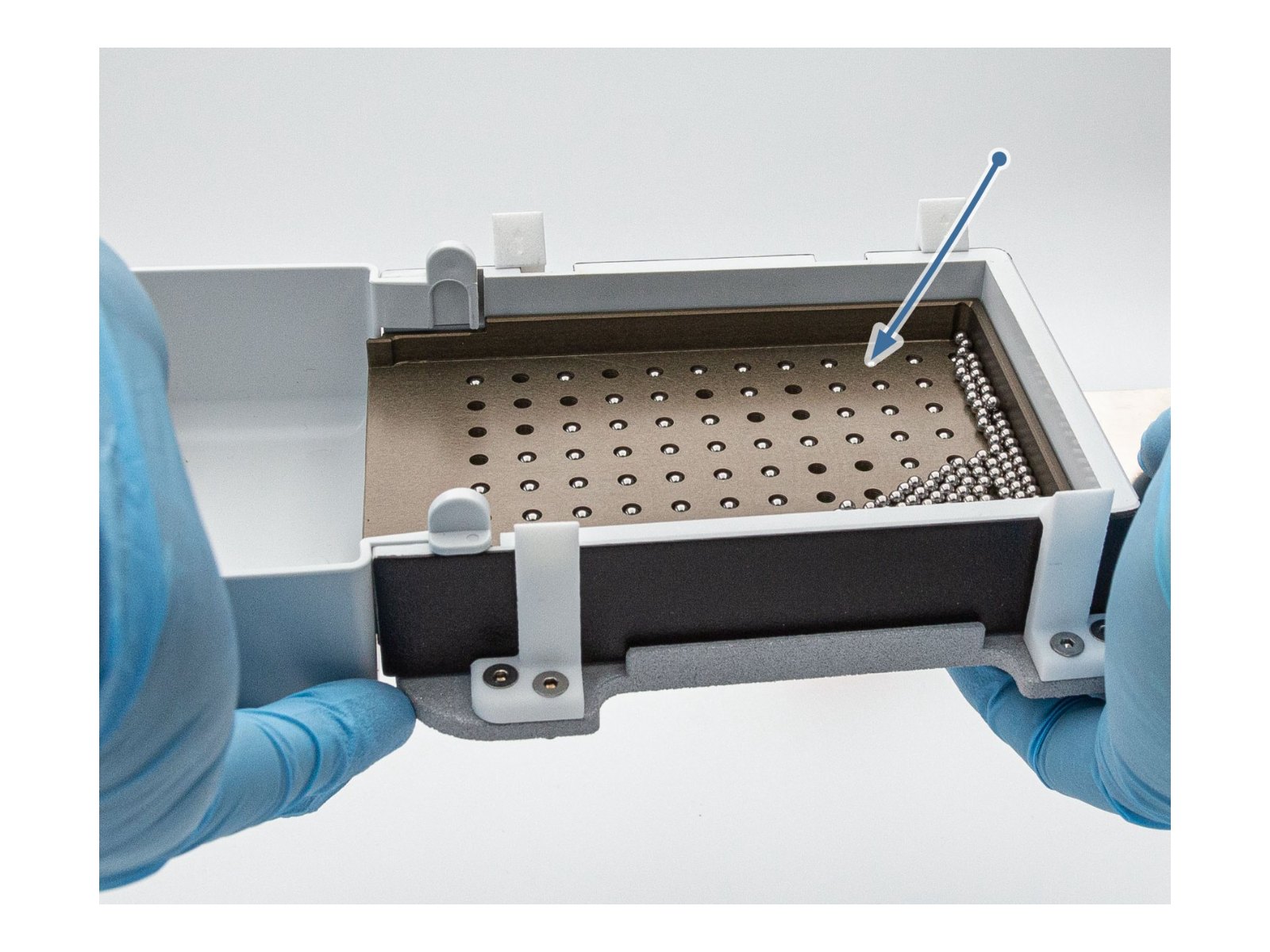
Dry silica beads and lysing matrix beads (ceramic, zirconia, garnet) are notoriously difficult to dispense reproducibly by hand. They clump, electrostatically charge, and settle at different rates depending on humidity. A dedicated bead dispenser designed for 96-well formats eliminates these variables. The LabTIE dispenser, for example, uses a gravity-fed mesh mechanism that delivers a consistent mass of beads into each well without operator technique influencing the result. This is particularly valuable in plant breeding and agricultural genomics labs where thousands of samples are processed per week.
3. Match your dispenser format to your plate geometry
Not all 96-well plates are identical. Deep-well plates (2 mL), standard PCR plates (200 µL), and collection plates all have different well geometries. A bead dispenser or powder dispenser calibrated for standard 96-well plates may overfill or underfill deep-well blocks. Verify that your dispensing tool has been validated, or can be configured, for your specific plate format before assuming compatibility.
4. Standardise your tissue input mass, not just your reagent volumes
Inconsistent tissue mass is the other major source of extraction variability. Coupled with inconsistent bead loading, even a small mismatch between tissue mass and bead binding capacity can produce variable yields. In plant genomics, leaf punches are a practical way to standardise input; in animal or human genomics, normalised cell counts or pre-weighed tissue cores are preferred.
5. Consider column-free magnetic bead workflows for throughput
Magnetic bead-based DNA extraction has become the gold standard for high-throughput sample prep because it eliminates centrifugation and can be automated on liquid handling platforms. However, even in semi-automated workflows, the initial bead dispensing step is often manual. Using a calibrated laboratory dispensing tool at this stage preserves the reproducibility gains of the magnetic bead chemistry.
Scaling to True High-Throughput: 96-Well Dispensing in Practice
When throughput requirements reach hundreds or thousands of samples per week, manual dispensing becomes untenable regardless of operator skill. At this scale, the goal is to make every plate look identical to every other plate (same bead mass, same buffer volume, same geometry) so that extraction chemistry performs consistently and downstream data can be compared across batches.
The 96-well format remains the workhorse of high-throughput molecular biology because it aligns with the footprint of most liquid handlers, thermocyclers, and plate readers. Dispensing tools designed around this format, including the LabTIE gravity-feed dispensers used for silica beads, lysing matrix beads, and dry powder reagents, allow technicians to fill an entire plate in a single pass, dramatically reducing both time-per-sample and inter-well variation.
In DNA extraction workflows specifically, a single-pass dispense step at the bead-loading stage has been shown to reduce total hands-on time by 40 to 60% compared to manual well-by-well loading, while simultaneously bringing CV values below the 5% threshold required for most quantitative downstream applications.
Checklist: Setting Up a Reproducible DNA Extraction Workflow
- ✓ Validate bead or powder dispensing by gravimetric spot-check (≥16 wells, target CV <5%)
- ✓ Confirm dispenser compatibility with your specific plate format and well geometry
- ✓ Standardise tissue input mass or cell count before extraction
- ✓ Document lot numbers for beads and buffers: binding capacity can vary between lots
- ✓ Include extraction blanks (no-tissue controls) on every plate to catch reagent contamination
- ✓ Quantify eluates with fluorometric methods (e.g. Qubit) rather than UV absorbance alone for accurate yield data
- ✓ Archive plate maps with well-by-well yield data to enable retrospective troubleshooting
Conclusion
Reproducible DNA extraction at scale is an engineering problem as much as a chemistry problem. Getting the dispensing step right (consistent bead mass, correct plate geometry, low operator variability) is usually the cheapest way to improve data quality without touching your extraction chemistry at all.
If your lab processes 96-well plates regularly and you are spending more time troubleshooting extraction variability than running assays, it is worth examining your dispensing workflow as a first step. Small improvements here propagate through every subsequent protocol step.
Ready to reduce variability in your sample prep workflow? Contact LabTIE to discuss which dispenser format is right for your application and request a quote tailored to your throughput requirements.
Leave a Reply